Consumer Guarantees Act: Your Rights When Things Go Wrong

Imagine buying a new washing machine that breaks down after just a few weeks, or hiring a plumber whose shoddy work floods your kitchen. In New Zealand, you're not left high and dry—the Consumer Guara...
Sarah covers personal finance, tax, and KiwiSaver topics for Lifetimes NZ. She focuses on making money management straightforward and practical for everyday Kiwis.
Imagine buying a new washing machine that breaks down after just a few weeks, or hiring a plumber whose shoddy work floods your kitchen. In New Zealand, you're not left high and dry—the Consumer Guarantees Act (CGA) steps in to protect your rights and ensure businesses deliver what they promise. This law empowers Kiwis to demand repairs, replacements, or refunds when things go wrong, fostering trust in our everyday purchases.
Whether it's a faulty appliance, subpar service, or goods that don't match the hype, understanding the CGA means you're equipped to stand up for yourself. In this guide, we'll break down your entitlements, when they apply, and practical steps to resolve issues—drawing on official New Zealand resources to keep you informed for 2026.
What is the Consumer Guarantees Act?
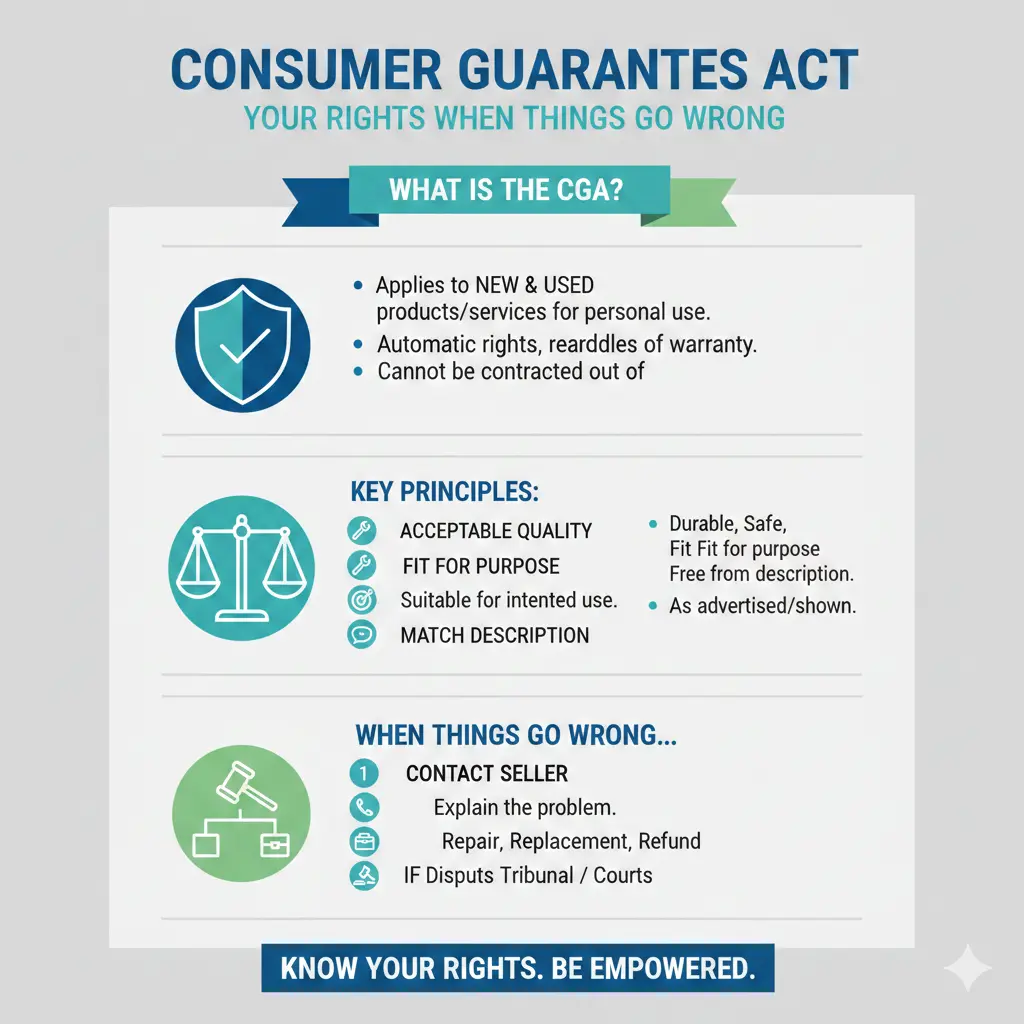
The Consumer Guarantees Act 1993 (CGA) is a cornerstone of consumer protection in New Zealand. It sets minimum standards for products and services sold by businesses, ensuring they're safe, reliable, and fit for purpose. Enforced nationwide, the CGA applies to all traders—from small retailers to online sellers—helping Kiwis trade confidently without fear of rip-offs.
Key principles include guarantees around quality, safety, and usability. If these aren't met, you can seek remedies like repairs or refunds. Importantly, the CGA overrides any weaker store warranties, so even "no refunds" signs don't hold up if your rights are breached.
Who Does the CGA Protect?
It covers anyone buying goods or services for personal, domestic, or household use—think appliances, vehicles, furniture, food, or even utilities like electricity and gas. Services from plumbers, lawyers, dentists, insurers, and repair shops are included too. Gifts qualify as well; if a present is faulty, you can claim directly from the seller.
- New and second-hand goods from businesses (not private sales).
- Online purchases from NZ traders.
- Hired items or free services bundled with purchases.
Business Responsibilities Under the CGA
Every business "in trade" must comply—no exceptions. This means providing clear info, fair terms, and sticking to product safety standards. Retailers remain liable even if the manufacturer folds, as seen in the 2024 Serene Industries bathroom heater recall where vendors handled remedies.
Sellers can't contract out of the CGA for household goods; attempts to do so (like "no consequential losses") can lead to Fair Trading Act prosecutions.
When Does the CGA Apply—and When Doesn't It?
The CGA kicks in for most consumer buys, but there are clear limits. Know these to avoid disputes.
Circumstances Where CGA Applies
- Products/services for personal use, bought from NZ businesses (in-store or online).
- Regardless of warranties or contracts—your CGA rights are baseline.
- Even if no direct contract with the supplier.
When CGA Does Not Apply
No coverage if:
- You simply changed your mind.
- Misuse, alteration, or ignoring instructions caused the issue.
- You damaged, lost, or disposed of the item post-delivery.
- Known faults were disclosed pre-purchase.
- Business/commercial use (though sellers can contract out in writing).
- Private sales, homes (but not repairs), or specialised gear like industrial machinery.
Pro tip: Always check product instructions and ask about suitability upfront to strengthen your claim.
Core Guarantees Under the Consumer Guarantees Act
The CGA mandates five key guarantees for goods (and similar for services). Businesses must deliver on all.
1. Acceptable Quality
Goods must be safe, durable, free of defects, and last a reasonable time—considering price, type, and branding. A cheap $50 blender might expect 6 months; a premium model, years.
"They must do what they are made to do, look acceptable, not have defects, be safe, and last a reasonable time."
2. Fit for a Particular Purpose
If you specify a need (e.g., "gluten-free for coeliac") or the seller recommends it, it must work. Discuss with staff to lock this in.
3. Match Description, Sample, or Demo
What you get must align with ads, labels, brochures, or in-store demos—no nasty surprises.
4. Ownership and Reasonable Price
You own it outright post-purchase, and if no price was set, it must be fair market value.
5. Services Guarantees
Services must be done with reasonable care/skill, fit for purpose, and completed in a reasonable time.
For all, deliveries must arrive on time/condition, with repairs/spares available—or disclose upfront.
Your Remedies: What to Do When Things Go Wrong
If guarantees fail, start with the seller. Escalate if needed. Remedies depend on failure severity.
Minor Failures
- Repair—free, using like-new parts, in reasonable time.
- Replace—same type/quality.
- Refund—full purchase price (choose one).
If repair/replacement isn't prompt or fails again, move to bigger remedies.
Substantial Failures
"Substantial" means unwarrantable for price/type, major safety risk, or unfixable in time.
- Refund or replacement (your choice).
- Keep it + compensation for value drop.
- Extra losses (e.g., travel, spoilt food).
For services: Cancel contract (pay for good work), get someone else to fix + recover costs, or compensation.
Real Kiwi Examples
Vacuum woes: A cordless stick vac lasts 6 years? No CGA claim if average life is 5 years—but extended warranty would cover.
Recall reality: Post-2024 heater recall, retailers fixed/replaced despite manufacturer exit.
Steps to Take
- Contact seller promptly with proof (receipt, photos).
- Explain issue, reference CGA guarantees.
- Negotiate remedy; get agreements in writing.
- If refused: Complain to business owner/head office, then Disputes Tribunal (claims under $30,000, no lawyers).
- For safety issues: Report to Consumer Protection (0800 943 600).
Keep records—texts, emails, quotes—to build your case.
Recent Updates and 2026 Considerations
The CGA remains robust in 2026, with no major overhauls yet. Watch the Consumer Guarantees Act (Right to Repair) Amendment Bill, which passed first reading, aiming to ease repairs for a circular economy. Submissions are open—could mean more repair rights soon.
Businesses face ongoing Fair Trading Act scrutiny; stay vigilant for "no refund" tricks.
Common Pitfalls and Practical Tips
- Don't DIY repairs: Voids claims.
- Business use? Check for opt-out clauses at sale.
- Online buys: CGA applies fully.
- Photograph faults immediately.
- Use ACC if injury-related; IRD for tax-deductible losses (consult pro).
Disclaimer: This isn't financial or legal advice. Consult a professional or Citizens Advice Bureau for your situation.
Next Steps: Protect Yourself Today
Armed with CGA knowledge, shop smarter: Ask questions, keep receipts, and assert your rights confidently. Next time a product flops, contact the seller citing the Act—most resolve quickly. For complex cases, head to Consumer Protection or Disputes Tribunal. Stay protected, Kiwi—your purchase power matters.
Word count: ~1850 (including HTML).
Frequently Asked Questions
Sources & References
-
1
Consumer Guarantees Act — consumerprotection.govt.nz — www.consumerprotection.govt.nz
-
2
Consumer Guarantees Act - know your rights — consumer.org.nz — www.consumer.org.nz
-
3
Guide to the Consumer Guarantees Act — retail.kiwi — retail.kiwi
-
4
What Consumer Guarantees Do I Owe? — legalvision.co.nz — legalvision.co.nz
-
5
Proposed amendments to the Consumer Guarantees Act — bellgully.com — www.bellgully.com
-
6
Complain about something you bought — govt.nz — www.govt.nz
-
7
What you can do if there's a problem — communitylaw.org.nz — communitylaw.org.nz
Related Articles

Industry Bodies and Professional Associations NZ
Whether you're launching a business, advancing your career, or navigating financial regulations, industry bodies and professional associations in New Zealand offer invaluable support. These organisati...

Emergency Benefit NZ: When You Have No Other Options
When you're struggling financially and don't qualify for other benefits, the Emergency Benefit might be your lifeline. It's a discretionary payment designed for Kiwis in genuine hardship who've exhaus...

Unpaid Internships NZ: Are They Legal?
Unpaid internships are a common pathway for students and graduates to gain work experience in New Zealand, but there's often confusion about whether they're actually legal. The short answer is: unpaid...

Estate Administration NZ: Managing Someone's Affairs After Death
Losing a loved one is one of life's toughest challenges, and stepping in to manage their estate can feel overwhelming. In New Zealand, estate administration—the process of handling someone's affairs a...