Debt Collection NZ: Your Rights When Collectors Call

If a debt collector has called you, it's natural to feel anxious. But you've got more rights than you might think. In New Zealand, debt collectors must follow strict rules, and knowing what those are...
Sarah covers personal finance, tax, and KiwiSaver topics for Lifetimes NZ. She focuses on making money management straightforward and practical for everyday Kiwis.
If a debt collector has called you, it's natural to feel anxious. But you've got more rights than you might think. In New Zealand, debt collectors must follow strict rules, and knowing what those are can help you protect yourself and understand your options.
Understanding Debt Collection in New Zealand
Debt collection happens when you fall behind on repayments for loans, credit contracts, or fines, and your creditor decides to pursue recovery. The process doesn't follow a standard template—your lender or the organisation you owe money to could hire a debt collector, sell your debt to a debt collection agency, repossess items if your debt is secured, or take you to court.
It's important to understand that debt collectors can either buy your debt (making them the new creditor) or collect it on behalf of the original lender. Your rights differ depending on which situation applies to you.
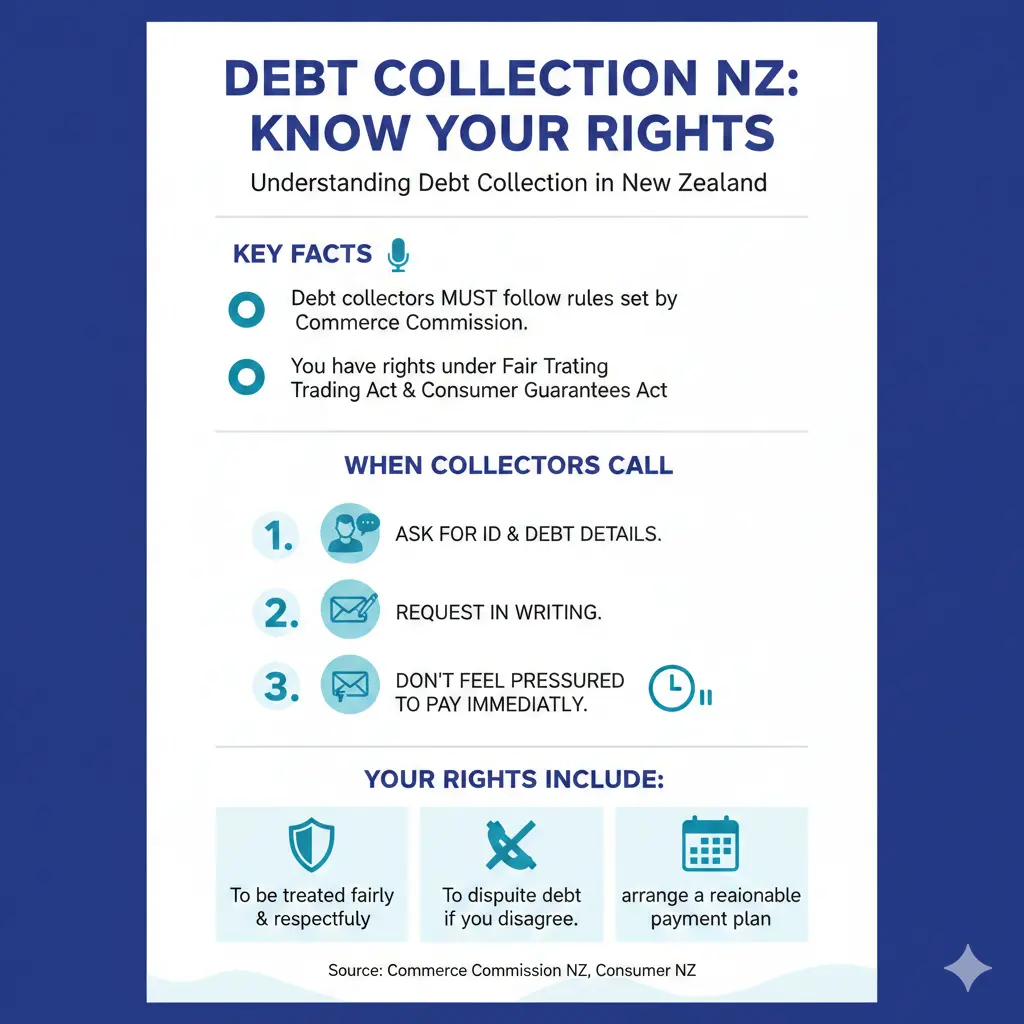
Your Legal Rights When Dealing with Debt Collectors
The Fair Trading Act 1986
Debt collectors must follow the Fair Trading Act 1986, which prohibits misleading and deceptive conduct. This means collectors cannot tell you (or imply) false information about your debt, and they must be transparent and honest in their dealings with you.
If a debt collector behaves in a threatening way, you can report them to the police. If you think they've misled you, report them to the Commerce Commission.
The Credit Contracts and Consumer Finance Act 2003
If your debt comes from a consumer credit contract—such as a personal loan, credit card, or store credit—the Credit Contracts and Consumer Finance Act 2003 (CCCFA) applies. This law ensures you're treated fairly and transparently. Collectors must provide accurate information about the amount owed, interest rates, fees, and other repayment terms.
If a debt collector has bought your debt, they must follow the CCCFA and the responsible lending code, including charging only reasonable fees—enough to cover costs, but not to earn a profit.
Collection Fees
Debt collectors can charge collection fees, but you must have been told about them beforehand by your original lender, store, or service provider. This notice can appear in your credit contract, on a store display, or on the back of a ticket.
If you're charged fees you weren't informed about, contact the original lender or provider first. If you can't resolve it, try their financial dispute resolution scheme.
What Happens If You Don't Pay
The Formal Demand Letter
Before pursuing legal action, creditors typically send a formal demand letter detailing the amount owed, the due date, and any applicable interest or fees. A letter on a law firm's letterhead can be particularly effective in showing you're serious and encouraging engagement.
Time Limits for Legal Action
Here's something important: under the Limitation Act 2010, creditors generally have six years from the date your debt became payable to start legal action. If this period passes, the debtor may have a valid defence, and the creditor could lose the right to recover the money. This doesn't mean the debt disappears—it just means they can't take you to court over it.
Court Options
If the debt remains unpaid after a demand letter, your creditor can take legal action. Your options depend on the debt amount:
- Disputes Tribunal: For debts of $30,000 or less that are disputed, you can apply to the Disputes Tribunal. If successful, the Tribunal will issue an order requiring you to pay, possibly with deductions if appropriate.
- District Court: For debts up to $350,000, your creditor can apply to the District Court. This process is more formal than the Tribunal and involves filing a Statement of Claim, serving you with legal documents, and attending court hearings.
- High Court: Debts exceeding $350,000 go to the High Court.
If your creditor is successful, the court will issue a judgment containing a legal order for you to pay off the debt.
Enforcement of Court Judgments
If you don't pay a court judgment on time, your creditor can take enforcement action. These measures include:
- Attachment order: Deducts repayments from your income or benefit
- Charging order: Registered against your property
- Warrant to seize property: An authorised legal officer (bailiff) can seize and sell your property to pay the debt
- Bankruptcy proceedings: If you're an individual
- Liquidation proceedings: If you're a company
Protecting Yourself: What You Should Know
Verify the Debt
Before paying anything, check that the debt is legally enforceable. Ask the debt collector for proof of the debt and verify it's actually yours. If you believe the debt is incorrect or you've already paid it, dispute it.
Seek Financial Advice
If you're struggling with debt, consider seeing a financial mentor. Many community organisations offer free financial advice to help you understand your options and negotiate repayment plans.
Amicable Resolution
Courts generally favour amicable, pre-legal methods of resolving debt disputes. It's advisable to try resolving the matter as soon as possible, since the risk of the debtor becoming insolvent will impact the chances of recovering the debt over time. If you can negotiate a payment plan with your creditor or debt collector, this is often the best outcome for both parties.
Know Your Limits
Late payments in New Zealand are not regulated, meaning that interest and collection costs depend essentially on the court decision. This is why it's crucial to understand what you're being charged and whether it's reasonable.
Frequently Asked Questions
Can a debt collector contact me at any time?
While there's no specific time restriction in New Zealand law, debt collectors must follow the Fair Trading Act 1986 and treat you fairly. Repeated, excessive contact or contact at unreasonable hours could be considered harassment. If you feel harassed, contact the Commerce Commission.
What if I can't afford to pay the debt?
Contact your creditor or debt collector immediately to discuss your situation. You may be able to negotiate a payment plan. If the debt is from a consumer credit contract, the lender must have checked affordability when lending to you, and you may have options under the CCCFA. Seek advice from a financial mentor or community law centre.
Can a debt collector take my belongings?
A debt collector cannot seize your property without a court order. Only after obtaining a Warrant to Seize Property from the court can an authorised bailiff seize and sell your property to recover the debt.
What if the debt collector is breaking the law?
If a debt collector is making false or misleading representations, behaving threateningly, or charging unreasonable fees, you can report them to the Commerce Commission or, if behaviour is threatening, to the police.
How long do I have before a debt becomes unenforceable?
Your creditor generally has six years from the date your debt became payable to start legal action. After this period, they cannot take you to court, though the debt itself doesn't disappear.
Can I dispute a debt that's been sold to a debt collector?
Yes. If a debt collector has bought your debt, they are now the creditor and must follow the CCCFA. You can still dispute the debt and request proof. If you believe it's incorrect, contact them in writing to dispute it.
Taking Action: Your Next Steps
If you're facing debt collection, don't ignore it. The longer you wait, the more serious the situation becomes. Here's what you should do:
- Verify the debt is actually yours and the amount is correct
- Review any contracts or agreements related to the debt
- Contact the debt collector or creditor to discuss your situation
- Try to negotiate a payment plan if you can afford some repayment
- Seek free financial advice from a community organisation or financial mentor
- Keep detailed records of all communications with the debt collector
- If necessary, seek legal advice from a community law centre
Remember, debt collectors must follow the law. You have rights, and understanding them puts you in a stronger position to protect yourself. If you're unsure about anything, don't hesitate to seek professional advice—many community organisations in New Zealand offer free support to people dealing with debt.
Related Articles

Industry Bodies and Professional Associations NZ
Whether you're launching a business, advancing your career, or navigating financial regulations, industry bodies and professional associations in New Zealand offer invaluable support. These organisati...

Emergency Benefit NZ: When You Have No Other Options
When you're struggling financially and don't qualify for other benefits, the Emergency Benefit might be your lifeline. It's a discretionary payment designed for Kiwis in genuine hardship who've exhaus...

Unpaid Internships NZ: Are They Legal?
Unpaid internships are a common pathway for students and graduates to gain work experience in New Zealand, but there's often confusion about whether they're actually legal. The short answer is: unpaid...

Estate Administration NZ: Managing Someone's Affairs After Death
Losing a loved one is one of life's toughest challenges, and stepping in to manage their estate can feel overwhelming. In New Zealand, estate administration—the process of handling someone's affairs a...