Importing Goods NZ: Customs Duties and GST
Ever ordered a bargain from overseas, only to be hit with a surprise bill from Customs? You're not alone—thousands of Kiwis importing goods each year face customs duties and GST that can double the co...
The Lifetimes NZ editorial team curates, fact-checks, and updates guides on personal finance, property, health, immigration, legal, business, and lifestyle topics relevant to Lifetimes NZ readers. Articles are produced with AI assistance and reviewed by the editorial team before publication.
Ever ordered a bargain from overseas, only to be hit with a surprise bill from Customs? You're not alone—thousands of Kiwis importing goods each year face customs duties and GST that can double the cost of that shiny new gadget or outfit. With changes rolling out in 2026, understanding Importing Goods NZ: Customs Duties and GST is essential to avoid nasty shocks and keep your wallet happy.
In this guide, we'll break down the rules, calculations, thresholds, and 2026 updates so you can import smartly. Whether you're a shopper grabbing deals from AliExpress or a business bringing in stock, we've got practical tips tailored for New Zealanders.
What Are Customs Duties and GST on Imports?
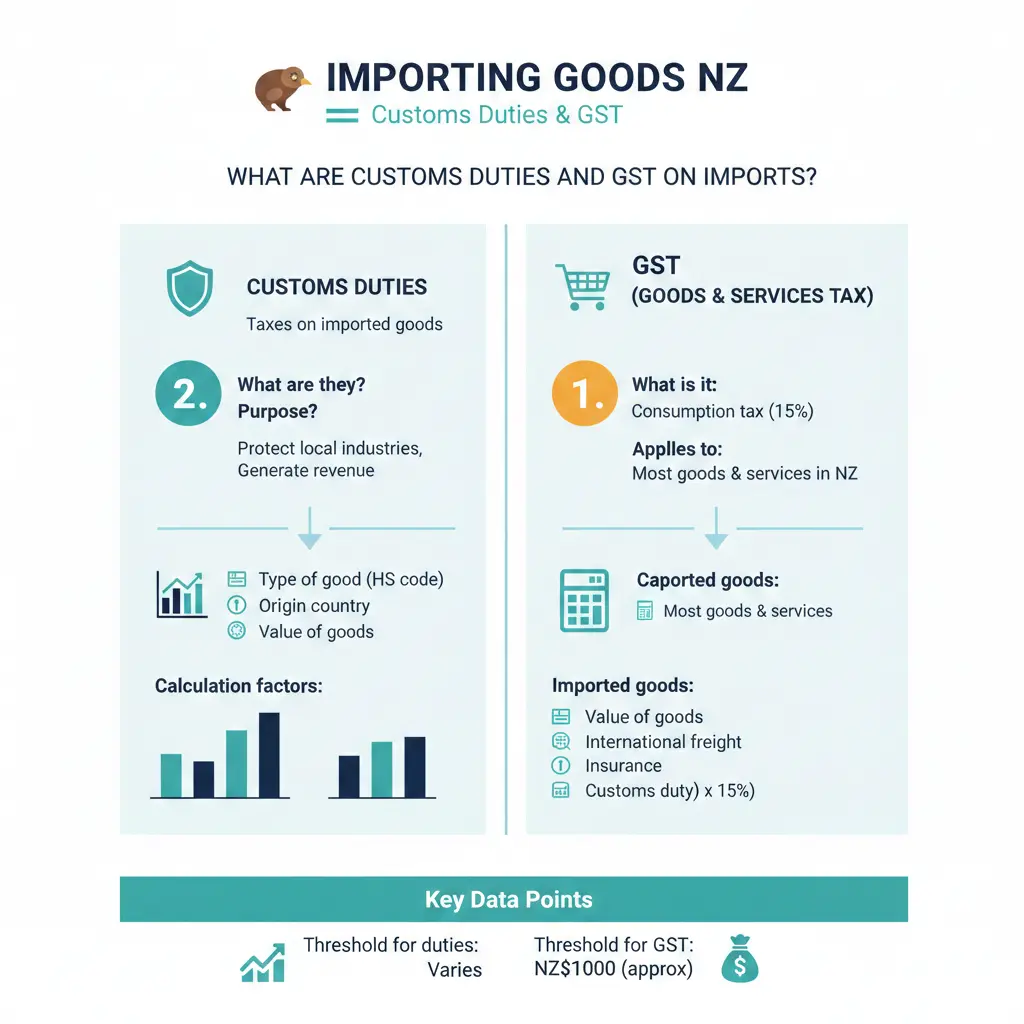
Customs duties are taxes on imported goods based on their type and origin, while GST (Goods and Services Tax) is a flat 15% consumption tax applied to most imports. Together, they form the bulk of your import costs, alongside fees like the Import Entry Transaction Fee (IETF) and Biosecurity System Entry Levy (BSEL).
Duties protect local industries and are calculated using Harmonized System (HS) codes—unique numbers classifying every product. Rates range from 0% (common for many items under Free Trade Agreements) to 10%, with textiles and footwear often at 5%. Alcohol, tobacco, and fuel attract higher specific duties, like fixed rates per litre.
GST hits 15% on the 'landed cost': item value + duty + freight + insurance. It's unavoidable for most imports, even low-value ones since 2019 changes.
Key Differences: Duties vs GST
- Duties: Vary by product (0-10% ad valorem or specific); many FTAs make them zero with proof of origin.
- GST: Flat 15% on total value; always applies unless exempt (rare for consumer goods).
- Fees: Fixed charges like IETF (~$40-50) and BSEL for biosecurity risks.
2026 Thresholds for Importing Goods NZ
The big news? No more de minimis threshold dodging duties and GST at the border for low-value shipments. Here's the 2026 landscape:
The $1,000 Customs Value Threshold
Historically, shipments valued at NZD $1,000 or less avoided border GST, duties, and fees—but not anymore for GST on B2C goods. Since 2019, overseas sellers must charge 15% GST upfront on items ≤$1,000 if they're over the $60,000 annual NZ sales threshold.
For 2026:
- ≤$1,000: No border duties/fees, but GST collected at purchase (B2C) or due on arrival (B2B). From 1 April 2026, low-value goods levy applies to all freight imports ≤$1,000.
- >$1,000: Full 15% GST + duties (if applicable) + fees at border.
Watch out: Customs can combine same-day shipments from one sender, pushing you over $1,000. Alcohol/tobacco always taxed, threshold per shipment not per item.
The $60,000 Seller Threshold
Overseas businesses selling >$60,000/year to Kiwis must register for NZ GST and charge it at checkout on B2C goods ≤$1,000. Above that, you pay at border.
How to Calculate Customs Duties and GST
Getting this wrong means delays or penalties. Use this step-by-step for 2026 imports.
Step 1: Determine Customs Value
Customs converts to NZD using bi-weekly rates, valuing at CIF (Cost, Insurance, Freight). Example: US$600 item = ~NZD $1,000 (check rates).
Step 2: Classify and Add Duty
Find HS code via Customs' tariff lookup. Say 5% duty on NZD $833 item:
Duty = 5% × $833 = $41.67
Step 3: Calculate GST Base
GST on: Value + Duty + Freight + Insurance.
Example: $833 (value) + $41.67 (duty) + $50 (freight) = $924.67
GST = 15% × $924.67 = $138.70
Step 4: Add Fees (Pre- and Post-2026)
- Now to 31 March 2026: IETF + BSEL ~$55.71/shipment if duties/GST apply.
- From 1 April 2026: Goods fees replaced by levies, including low-value goods levy for ≤$1,000 air freight (~$145.64 ex-GST equivalent pre-change).
Total Example: $41.67 duty + $138.70 GST + $55 fees = ~$235 extra on $833 item.
Pro tip: Use online calculators like GSTcalc.nz for quick estimates.
| Component | Example Amount (NZD) |
|---|---|
| Item Value | 833 |
| Duty (5%) | 41.67 |
| Freight/Insurance | 50 |
| GST (15%) | 138.70 |
| Fees | 55 |
| Total Landed Extra | 235.37 |
Upcoming 2026 Changes: What Kiwis Need to Know
Big shifts from 1 July 2025 and 1 April 2026—don't get caught out.
Fee Changes from 1 July 2025
Customs goods fees adjust:
| Fee Type | Until 30 June 2025 (incl GST) | 1 July 2025 - 31 Mar 2026 (incl GST) |
|---|---|---|
| Sea (main) | $537.09 | $238.66 |
| Air (main) | $93.45 | $120.01 |
| Air (other) | $40.08 | $53.44 |
From 1 April 2026: Levies Replace Fees
Existing fees revoked; new goods management levies cover Customs and MPI costs fairer. Low-value goods (≤$1,000) now levied on all freight imports/exports (exempt: diplomatic, carnets). Air low-value ICR with 5 items could jump costs—check Customs packs for your industry.
Prepare: Review MPI/Customs industry packs now.
Practical Tips for Importing Goods NZ
- Check HS Code & Origin: Use Customs tariff tool; claim FTAs (e.g., with China, EU) for 0% duty.
- Declare Accurately: Under-declaring risks fines up to 200% value + seizure.
- Factor All Costs: Add 20-30% buffer for duties/GST/fees.
- Use Couriers Wisely: DHL/FedEx often pay and invoice you—easier than DIY.
- Biosecurity Check: Clean goods; food/wood risks MPI clearance fees.
- Business Imports?: Register for GST if turnover >$60k; claim input credits.
Example: Importing sneakers from US? HS 6404 likely 5% duty unless FTA proof. Total cost: item + 15% GST + fees.
"Customs can combine multiple shipments... pushing you over the threshold."
Next Steps for Smart Importing
Ready to import without regrets? Start with Customs' tools: check tariffs, use GST calculators, and review 2026 levy packs. For businesses, consult IRD on GST registration. Track shipments via courier apps, and always declare fully to avoid ACC claims from seized goods!
Disclaimer: This is general info for 2026—taxes change. Seek advice from a customs broker or accountant for your situation. Not financial advice.
Frequently Asked Questions
Sources & References
-
1
Essential 2026 Updates for Shipping from the USA to New Zealand — www.comgateway.com
- 2
-
3
New Zealand GST rates and GST compliance - Avalara — www.avalara.com
-
4
New Zealand tariff Rates 2026 - Deepbeez — deepbeez.com
-
5
Goods Fees – 2026 changes - New Zealand Customs Service — www.customs.govt.nz
-
6
Goods fees and hourly rate - New Zealand Customs Service — www.customs.govt.nz
-
7
Change 1 - Low-value goods levy - New Zealand Customs Service (PDF) — www.customs.govt.nz
- 8
- 9
Related Articles

Working Multiple Jobs NZ: Tax and Legal Considerations
Juggling multiple jobs can boost your income, but it's crucial to understand the tax implications and legal requirements that come with working more than one role in Aotearoa. Whether you're a contrac...

Name Changes NZ: Legal Process and Costs
Considering a fresh start with a new name? Whether it's after marriage, divorce, or simply embracing a personal transformation, changing your name in New Zealand is straightforward but requires follow...

Holiday Home Tax Rules NZ: Private Use and Rental
Own a bach in Coromandel or a holiday home in Queenstown? You're not alone—many Kiwis cherish these escapes, but renting them out while enjoying personal use can trip you up on tax rules. Getting the...

Industry Bodies and Professional Associations NZ
Whether you're launching a business, advancing your career, or navigating financial regulations, industry bodies and professional associations in New Zealand offer invaluable support. These organisati...