Neighbours Trees NZ: Rights and Legal Options
Picture this: it's a sunny Kiwi weekend, and you're firing up the barbie in your backyard only to find your neighbour's sprawling pohutukawa blocking your view, dropping leaves into your gutters, or w...
The Lifetimes NZ editorial team curates, fact-checks, and updates guides on personal finance, property, health, immigration, legal, business, and lifestyle topics relevant to Lifetimes NZ readers. Articles are produced with AI assistance and reviewed by the editorial team before publication.
Picture this: it's a sunny Kiwi weekend, and you're firing up the barbie in your backyard only to find your neighbour's sprawling pohutukawa blocking your view, dropping leaves into your gutters, or worse, cracking your driveway with its roots. You're not alone—tree disputes are one of the most common neighbourly headaches in New Zealand, affecting thousands of homeowners each year. Understanding your rights and legal options under Kiwi law can help you resolve these issues amicably or, if needed, through the courts without escalating tensions.
In this guide, we'll break down everything you need to know about neighbours trees NZ: rights and legal options, from trimming overhanging branches to seeking court orders. Backed by the Property Law Act 2007 and local council rules, you'll get practical steps tailored for Kiwis, including real-world examples and tips to avoid costly mistakes.Jump to FAQ
Your Basic Rights: Trimming Overhanging Branches and Roots
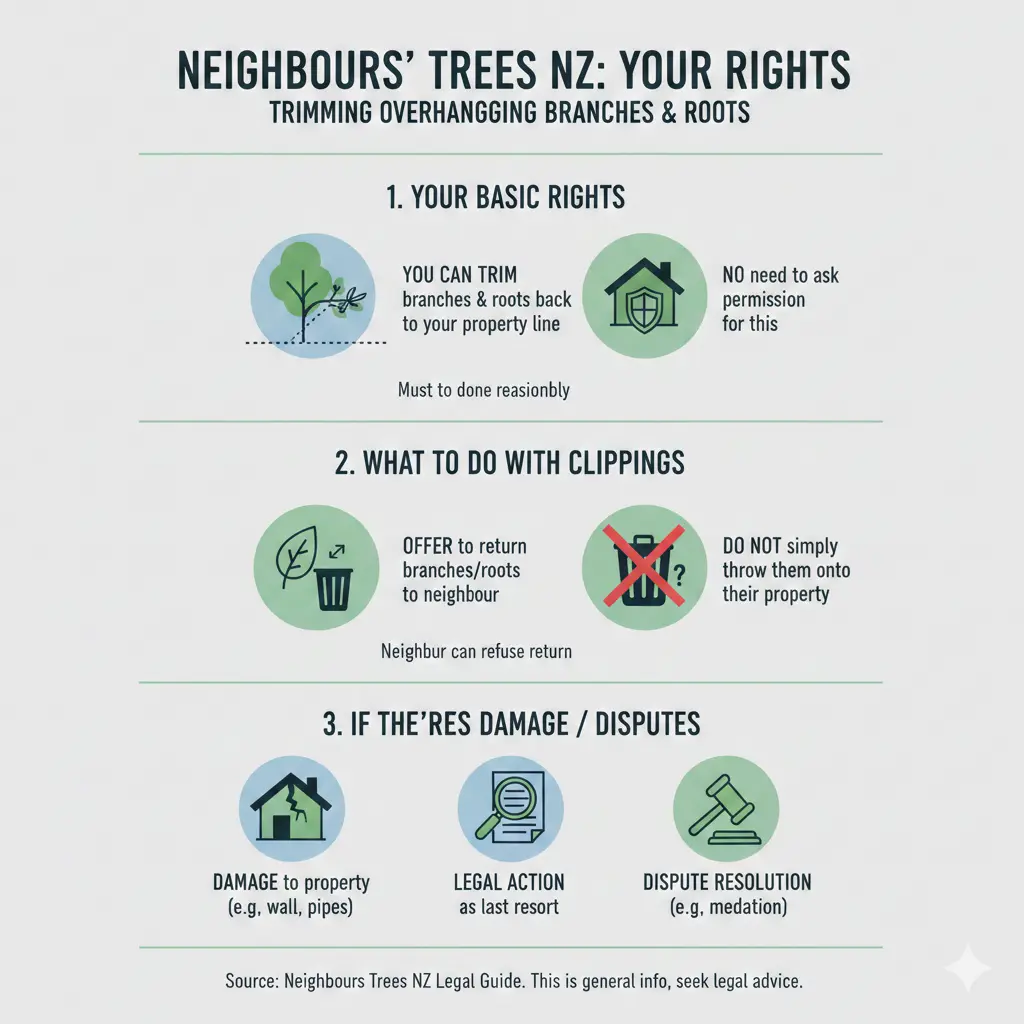
Under New Zealand law, you have the right to trim any branches or roots from your neighbour's trees that encroach onto your property, but only up to the boundary line. This applies whether the tree is causing minor annoyance or actual damage—think roots lifting your concrete path or branches scraping your roof.
How to Trim Safely and Legally
- Check for protected status first: Some trees are safeguarded under the Resource Management Act 1991 or local council bylaws, like notable pohutukawa or natives in conservation areas. Contact your local council (e.g., Auckland Council or Manawatū District Council) to verify before picking up the secateurs.
- Don't trespass: Stay on your side of the fence. Trimming beyond the boundary could land you in hot water for trespass or property damage.
- Avoid harm: Trim carefully to prevent killing the tree or causing unnecessary damage. Use a qualified arborist for large jobs—DIY mishaps can lead to disputes.
- Return the cuttings: Branches and fruit remain your neighbour's property, so offer to return them (or dispose ethically if they decline).
For example, if leaves from a neighbour's tree clog your gutters in Manawatū, you can trim overhanging branches back to the fence line yourself, but the cost is on you unless damage is proven. Always start with a friendly chat—most Kiwis sort it out over a cuppa rather than clippers.
When Trees Cause Damage: Claiming Costs and Repairs
If encroaching roots or branches damage your property—like blocking drains or cracking foundations—you're not stuck footing the bill. You can remove the offending parts and pursue compensation.
Steps for Damage Claims
- Document everything: Take photos, get arborist reports, and keep receipts for repairs. In a 2012 Disputes Tribunal case, a homeowner successfully claimed costs for removing damaging roots and fixing their property.
- Disputes Tribunal for small claims: If damage is under $30,000, apply to the Disputes Tribunal (no lawyers needed, low fees). They can award repair costs or compensation.
- District Court for bigger issues: Seek orders for repairs, tree trimming, and cost recovery. You're entitled to full reimbursement if the tree owner ignores responsibilities.
Roots blocking drains? Courts have ordered neighbours to pay for unblocking at their expense. Remember, even if the tree predated your purchase, you're still entitled to protection.
District Court Orders: For Dangerous Trees or Nuisance
When talking fails and trimming isn't enough, the Property Law Act 2007 (sections 332(b), 335(1), 336(2), 337(1)-(2)) empowers the District Court to order tree removal or trimming. This covers dangers to life/health/property, blocked views/sunlight, or unreasonable interference (e.g., leaves in gutters, root damage).
What the Court Considers
The judge balances hardship—yours if the tree stays versus your neighbour's if it's removed. Key factors include:
- Actual/potential danger (e.g., dead branches over a playground).
- Undue view/light obstruction from residential-zoned land.
- Interference with drains, gutters, or land enjoyment.
- Tree's protected status, age, or significance (historical/cultural/scientific).
- Whether the issue existed when you bought the property (won't automatically bar relief).
"The judge also has to be satisfied that the hardship you’d be caused if the tree isn’t trimmed or removed is greater than the hardship this would cause your neighbour."
Protected trees (e.g., under RMA 1991) require proof of life/health/property risk for removal. Cases like (2005) 5 NZCPR 520 and NZDC 9207 show courts siding with affected owners when interference is unreasonable.
Enforcing the Order
Neighbours get 20 working days to comply. If not, seek permission to enter their land and do the work yourself—recover full costs, including arborist fees. The court can also order compensation for any mishaps during trimming.
Protected Trees and Local Council Rules
Not all trees are fair game. Check with your council—Auckland residents, for instance, may need resource consent even for neighbour-trimming if your tree is involved. Covenants, QEII trusts, or district plans protect significant specimens. Penalties for unauthorised work can hit thousands in fines.
Quick Council Checks
- Auckland Council: Use their online tree register.
- Manawatū DC: Defer to Property Law Act but advise arborists.
- General: Search govt.nz or call your local authority.
Boundary-planted trees make you co-owners—trimming requires agreement.
Practical Tips: Resolving Disputes Kiwi-Style
Before lawyers, try mediation via Community Law Centres or Neighbourhood Support. Hire a registered arborist (find via arboriculture.org.nz) for reports—courts value expert evidence.
| Scenario | Your Option | Cost Recovery? |
|---|---|---|
| Overhanging branches | Trim to boundary | No, unless damage |
| Root damage to driveway | Trim + Disputes Tribunal | Yes, up to $30k |
| Blocks sunlight/view | District Court order | Possible, if ordered |
| Dangerous deadwood | Court for removal | Neighbour pays if non-compliant |
Budget $500–$2,000 for arborists; tribunals cost ~$45–$180 filing fees. Insurance might cover via public liability if damage qualifies—check with your provider.
Financial Implications and Insurance
Tree disputes can ding your wallet—repairs, legal fees, lost enjoyment. While not directly tied to IRD or KiwiSaver, unclaimed damages could impact household budgets. Disputes Tribunal awards are taxable if over certain thresholds, but most homeowners recover via nuisance claims. ACC doesn't cover property damage, but home insurance often includes neighbour tree fallout—review your policy.
Disclaimer: This isn't financial or legal advice. Consult a lawyer or accountant for your situation, especially tax implications via ird.govt.nz.
Next Steps: Act Smart, Stay Neighbourly
Start with a polite conversation, document issues, and consult Community Law or a lawyer via lawsociety.org.nz. For urgent dangers, notify council immediately. By knowing your neighbours trees NZ: rights and legal options, you protect your property and peace. Download a boundary survey from LINZ if unsure, and keep records for WINZ or insurance claims if renting.
Resolve early—happy backyard barbecues await.
Frequently Asked Questions
Sources & References
-
1
Trees - Community Law Manual — communitylaw.org.nz
-
2
Disputes between neighbours - New Zealand Law Society — www.lawsociety.org.nz
-
3
My Neighbour's Trees Are Interfering With My Property - BBL Lawyers — www.bbllawyers.nz
-
4
Neighbour Disputes Series (Part 2) - Glaister Keegan — www.glaisterkeegan.co.nz
-
5
Check if you can chop, prune or trim a tree on neighbouring properties - Auckland Council — www.aucklandcouncil.govt.nz
-
6
Nuisance Trees - Manawatū District Council — www.mdc.govt.nz
- 7
-
8
Pruning tree branches - New Zealand Government — www.govt.nz
Related Articles
Working Multiple Jobs NZ: Tax and Legal Considerations
Juggling multiple jobs can boost your income, but it's crucial to understand the tax implications and legal requirements that come with working more than one role in Aotearoa. Whether you're a contrac...
Name Changes NZ: Legal Process and Costs
Considering a fresh start with a new name? Whether it's after marriage, divorce, or simply embracing a personal transformation, changing your name in New Zealand is straightforward but requires follow...
Holiday Home Tax Rules NZ: Private Use and Rental
Own a bach in Coromandel or a holiday home in Queenstown? You're not alone—many Kiwis cherish these escapes, but renting them out while enjoying personal use can trip you up on tax rules. Getting the...

Industry Bodies and Professional Associations NZ
Whether you're launching a business, advancing your career, or navigating financial regulations, industry bodies and professional associations in New Zealand offer invaluable support. These organisati...