Resignation Notice NZ: Your Obligations When Leaving

Leaving your job is a significant decision, and getting the resignation process right protects both you and your employer. In New Zealand, there are specific obligations you'll need to meet when you r...
The Lifetimes NZ editorial team curates, fact-checks, and updates guides on personal finance, property, health, immigration, legal, business, and lifestyle topics relevant to Lifetimes NZ readers. Articles are produced with AI assistance and reviewed by the editorial team before publication.
Leaving your job is a significant decision, and getting the resignation process right protects both you and your employer. In New Zealand, there are specific obligations you'll need to meet when you resign, from providing proper notice to following the correct procedures. Understanding these requirements means you'll leave on good terms, maintain your professional reputation, and avoid potential financial penalties or legal complications.
Understanding Your Resignation Obligations in New Zealand
When you decide to resign, you're not just handing in a letter and walking away. You have legal obligations that are typically set out in your employment agreement. The most important of these is providing the required notice period. This gives your employer time to find a replacement and ensures a smooth transition for the business.
Unlike some countries, New Zealand doesn't have a single legal minimum notice period that applies to everyone. Instead, the amount of notice you must give depends on what's written in your employment agreement. This is why it's crucial to check your contract before you resign—you need to know exactly what you're committing to.
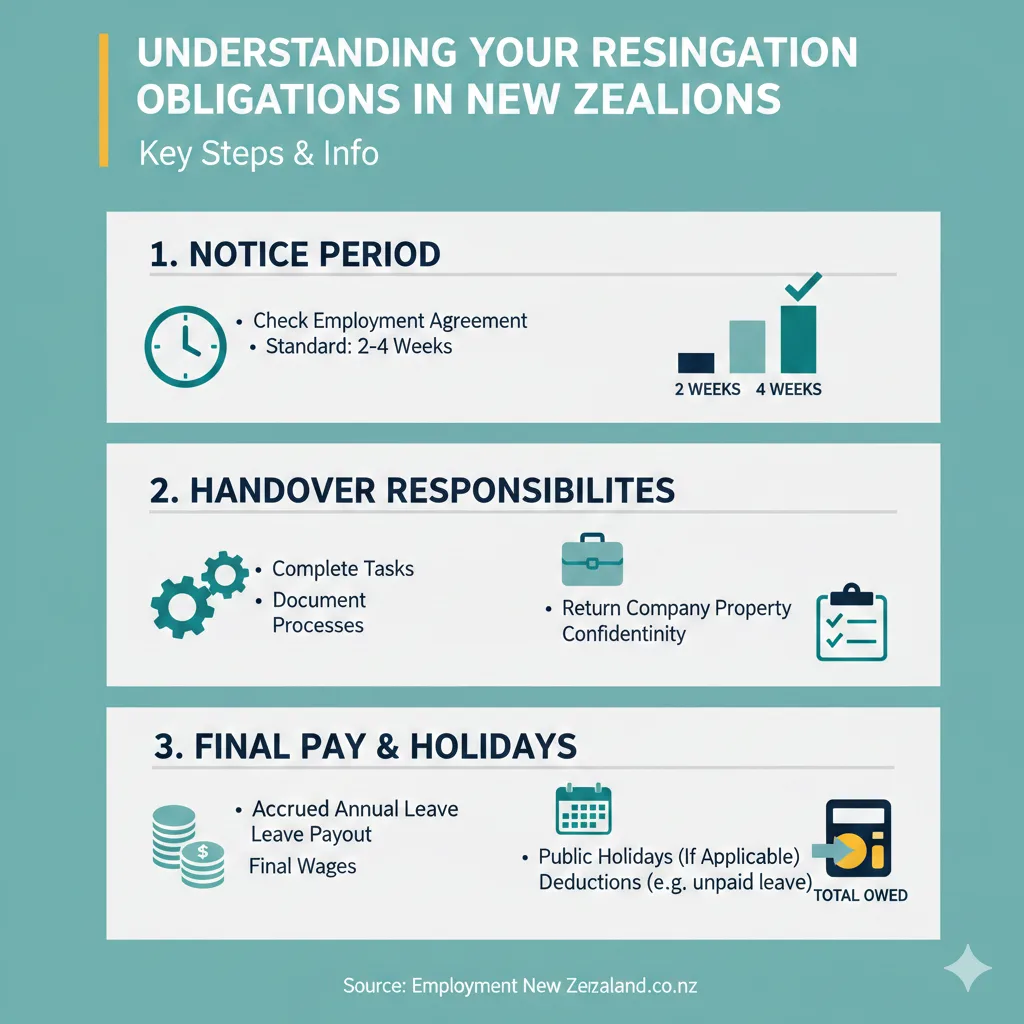
How Much Notice Must You Give?
The notice period you're required to give varies depending on your role and your employment agreement. Here's what you need to know:
Standard Notice Periods
- Most roles: 2 to 4 weeks' notice is standard across most New Zealand workplaces.
- Senior or specialised positions: You may be required to give 6 weeks or more notice.
- No notice period specified: If your employment agreement doesn't mention a notice period, you're expected to give fair and reasonable notice, which is typically 1 to 2 weeks.
When determining what's "fair and reasonable," the law considers several factors:
- How long you've worked for the employer
- The type of job you do
- How long it might take to replace you
- Common practice in your industry
For example, if you're a senior manager who's been with your company for five years, a 2-week notice period might not be considered fair and reasonable—your employer might reasonably expect 4 to 6 weeks to find a suitable replacement.
The Formal Resignation Process
Getting the process right is essential. Here's how to resign properly in New Zealand:
Step 1: Make Your Resignation Clear and Unequivocal
Your resignation must be clear and unequivocal. Saying things like "I'm thinking about leaving" or "I might look elsewhere" doesn't count as a resignation—these are just expressions of intention. You need to make it absolutely clear that you intend to resign. In the case of Nelson v Air New Zealand International Ltd, the Employment Relations Authority found that vague or emotional statements don't constitute valid notice of resignation.
Step 2: Put It in Writing
Most employment agreements in New Zealand require resignation to be submitted in writing. A verbal statement, text message, or casual remark won't count if your contract specifies written notice. Written resignation protects both you and your employer by creating a clear record of when you resigned and what your final day of work will be.
Employment New Zealand provides a resignation letter template you can use to ensure you cover all the necessary points. Your resignation letter should include:
- Your intention to resign
- Your proposed final working day (which must be at least the required notice period away)
- Your signature
- The date you're submitting the letter
Step 3: Submit Your Resignation to the Right Person
Deliver your resignation letter to your manager or HR department, depending on your company's procedures. Keep a copy for your records—this is your proof that you've formally resigned and when you did so.
What Happens After You Resign
Once you've given notice, several things come into play:
Your Employer Must Pay You Through Your Notice Period
If you've given the required notice, your employer must pay you until the end of your notice period. However, your employer can ask you not to work the full notice period. In this case, they may choose to put you on garden leave (paid time away from work) or agree to waive the notice period altogether.
If your employer agrees not to require you to work your notice period, you won't be paid for the portion you don't work unless you've agreed otherwise.
Can You Leave Before Your Notice Period Ends?
In most cases, leaving without working your notice period can result in financial penalties or legal action. Your employer could potentially deduct money from your final pay equivalent to the notice period you didn't work—but only if your employment agreement expressly allows this.
However, there are exceptions where immediate resignation is justified:
- Your employer seriously breaches your employment agreement (such as unpaid wages, unsafe work conditions, or bullying)
- Staying in the job causes immediate health or safety risks
- Both you and your employer agree to waive the notice period
If you must resign immediately, explain your reasons clearly and professionally, and keep documentation of any employment breaches if applicable.
Can Your Employer Stop You from Leaving?
Once you've given the correct notice, your employer cannot stop you from leaving at the end of your notice period. However, your employer can terminate your employment during the notice period if you engage in serious misconduct, such as fraud, harassment, or theft—in which case they can dismiss you immediately.
What You Don't Have to Do
It's worth knowing what you're not obligated to do when you resign:
- Provide a reason: You're not legally required to explain why you're resigning unless your employment contract specifically asks for one. You can simply state that you're resigning.
- Justify your decision: As the Employment Relations Authority noted in Mikes Transport Warehouse Limited and Vermuelen, an employee is not required to justify their decision to resign, nor does it need to be "demonstrably sensible or well thought through."
Withdrawing Your Resignation
If you've resigned but change your mind, you can ask your employer to withdraw your resignation. However, your employer doesn't have to agree. If they refuse, your resignation still stands. Your employer should respond to any withdrawal request in writing so there's no misunderstanding.
Frequently Asked Questions About Resigning in New Zealand
What if my employment agreement doesn't specify a notice period?
If there's no notice period in your employment agreement, you must give fair and reasonable notice based on your length of service, the type of job, how long it might take to replace you, and common practice in your industry. Generally, 2 to 4 weeks is considered fair and reasonable for most roles.
Can my employer force me to work my notice period?
Your employer can require you to work your notice period if it's specified in your employment agreement. However, they can also choose to waive it or put you on garden leave (paid time away from work). If they waive the notice period, you won't be paid for the portion you don't work unless you've agreed otherwise.
What if I'm on a fixed-term contract?
Fixed-term employment agreements may have a notice period or a set date when employment will end. Check your specific contract to understand your obligations. In some cases, you may be locked into the contract until the end date unless both parties agree otherwise.
Can I resign during my probation period?
Yes, you can resign at any time, including during your probationary period. However, you still need to follow the notice requirements in your employment agreement. Some agreements may specify a shorter notice period for probationary employees.
What should I do if my employer doesn't accept my resignation?
Your employer doesn't need to formally "accept" your resignation for it to be valid. Once you've given the correct notice in writing, you have the right to leave at the end of your notice period, whether your employer accepts it or not.
Can I be dismissed during my notice period?
Yes, but only under certain conditions. If you engage in serious misconduct (such as fraud, harassment, or theft), your employer can dismiss you immediately without notice. However, for standard performance or conduct issues, your employer would need to follow a fair process.
Key Takeaways for Resigning in New Zealand
Resigning properly protects your professional reputation and ensures you leave on good terms. Here's what you need to remember:
- Check your employment agreement for the required notice period before you resign
- Make your resignation clear and unequivocal in writing
- Give at least the notice period specified in your contract (typically 2-4 weeks)
- Submit your resignation letter to your manager or HR and keep a copy
- You're entitled to be paid through your notice period unless your employer waives it
- You don't need to provide a reason for resigning
- If you need to leave immediately, document any serious breaches by your employer
Leaving your job professionally means you'll maintain positive relationships with your employer and colleagues, which can be valuable for future references and your career. If you have questions about your specific situation, consider seeking advice from Employment New Zealand, or if you need legal guidance, consult an employment lawyer.
Related Articles

Industry Bodies and Professional Associations NZ
Whether you're launching a business, advancing your career, or navigating financial regulations, industry bodies and professional associations in New Zealand offer invaluable support. These organisati...

Emergency Benefit NZ: When You Have No Other Options
When you're struggling financially and don't qualify for other benefits, the Emergency Benefit might be your lifeline. It's a discretionary payment designed for Kiwis in genuine hardship who've exhaus...

Unpaid Internships NZ: Are They Legal?
Unpaid internships are a common pathway for students and graduates to gain work experience in New Zealand, but there's often confusion about whether they're actually legal. The short answer is: unpaid...

Estate Administration NZ: Managing Someone's Affairs After Death
Losing a loved one is one of life's toughest challenges, and stepping in to manage their estate can feel overwhelming. In New Zealand, estate administration—the process of handling someone's affairs a...