Waste and Recycling: What Goes Where in NZ
Ever stared at your rubbish bag, wondering if that yoghurt pottle or pizza box truly belongs in the recycling? You're not alone—Kiwis generate over 17 million tonnes of waste annually, much of it land...
Sarah covers personal finance, tax, and KiwiSaver topics for Lifetimes NZ. She focuses on making money management straightforward and practical for everyday Kiwis.
Ever stared at your rubbish bag, wondering if that yoghurt pottle or pizza box truly belongs in the recycling? You're not alone—Kiwis generate over 17 million tonnes of waste annually, much of it landing in landfills when it could be diverted. With New Zealand's waste policies evolving rapidly into 2026, knowing what goes where saves money, cuts emissions, and keeps our whenua pristine. This guide breaks it down with the latest rules, practical tips, and council resources to make sorting simple and effective for your home or business.
Understanding New Zealand's Waste Management Landscape in 2026
New Zealand's approach to waste has shifted towards a circular economy, emphasising reduction, reuse, and recycling under the Aotearoa New Zealand Waste Strategy. The Waste Minimisation Act drives much of this, supported by the Waste Minimisation Fund (WMF), which invests in infrastructure like materials recovery facilities. Key priorities for 2024-2026 include organics, plastics, construction waste, and kerbside recyclables.
The Waste Disposal Levy, expanded in 2024, now covers all landfills at $60 per tonne for municipal waste, incentivising diversion. Councils allocate levy funds for education, innovation, and infrastructure—70-80% goes to recycling and manufacturing facilities. Despite some policy pauses, like deferred plastic bans, standardisation remains a win for consistency nationwide.
Recent Changes and What's Ahead
- Kerbside Standardisation (Feb 2024): Uniform rules across all councils for recycling bins.
- Produce Labels Extension: Fully home compostable labels (including adhesives) required by 1 July 2028.
- Food Organics Push: Targeted investments for food scrap collections to cut emissions.
- Product Stewardship: Schemes for e-waste, refrigerants, and potentially beverage containers.
- Legislative Modernisation: Updates to Waste Minimisation Act expected before 2026 election.
These changes aim to halve food waste by 2030 and boost resource recovery, aligning with emissions reduction plans through 2030.
Kerbside Recycling: The National Standard
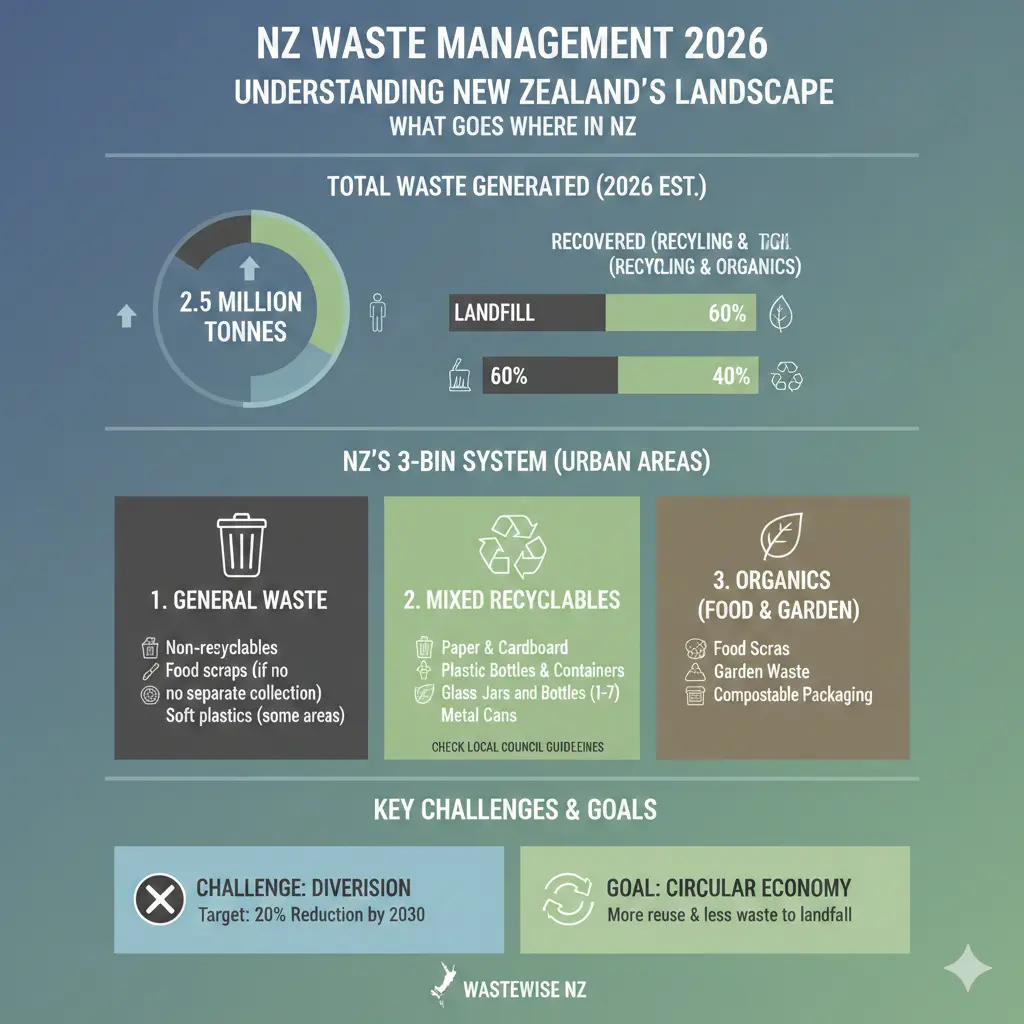
Since 1 February 2024, every Kiwi follows the same kerbside recycling rules, regardless of council. This eliminates confusion from varying local guidelines. Check your council's app or website for collection days, but the what goes where is now standardised.
What Goes in Your Yellow Recycling Bin
Only these five categories—clean, loose, and rinsed:
- Glass bottles and jars (no lids, no broken glass).
- Paper and cardboard (including pizza boxes—greasy is okay if flattened).
- Steel and aluminium cans (rinsed; aerosol cans excluded).
- Plastic bottles, tubs, and trays marked 1, 2, or 5 (e.g., milk bottles, yoghurt pottles, margarine tubs—squash and lids separate).
Common Items Now Banned from Kerbside Recycling
To improve quality and reduce contamination, these are out from 1 February 2024:
| Item | Why Excluded | Alternative |
|---|---|---|
| Items under 50mm (e.g., bottle caps, small pots) | Too small for sorting machines | Bag it and bin it, or collect for soft plastics. |
| Aerosol cans | Safety risk in processing | Take to a community recycling centre. |
| Liquid paperboard (Tetrapak, juice boxes) | Not processed kerbside | Check council for collection points. |
| Plastics 3, 4, 6, 7 (and all plastic film) | Low recycling value | Soft plastics recycling at supermarkets. |
Pro Tip: Flatten cardboard and squash plastics to maximise bin space. Contamination rates dropped 20% post-standardisation, boosting recycling efficiency.
Organics and Food Waste: Composting at Home or Council Collection
Organic waste—food scraps, garden trimmings—makes up 30% of household rubbish, emitting methane in landfills. Many councils offer food and garden organics (FOGO) bins; check yours via Recycle.co.nz.
Home Composting Basics
- Bin Setup: Use a council-subsidised compost bin or worm farm.
- Greens (Wet): Fruit/veg scraps, tea bags, lawn clippings.
- Browns (Dry): Dry leaves, cardboard, sawdust (2:1 ratio to greens).
- Avoid: Meat, dairy, citrus, diseased plants.
- Maintain: Aerate weekly, keep moist like a wrung sponge.
Ready compost in 3-6 months for garden use. Aucklanders can access free workshops via council programs.
Council FOGO Collections
Over 50% of councils now collect food scraps weekly. Line bins with compostable bags (certified home compostable by 2028). Businesses face upcoming mandates—inspired by NSW's 2026 rollout for large premises—to separate food organics.
Soft Plastics and Hard-to-Recycle Items
Plastic bags, wrappers, and films go to supermarket collection points via the Soft Plastics Scheme. Over 150 stores nationwide accept clean, dry film plastics (e.g., bread bags, fertiliser bags).
Where to Take the Rest
- E-waste: TVs, chargers—free at council events or Transfer Stations.
- Hazardous: Batteries, paint, chemicals—Harmful Substances bins at tips.
- Tyres, Scrap Metal: Agrecovery or council facilities.
- Construction Waste: Sort timber, metal, concrete onsite to avoid levy costs.
Use Recycle.co.nz's finder for nearest spots.
Business and Commercial Waste Rules
Kiwi businesses produce 60% of waste. From 2026, expect phased mandates for food organics separation, starting with large operations (e.g., supermarkets by floor space). Levy increases push efficiency—divert organics to cut bills by 20-30%.
Practical Steps:
- Audit waste streams quarterly.
- Partner with providers like Method Recycling for COFO compliance prep.
- Track via mandatory reporting from July 2024.
Ties into KiwiSaver sustainability goals and IRD green deductions—consult an advisor for tax perks.
Costs, Fines, and Financial Incentives
Wrong sorting hikes council rates via higher processing costs. Fines for illegal dumping start at $400. Positively, WMF grants fund business upgrades, and levy savings reward diversion.
Household Savings Tip: Proper sorting cuts bin collections, saving $50-100/year. Businesses: Anaerobic digestion turns food waste into biogas, slashing disposal fees.
"A well-designed food waste system can improve operational efficiency and reduce waste disposal costs."
Next Steps to Master Waste in Your Whare
Start today: Download your council's app, label bins clearly, and track one week's waste to spot diversions. Join Recycling Week 2026 for free resources. For businesses, audit now ahead of organics mandates. Small changes compound—New Zealand diverted 28% of waste in 2024; let's hit 50% by 2030.
Disclaimer: This guide uses 2026 data; waste rules vary by council. Seek professional advice for financial or compliance decisions, especially IRD/ACC implications.
Frequently Asked Questions
Sources & References
-
1
Commercial Food Organics (COFO) Mandate 2025 - Method Recycling — methodrecycling.com
-
2
Waste and Resource Efficiency Work Programme 2024-2026 — environment.govt.nz — environment.govt.nz
-
3
New Zealand's Waste Policy Evolution — Compost Connect — www.compostconnect.org
-
4
Government Waste Work Programme — Ministry for the Environment — environment.govt.nz
-
5
Consumer Recycling Guidelines — Plastics New Zealand — www.plastics.org.nz
-
6
New EU Rules on Packaging and Waste — MFAT — www.mfat.govt.nz
-
7
Recycle.co.nz — Reclaim NZ — www.reclaim.co.nz
-
8
NZ New Recycling Rules Video — TVNZ Breakfast — www.youtube.com
Related Articles

Industry Bodies and Professional Associations NZ
Whether you're launching a business, advancing your career, or navigating financial regulations, industry bodies and professional associations in New Zealand offer invaluable support. These organisati...

Emergency Benefit NZ: When You Have No Other Options
When you're struggling financially and don't qualify for other benefits, the Emergency Benefit might be your lifeline. It's a discretionary payment designed for Kiwis in genuine hardship who've exhaus...

Unpaid Internships NZ: Are They Legal?
Unpaid internships are a common pathway for students and graduates to gain work experience in New Zealand, but there's often confusion about whether they're actually legal. The short answer is: unpaid...

Estate Administration NZ: Managing Someone's Affairs After Death
Losing a loved one is one of life's toughest challenges, and stepping in to manage their estate can feel overwhelming. In New Zealand, estate administration—the process of handling someone's affairs a...