Aged Residential Care: Understanding Rest Home Costs

As Kiwis, we all want the best for our whānau when the time comes for aged residential care. But with rest home costs averaging $1,450 per week or more, understanding these expenses—and how to offset...
The Lifetimes NZ editorial team curates, fact-checks, and updates guides on personal finance, property, health, immigration, legal, business, and lifestyle topics relevant to Lifetimes NZ readers. Articles are produced with AI assistance and reviewed by the editorial team before publication.
As Kiwis, we all want the best for our whānau when the time comes for aged residential care. But with rest home costs averaging $1,450 per week or more, understanding these expenses—and how to offset them—can make all the difference in planning ahead. Whether you're considering options for a loved one or yourself, this guide breaks down the realities of rest home pricing in New Zealand for 2026, from subsidies to private payments.
What is Aged Residential Care?
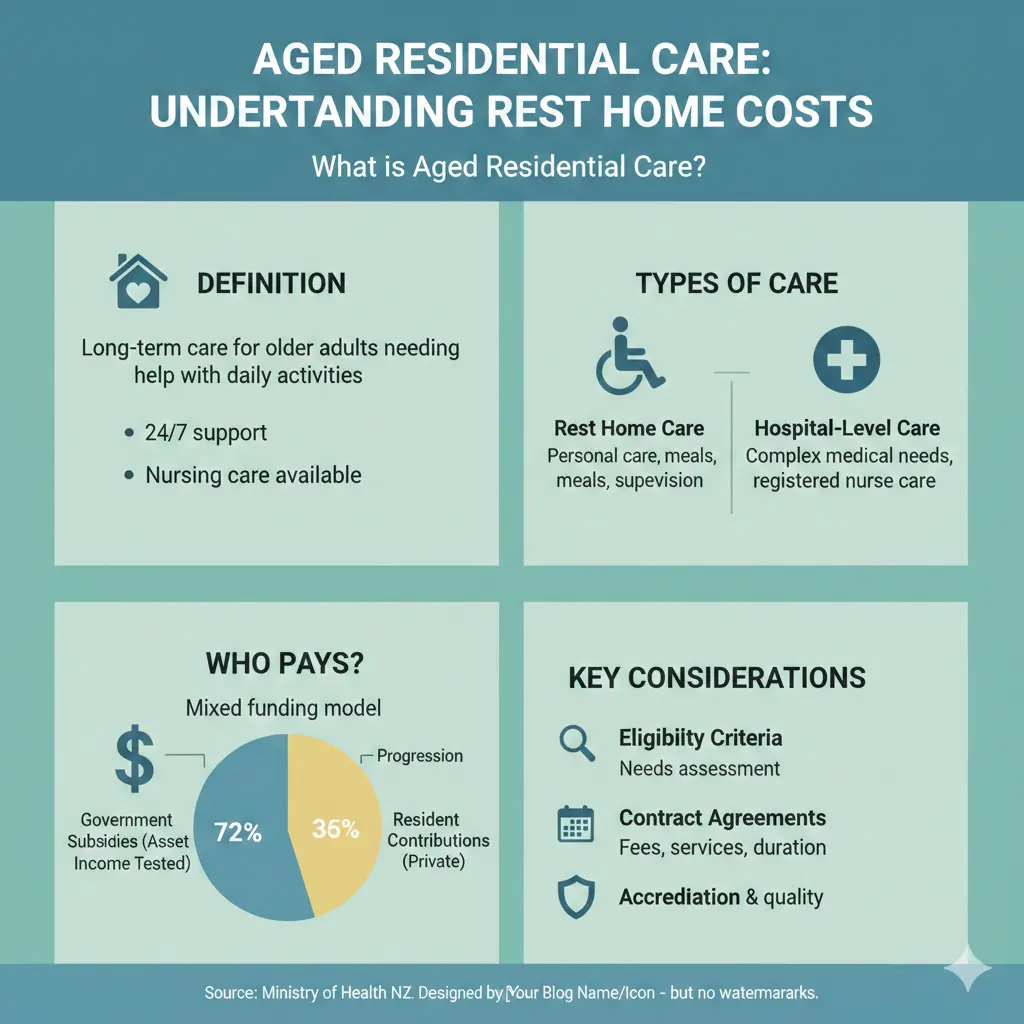
Aged residential care, often called rest home care, provides support for older Kiwis who need help with daily living but not full hospital-level care. Facilities offer personal care like bathing and dressing, medication management, and nursing, in options from shared rooms to self-contained units. Regulated by the Ministry of Health through Te Whatu Ora (Health New Zealand), these homes must meet strict standards for safety and quality.
Rest homes differ from hospital-level care or dementia units, which cost more but come with government top-ups to cap your contribution at rest home rates for standard rooms. The average stay for those receiving subsidies is just 18 months, so choosing the right facility early matters.
Types of Accommodation in Rest Homes
- Standard rooms: Basic shared or single rooms, covered up to the maximum weekly contribution (around $1,510 in Auckland as of late 2024, subject to 2026 updates).
- Premium options: Ensuites or luxury features, adding $70–$840 per week on top of the base rate.
- Self-contained units: More independence with kitchenettes, often at higher rates but with flexibility.
Prices vary by region—Auckland and Wellington tend to be pricier than smaller centres—but all contracted facilities charge the same care fee per region, set by Te Whatu Ora.
Breaking Down Rest Home Costs in 2026
Expect to pay $1,400–$1,500+ per week for standard rest home care, equating to $72,800–$78,000 annually. This covers the care component, but extras like premium rooms push totals to $122,000+ yearly.
Standard vs Premium Accommodation Costs
Here's a breakdown based on Auckland's maximum contribution of $1,510 per week (2024 figure; check Te Whatu Ora for 2026 rates):
| Accommodation Type | Weekly Cost (Max Contribution + Premium) | Annual Cost |
|---|---|---|
| Base (Standard Room) | $1,510 | $78,520 |
| Premium ($70/week extra) | $1,580 | $82,160 |
| Luxury ($175/week extra) | $1,685 | $87,620 |
| Ultra-Luxury ($375/week extra) | $1,885 | $98,020 |
| Top-Tier ($840/week extra) | $2,350 | $122,200 |
Note: These are maximums for the care component; all include minimum residential care levels. Actual prices depend on your needs and facility.
Additional Fees to Watch For
- Premium accommodation charges (daily or weekly).
- Optional services like laundry, hairdressing, or podiatry.
- Entrance fees or bonds for some private facilities (refundable in many cases).
- Medical supplies or specialist visits not covered by the subsidy.
If you're not subsidy-eligible, you'll pay the full contracted rate up to the Te Whatu Ora maximum, plus extras.
Government Subsidies and Eligibility
Te Whatu Ora funds rest homes via the Residential Care Subsidy (for care) and Accommodation Supplement (for lodging), but it's means-tested. You must undergo a needs assessment through your local Needs Assessment and Service Coordination (NASC) agency.
Asset and Income Thresholds for 2026
For a single person, the asset limit is around $291,825 (2025 figure; confirm with Work and Income for 2026). Couples have the same limit if both need care, or higher if only one does. Income is assessed too—NZ Super alone won't qualify you if assets exceed limits.
Your home is exempt if a spouse lives there or you're likely to return, but it counts after 12 months in care (with exceptions). Use Work and Income's online estimator to check eligibility.
How the Subsidy Works
- Get a needs assessment confirming residential care requirement.
- Apply for financial assistance via Work and Income (WINZ).
- If eligible, the government pays the facility directly, leaving you with the maximum contribution (e.g., $1,510/week in Auckland).
Non-eligible Kiwis in contracted homes still cap care costs at the maximum, paying privately for accommodation extras.
Funding Your Rest Home Stay: Options Beyond Subsidies
With average costs far outstripping NZ Super—$27,994 annually for a single living alone in 2026, covering just 60% of modest living expenses—planning is key.
Leverage NZ Super and Other Income
NZ Super rates for 2025-2026: single living alone at $538/week after tax ($1,949/fortnight including supplements). Couples get $2,529/fortnight combined. But rest home fees dwarf this, so consider:
- KiwiSaver withdrawals: From age 65, tax-free for residential care.
- Veterans' Pension: Extra support via Veterans' Affairs.
- Private savings or investments.
Equity Release from Your Home
Can't sell your home yet? Equity release schemes let you access its value tax-free. A $1m home might yield $873/fortnight for 10 years, boosting a single's total income to $1,949/fortnight with NZ Super. Providers like Reverse Mortgages NZ offer these, but compare fees and impact on inheritance.
Private Payment and Bonds
Some facilities charge refundable bonds (e.g., 50–100% of annual fees), repayable after leaving. Shop around—use Eldernet.co.nz to compare.
Practical Tips for Managing Costs
Planning ahead can save thousands. Here's actionable advice:
- Assess needs early: Contact your local NASC for a free assessment.
- Compare facilities: Use govt.nz tools or Eldernet for pricing and reviews.
- Review assets annually: Small gifts to whānau might affect eligibility—seek advice from a financial adviser.
- Budget for extras: Factor in $5,000–$10,000/year for premiums and services.
- Explore respite care first: Short-term stays to test facilities without full commitment.
Remember, costs rose with inflation in 2026, but so did subsidies—check Te Whatu Ora's site for updates.
"The maximum contribution is the highest you’ll ever have to pay for the care component in any rest home." Ministry of Health guidance via MoneyHub
Next Steps for Peace of Mind
Start by visiting Te Whatu Ora's residential care page for current maximums and your local NASC contacts. Use Work and Income's subsidy calculator, and consult a financial adviser or elder law specialist—especially for asset protection. With smart planning, you can secure quality care without financial stress. Always seek personalised advice, as this guide is general information only.
Frequently Asked Questions
Sources & References
-
1
Rest Home Costs, Subsidies and Financing — moneyhub.co.nz — www.moneyhub.co.nz
-
2
Aged Care Pricing Guide — oceaniahealthcare.co.nz — oceaniahealthcare.co.nz
-
3
NZ Super Shock: Payments Now Cover Only 60% of Real Living Costs in 2026 — dirtdevildetailing.co.nz — dirtdevildetailing.co.nz
-
4
Goodbye Retirement Dream? NZ Super Covers Just 60% of Living Costs in 2026 — exclusivechauffeur.co.nz — www.exclusivechauffeur.co.nz
-
5
Cost-of-Living Crisis 2026: Is NZ Super Still Enough? — exclusivechauffeur.co.nz — www.exclusivechauffeur.co.nz
-
6
The Real Cost of Retirement in NZ — artbeat.org.nz — www.artbeat.org.nz
-
7
NZ Super Rates vs Cost of Living 2026 — artbeat.org.nz — www.artbeat.org.nz
-
8
Goodbye Fixed-Income Safety — outdoorshadesolutions.co.nz — www.outdoorshadesolutions.co.nz
-
9
NZ Super Shock as Payments Cover Only 60% — ijservices.co.nz — ijservices.co.nz
-
10
What is the Asset Limit for the Rest Home Subsidy? — eldernet.co.nz — www.eldernet.co.nz
Related Articles

Working Multiple Jobs NZ: Tax and Legal Considerations
Juggling multiple jobs can boost your income, but it's crucial to understand the tax implications and legal requirements that come with working more than one role in Aotearoa. Whether you're a contrac...

Name Changes NZ: Legal Process and Costs
Considering a fresh start with a new name? Whether it's after marriage, divorce, or simply embracing a personal transformation, changing your name in New Zealand is straightforward but requires follow...

Holiday Home Tax Rules NZ: Private Use and Rental
Own a bach in Coromandel or a holiday home in Queenstown? You're not alone—many Kiwis cherish these escapes, but renting them out while enjoying personal use can trip you up on tax rules. Getting the...

Industry Bodies and Professional Associations NZ
Whether you're launching a business, advancing your career, or navigating financial regulations, industry bodies and professional associations in New Zealand offer invaluable support. These organisati...