Asking for a Pay Rise NZ: Timing and Tactics

Ever stared at your payslip, feeling the pinch of rising Kiwi living costs while your salary stays stubbornly flat? You're not alone—many Kiwis are gearing up to ask for a pay rise in 2026, especially...
The Lifetimes NZ editorial team curates, fact-checks, and updates guides on personal finance, property, health, immigration, legal, business, and lifestyle topics relevant to Lifetimes NZ readers. Articles are produced with AI assistance and reviewed by the editorial team before publication.
Ever stared at your payslip, feeling the pinch of rising Kiwi living costs while your salary stays stubbornly flat? You're not alone—many Kiwis are gearing up to ask for a pay rise in 2026, especially with minimum wage hikes and KiwiSaver changes on the horizon. Timing it right and using smart tactics can make all the difference in landing the increase you deserve.
In New Zealand's evolving job market, where inflation hovers around 2% and unions push for above-cost-of-living gains, knowing when and how to broach the topic is key. This guide breaks down the best timing for asking for a pay rise NZ, proven tactics, and NZ-specific tips to boost your chances.
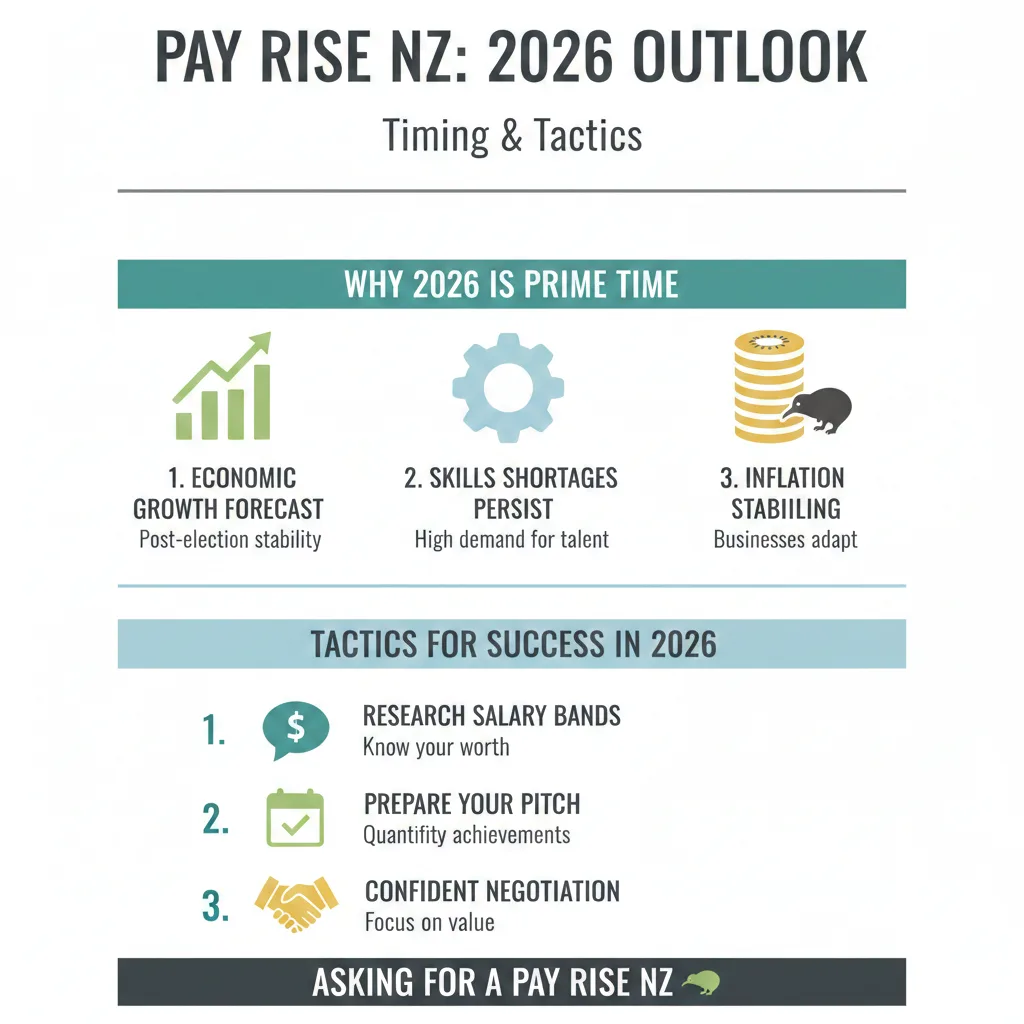
Why 2026 is a Prime Time for Pay Rise Talks in New Zealand
The economic landscape in 2026 offers mixed signals but real opportunities. With the adult minimum wage rising to $23.95 per hour from 1 April 2026—a 2% increase benefiting around 122,500 workers—there's upward pressure on wages across sectors. Employers face constraints from operational costs, yet unions are assertive, demanding holistic packages beyond just cash, like flexible work and training.
KiwiSaver employer contributions jump from 3% to 5% on 1 April 2026, effectively boosting take-home value without direct salary hikes. Meanwhile, Employment Relations Act changes, including a high-income threshold of $180k removing unfair dismissal rights, could shift negotiation dynamics.
Key Economic Factors Influencing Pay Rises
- Inflation and Cost-of-Living: Projected at 2% from June 2026, moderate rises align with minimum wage adjustments.
- Sector Pressures: Industries like hospitality and manufacturing see wage compression, but skilled roles have leverage.
- Union Bargaining: Expect pushes for non-monetary perks amid limited cash growth.
These shifts mean asking for a pay rise NZ now positions you ahead of broader bargaining rounds.
Best Timing for Asking for a Pay Rise
Timing isn't just about calendars—it's about aligning with your employer's cycle and performance peaks. In NZ, avoid year-end squeezes; target post-budget or review periods.
Optimal Windows in the NZ Calendar
- Post-Performance Review (March-May): Fresh achievements in mind, before April minimum wage changes.
- After KiwiSaver Boost (April Onwards): Leverage the 5% contribution increase as a win-win.
- Pre-Budget Planning (June-August): FY planning allows budget allocation.
- End of Probation or Project Success: Immediate value demonstrated.
Avoid December holidays or post-April cost pressures from minimum wage hikes. Randstad's 2026 research shows Kiwis negotiating autonomy during reviews, tying into pay talks.
Personal Timing Tips
- Track your wins: Quantify contributions, e.g., "Boosted team output by 15%."
- Monitor company signals: Earnings reports or hiring sprees indicate capacity.
- Market check: Use Seek or Trade Me Jobs to benchmark salaries in your field.
Proven Tactics for Asking for a Pay Rise NZ
Approach pay rise requests as a business case, not a plea. Focus on value, data, and alternatives—NZ employers value partnership.
Step-by-Step Preparation
- Research Your Worth: Use IRD tax thresholds and KiwiSaver calculators for net impact. Aim for 5-10% above current, market-aligned.
- Document Achievements: Metrics matter—sales up, costs down, projects delivered.
- Practice Your Pitch: Rehearse with a mate; keep it 10-15 minutes.
Effective Scripts and Negotiation Tactics
Use outcome-focused language, inspired by NZ trends toward autonomy.
"I've delivered [specific result, e.g., 20% efficiency gain] this year. With market rates at [figure] and minimum wage rising to $23.95, I'd like to discuss adjusting my salary to [target], plus flexibility on hours to maintain that momentum."
- Bundle Requests: Pair pay with non-cost perks like extra leave or training—unions highlight this.
- Propose a Trial: "Test and learn" for changes, building trust.
- Handle No's Gracefully: Ask, "What metrics would justify a review in six months?"
NZ-Specific Legal Considerations
Under the Employment Relations Act, good faith bargaining applies. For collective agreements, timing aligns with 2026 rounds. High earners over $180k lose some protections—know your rights via MBIE. ACC levies and PAYE changes don't directly impact, but factor IRD brackets (e.g., 33% from $70k).
Common Mistakes to Avoid When Asking for a Pay Rise
- Emotional appeals over data.
- Ignoring employer constraints, like 2026 wage pressures.
- No Plan B—always have alternatives ready.
- Forgetting follow-up: Email a summary post-meeting.
FAQ: Asking for a Pay Rise NZ
Q: What's the average pay rise in NZ for 2026?
A: Expect 2-4% aligned with minimum wage and inflation, though skilled roles see 5-8% via negotiation.
Q: Can I ask during probation?
A: Yes, if exceeding expectations—many succeed post-project milestones.
Q: What if I'm on minimum wage?
A: Automatic rise to $23.95 from April 2026; negotiate above that with performance proof.
Q: How does KiwiSaver affect my ask?
A: The 3% to 5% employer boost adds value—frame pay rise as complementary.
Q: Union members: When to involve them?
A: Before collective rounds; they push for extras amid 2026 constraints.
Q: Remote workers—any edge?
A: Yes, negotiate autonomy as per Randstad trends for productivity gains.
Next Steps: Secure Your Pay Rise Today
Update your achievement log, benchmark your salary, and book that meeting. With 2026's minimum wage at $23.95 and KiwiSaver enhancements, employers have reasons to invest in you. Practice your pitch, stay data-driven, and remember: confident Kiwis get results.
Disclaimer: This is general advice. Consult a financial adviser or Employment NZ for personalised guidance on pay, tax, or KiwiSaver.
Related Articles

Working Multiple Jobs NZ: Tax and Legal Considerations
Juggling multiple jobs can boost your income, but it's crucial to understand the tax implications and legal requirements that come with working more than one role in Aotearoa. Whether you're a contrac...

Name Changes NZ: Legal Process and Costs
Considering a fresh start with a new name? Whether it's after marriage, divorce, or simply embracing a personal transformation, changing your name in New Zealand is straightforward but requires follow...

Holiday Home Tax Rules NZ: Private Use and Rental
Own a bach in Coromandel or a holiday home in Queenstown? You're not alone—many Kiwis cherish these escapes, but renting them out while enjoying personal use can trip you up on tax rules. Getting the...

Industry Bodies and Professional Associations NZ
Whether you're launching a business, advancing your career, or navigating financial regulations, industry bodies and professional associations in New Zealand offer invaluable support. These organisati...