Buying with Family: Co-Ownership Agreements NZ

Buying a home with family members can make homeownership more affordable, but it also comes with legal complexities and potential pitfalls. Whether you're pooling deposits with siblings, parents, or e...
Sarah covers personal finance, tax, and KiwiSaver topics for Lifetimes NZ. She focuses on making money management straightforward and practical for everyday Kiwis.
Buying a home with family members can make homeownership more affordable, but it also comes with legal complexities and potential pitfalls. Whether you're pooling deposits with siblings, parents, or extended family, a solid co-ownership agreement is essential to protect everyone involved and prevent costly disputes down the track.
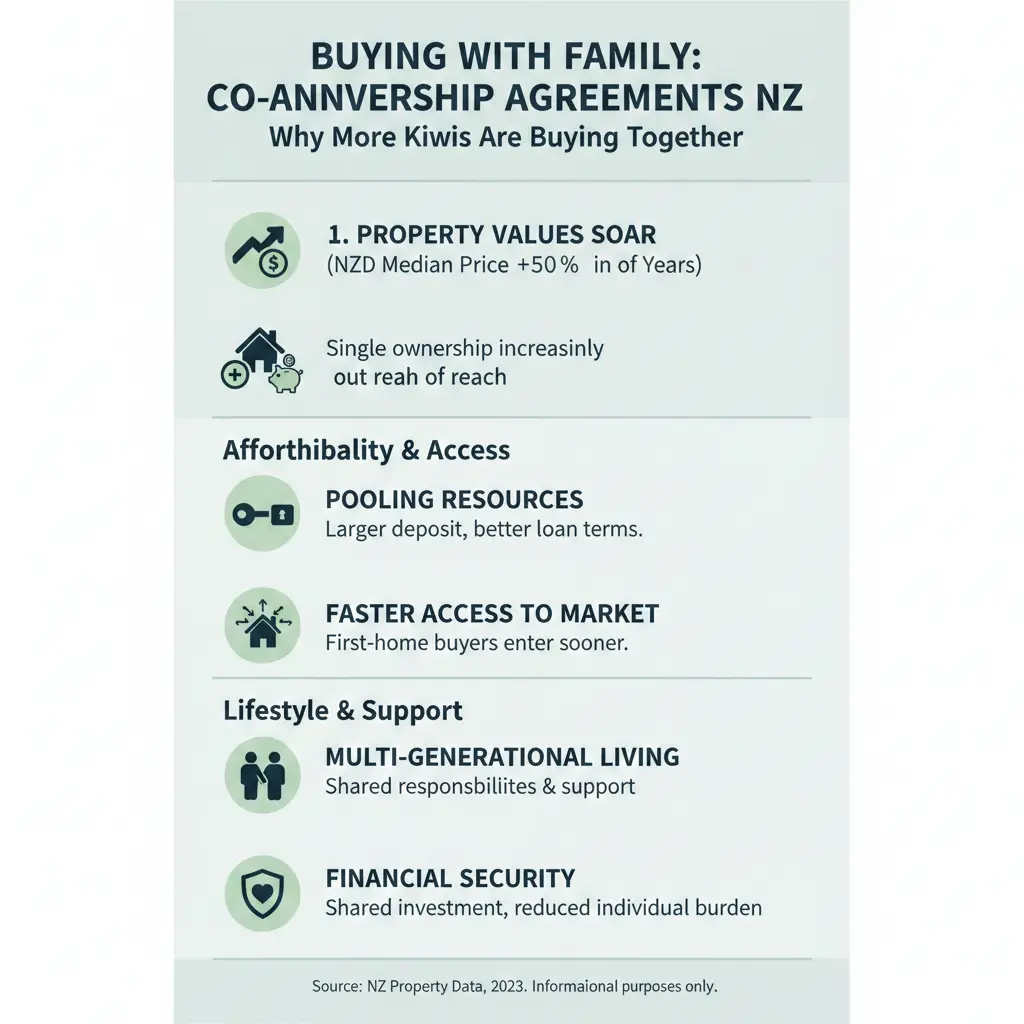
Why More Kiwis Are Buying Together
With house prices and interest rates climbing, it's becoming increasingly common for first home buyers to partner with others to purchase homes. Co-ownership allows you to combine deposits and share mortgage repayments, making it easier to afford a property that would be unattainable individually. For young professionals, extended families, and investors alike, shared property ownership offers a practical solution to New Zealand's challenging property market.
Understanding Co-Ownership Structures
Before you and your family members sign anything, you need to understand the two main legal types of co-ownership under the Property Law Act 2007.
Joint Tenancy
Under a joint tenancy, each co-owner has an equal undivided share in the entire property. This means you each own the whole property together, rather than owning separate portions. Joint tenancy is commonly used when the two parties are a couple, as it offers simplicity and equal rights.
One important feature of joint tenancy is the right of survivorship—if one owner dies, their share automatically passes to the surviving owner(s). This can be beneficial for family arrangements, but it's crucial to understand the implications before committing.
Tenancy in Common
Tenancy in common allows each co-owner to have a separate, defined share in the property. This is more flexible and is almost always preferred for unrelated co-owners, particularly where contributions are unequal and co-ownership is temporary or investment-based. For example, if one family member contributes 60% of the deposit and another contributes 40%, you can record ownership shares that reflect this difference.
With tenancy in common, there's no automatic right of survivorship—each owner's share forms part of their estate and passes according to their will or the laws of intestacy.
Government Co-Ownership Schemes for First Home Buyers
If you're a first home buyer, you might be eligible for schemes that make co-ownership more accessible.
Kainga Ora's First Home Partner Scheme
Kainga Ora offers a co-ownership option where Kainga Ora will purchase the home with you as tenants in common. The goal is that within 15 years, you can purchase Kainga Ora's share for full ownership. This scheme helps reduce the deposit burden upfront while giving you a pathway to sole ownership.
YouOwn's Co-Ownership Scheme
YouOwn provides an alternative by contributing funds to first home buyers, reducing the deposit amount you need to provide to your bank. YouOwn may cover up to 15% of the usually required 20% deposit. Over time, you can purchase YouOwn's share in the property to achieve full ownership.
Essential Elements of a Co-Ownership Agreement
A formal co-ownership agreement isn't legally required, but it's strongly recommended. Verbal agreements can lead to serious disputes, so protect everyone by putting everything in writing.
Your co-ownership agreement should outline:
- Ownership shares — clearly define each co-owner's share in the property, particularly if financial contributions differ
- Structure choice — whether you'll be joint tenants or tenants in common
- Financial obligations — specify each party's responsibility for the deposit, mortgage payments, maintenance, and other costs
- How mortgage payments and other costs will be shared — be explicit about who pays what and when
- The process for selling the property and buying out shares — set out terms for exit, including how the property's value will be determined
- Dispute resolution processes — establish a process to handle conflicts and prevent escalation
- Rules regarding occupation and decision-making — clarify who can live in the property and how major decisions (renovations, tenants, sale timing) will be made
It's also important to consider that co-owners are typically jointly and severally liable for the mortgage, insurance, and compliance with council and building regulations. This means banks hold all co-owners fully responsible for the entire loan—if another party can't pay, you may be required to cover the shortfall.
Special Consideration for Couples
If you're buying with a partner, entering into a contracting out agreement allows you to record separate contributions and, in the event of death or separation, ensure that your contributions remain separate. This is particularly important if one partner brings significantly more capital to the purchase.
The Step-by-Step Process to Co-Ownership
Here's how to set up a co-ownership arrangement properly:
- Agree on the partnership — discuss goals, contributions, and exit plans with your family members. Choose whether you'll be joint tenants or tenants in common.
- Seek legal advice early — your solicitor will draft a co-ownership agreement outlining each party's rights, obligations, and what happens if one wants to exit.
- Get finance pre-approval — most banks will assess all buyers collectively. Ensure all parties have solid credit profiles.
- Search and buy — work with a real estate agent to find a property within your joint budget and ideal location.
- Finalise the agreement — the co-ownership agreement is signed before or at settlement.
Key Risks and How to Mitigate Them
Shared Liability
The risk: Lenders hold all co-owners fully responsible for the entire loan. If one person loses their job or can't pay, the others must cover the shortfall.
The solution: Ensure all parties are financially responsible and have stable incomes. Discuss what happens if someone can't meet their obligations before you buy.
Complex Decision-Making
The risk: Renovations, tenants, and sale timing must be agreed collectively. Disagreements can delay important decisions or damage relationships.
The solution: Set clear rules in your co-ownership agreement about who can make which decisions. For example, you might allow individual owners to make minor maintenance decisions but require unanimous approval for major renovations.
Relationship Strain
The risk: Money and property decisions can place pressure on personal relationships.
The solution: Communicate openly and honestly from the start. A formal agreement removes ambiguity and reduces the chance of misunderstandings escalating into conflict.
Challenging Exits
The risk: A departing co-owner may require refinancing, a buy-out, or sale of the property.
The solution: Your co-ownership agreement should clearly set out the process for exit, including how the property's value will be determined and how the departing owner's share will be handled.
Tax Implications for Co-Owners
The Bright-line test applies to the property itself, so all co-owners follow the same timeline for potential tax obligations. This means if you sell the property within two years of purchase, you may need to pay tax on the gain—regardless of your individual ownership share.
It's worth discussing tax implications with an accountant or tax advisor before you buy, especially if you're planning to sell within a few years or if the property will be an investment rather than your primary residence.
Getting Professional Help
Co-ownership can be straightforward if you get the foundations right. Before you buy, invest in professional advice from:
- A solicitor — to draft your co-ownership agreement and ensure the property title is registered correctly
- A mortgage broker — to tailor the lending arrangement and ensure all co-owners understand their liability
- An accountant or tax advisor — to discuss tax implications and ensure you're aware of obligations like the Bright-line test
These costs upfront will save you thousands in potential disputes, refinancing fees, or legal battles down the track.
Moving Forward with Confidence
Buying a home with family members can be a smart financial move, but it requires clear communication, solid legal documentation, and professional guidance. By choosing the right co-ownership structure, putting a comprehensive agreement in place, and understanding your obligations, you'll protect everyone involved and set yourselves up for a successful shared ownership experience.
Start by having an honest conversation with your family about goals, contributions, and what happens if circumstances change. Then, engage a solicitor to draft a proper co-ownership agreement. It might feel like an extra step, but it's the best investment you can make in your shared property journey.
Frequently Asked Questions
Sources & References
- 1
- 2
-
3
NZ Legal — Ownership Options in New Zealand: A Comprehensive Guide — www.nzlegal.co.nz
- 4
-
5
Harcourts Patras & Co — Shared Ownership Property NZ — www.patrasandco.nz
-
6
Inland Revenue — Bright-line test and co-ownership — www.ird.govt.nz
Related Articles

Industry Bodies and Professional Associations NZ
Whether you're launching a business, advancing your career, or navigating financial regulations, industry bodies and professional associations in New Zealand offer invaluable support. These organisati...

Emergency Benefit NZ: When You Have No Other Options
When you're struggling financially and don't qualify for other benefits, the Emergency Benefit might be your lifeline. It's a discretionary payment designed for Kiwis in genuine hardship who've exhaus...

Unpaid Internships NZ: Are They Legal?
Unpaid internships are a common pathway for students and graduates to gain work experience in New Zealand, but there's often confusion about whether they're actually legal. The short answer is: unpaid...

Estate Administration NZ: Managing Someone's Affairs After Death
Losing a loved one is one of life's toughest challenges, and stepping in to manage their estate can feel overwhelming. In New Zealand, estate administration—the process of handling someone's affairs a...