Disputing an ACC Decision: How to Appeal

Receiving a decision from ACC that doesn't sit right can feel like a punch to the gut—especially when you're already dealing with an injury or loss. Whether it's a declined claim, reduced entitlements...
The Lifetimes NZ editorial team curates, fact-checks, and updates guides on personal finance, property, health, immigration, legal, business, and lifestyle topics relevant to Lifetimes NZ readers. Articles are produced with AI assistance and reviewed by the editorial team before publication.
Receiving a decision from ACC that doesn't sit right can feel like a punch to the gut—especially when you're already dealing with an injury or loss. Whether it's a declined claim, reduced entitlements, or a levy dispute, knowing your rights under New Zealand's no-fault accident compensation scheme is crucial. This guide walks you through every step of disputing an ACC decision, from initial review to court appeals, empowering you to fight for what you're entitled to in 2026.
Understanding ACC Decisions and Your Right to Challenge
ACC, New Zealand's Accident Compensation Corporation, handles claims for personal injuries from accidents, covering medical costs, weekly compensation, and rehabilitation under the Accident Compensation Act 2001. But decisions aren't always perfect—reviewers or case managers might overlook evidence or misapply the law. As a Kiwi, you're protected by law with clear pathways to challenge any decision on your claim or levy invoice.
The process starts internally but escalates to independent reviews and courts if needed. Importantly, you don't need a lawyer at every stage, though representation can strengthen your case. Legal aid may be available for District Court appeals. Time limits are strict, so act fast to avoid losing your rights.
Common Reasons Kiwis Dispute ACC Decisions
- Declined cover for injuries deemed non-accidental or outside scope.
- Disputes over weekly compensation rates or duration.
- Levies incorrectly assessed for self-employed or businesses.
- Treatment or rehabilitation funding refused.
- Sensitive injury claims, like those from sexual abuse, following recent Court of Appeal rulings.
Real-life examples from District Court decisions show successes: late appeals granted due to ACC delays in sending notices, or cover reinstated after reviewers missed key evidence.
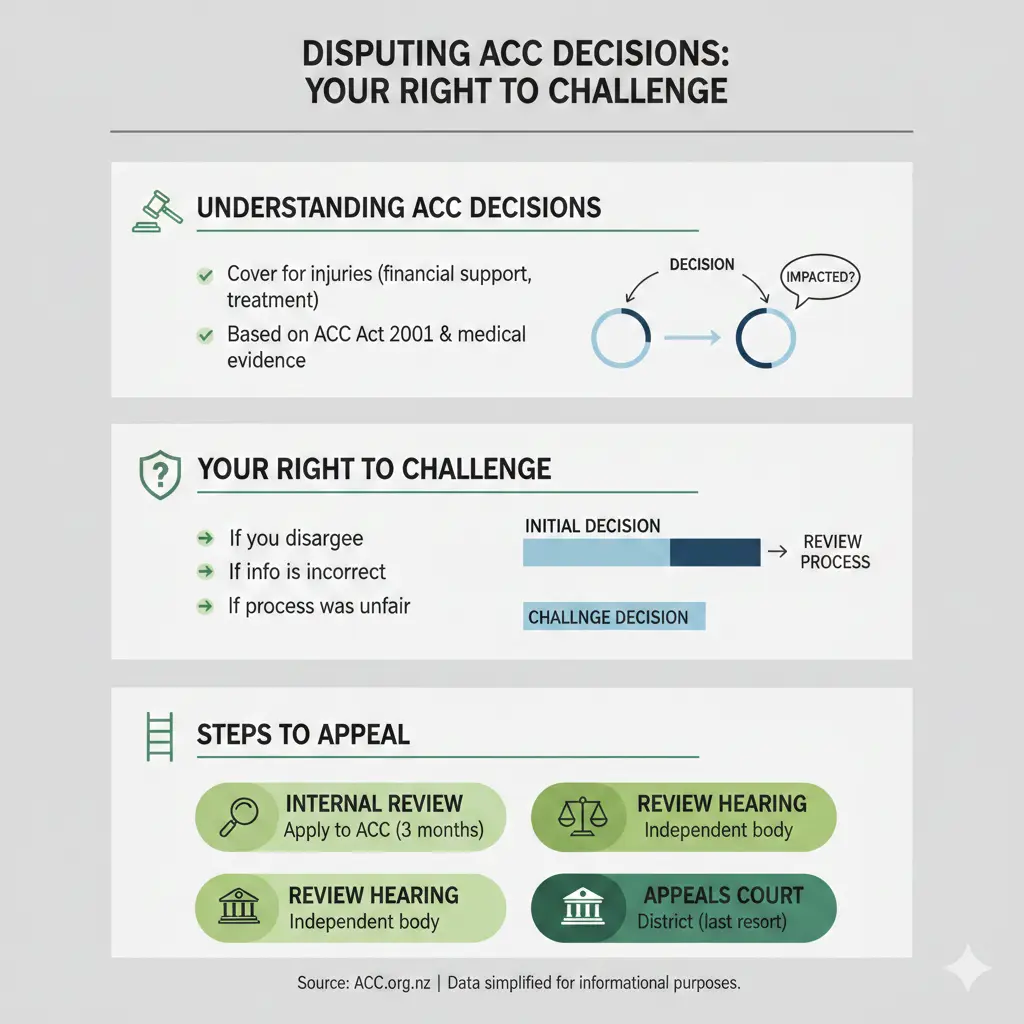
Step 1: Request an Administrative Review (Internal First)
Before going external, ask ACC for an internal administrative review. This is free and informal—contact your case manager or use the online form on acc.co.nz. Provide new evidence or explain why the decision is wrong. ACC must respond, but if unsatisfied, proceed to independent review.
Tip: Document everything. Keep emails, letters, and notes of phone calls. This builds your case for later stages.
Step 2: Apply for an Independent Review
The cornerstone of disputing an ACC decision is the independent review, handled by providers like Fair Way Resolution. You're entitled to this under the Accident Compensation Act 2001—ACC must allocate it to an impartial reviewer outside their organisation.
How to Apply
- Complete the review application form from acc.co.nz or call 0800 222 070. No fee applies.
- Submit within 3 months of ACC's decision notice (extensions possible for good reason).
- Include all evidence: medical reports, witness statements, photos, or expert opinions.
What Happens Next?
ACC forwards your file to the reviewer, who schedules a case conference within weeks. Most hearings are via Zoom, but in-person options exist at eight regional centres. If no hearing date is set within 3 months of your application, the original decision is overturned in your favour— a powerful automatic win.
At the hearing, the reviewer ignores ACC's original decision, examines fresh evidence, and applies the legislation. You'll get a written decision within 28 days, which is binding unless appealed. Reviewers can uphold, vary, or cancel ACC's call.
"An independent reviewer will start by putting ACC’s decision to one side, then they take a fresh look at your claim."
Step 3: Appeal to the District Court
If the review doesn't go your way, appeal to the District Court within 28 days of receiving the review decision. This is a rehearing based on review evidence, though courts can admit new info.
Filing Your Appeal
- Complete the Notice of Appeal form from justice.govt.nz/tribunals.
- File at your local District Court registry—online or in person. Include the review decision and $50 filing fee (waivable for hardship).
- The court checks and sends a copy to ACC, issuing an acknowledgement and timetable.
Late appeals? Possible if you show good reason, like not receiving the decision. Courts have granted extensions for understandable errors.
The Hearing Process
Appear in person or via representative (lawyer not required). Follow court directions or risk dismissal. The judge can dismiss, amend, cancel the review, or order ACC actions like a new review.
Costs: ACC often covers if you win, but losers may pay. Seek free advice from Community Law Centres or ACC specialists.
Real Kiwi Success Stories
In one case, an appeal filed 4 days late was allowed due to inadvertence, letting the claimant proceed. Another saw cover granted post-review for a treatment injury after new evidence.
Higher Court Appeals: When to Escalate
District Court loss? Appeal to the High Court, but only on a question of law (not facts). Apply for leave within 21 days. If granted, file within another 21 days.
From High Court, seek Court of Appeal permission—strict 28-day limit unless extended. These are rare; most disputes resolve earlier. Recent rulings, like ACC v TN (2023), have clarified entitlements for sensitive claims.
| Appeal Level | Time Limit | Grounds | Permission Needed? |
|---|---|---|---|
| District Court | 28 days from review | Rehearing of evidence | No |
| High Court | 21 days for leave | Question of law | Yes (District Court first) |
| Court of Appeal | 28 days from High Court | Question of law | Yes |
Alternatives to Full Appeals: Mediation and Conciliation
Not every dispute needs court. Use mediation for quicker, less formal resolution—often recommended at case conference. Conciliation via Fair Way can settle before review. These save time and stress, with high success rates for Kiwis.
Practical Tips for a Strong Appeal
- Gather evidence early: GP notes, specialist reports, employer letters on lost wages.
- Get free help: Community Law, YouthLaw Aotearoa (under 25s), or ACC lawyers like AC Law.
- Track deadlines religiously—use calendar reminders.
- Prepare submissions: Clearly state facts, law, and why ACC erred.
- Consider costs: Budget for experts; check Legal Aid eligibility.
For levies, same process applies—reviews often overturn IRD-linked errors.
Costs, Legal Aid, and Support for Kiwis
Reviews are free. Court fees are low, but lawyer fees add up—many firms offer no-win-no-fee for ACC. Legal Aid covers District Court if you qualify (low income test via justice.govt.nz). WINZ may assist with living costs during disputes.
Disclaimer: This isn't personalised financial or legal advice. Consult a lawyer or advisor for your situation.
Next Steps: Take Control Today
Don't let a bad ACC decision define your recovery. Start by requesting that independent review—download the form from acc.co.nz now. Gather your evidence, note deadlines, and reach out for free advice. With persistence, many Kiwis turn denials into approvals. If needed, connect with Community Law or a specialist today. Your entitlements matter—fight for them.
Frequently Asked Questions
Sources & References
- 1
-
2
Challenging an ACC decision - Community Law — communitylaw.org.nz
-
3
Appeal to District Court and higher courts - Community Law — communitylaw.org.nz
-
4
What happens next | New Zealand Ministry of Justice — www.justice.govt.nz
-
5
Review ACC's decision | Fair Way Resolution Limited — www.fairwayresolution.com
-
6
Accident Compensation - Decisions | New Zealand Ministry of Justice — www.justice.govt.nz
-
7
Request an independent review - ACC — www.acc.co.nz
-
8
ACC Explained: Why It Exists, Who It Covers, and What to Do If Your Claim is Declined — www.franklinlaw.co.nz
- 9
-
10
ACC Archives - YouthLaw Aotearoa — youthlaw.co.nz
Related Articles

Working Multiple Jobs NZ: Tax and Legal Considerations
Juggling multiple jobs can boost your income, but it's crucial to understand the tax implications and legal requirements that come with working more than one role in Aotearoa. Whether you're a contrac...

Name Changes NZ: Legal Process and Costs
Considering a fresh start with a new name? Whether it's after marriage, divorce, or simply embracing a personal transformation, changing your name in New Zealand is straightforward but requires follow...

Holiday Home Tax Rules NZ: Private Use and Rental
Own a bach in Coromandel or a holiday home in Queenstown? You're not alone—many Kiwis cherish these escapes, but renting them out while enjoying personal use can trip you up on tax rules. Getting the...

Industry Bodies and Professional Associations NZ
Whether you're launching a business, advancing your career, or navigating financial regulations, industry bodies and professional associations in New Zealand offer invaluable support. These organisati...