NZ Driver License Test: What to Expect

Getting your driver's licence in New Zealand is a significant milestone, but the process can feel daunting if you're not sure what to expect. Whether you're a young learner just starting out or someon...
Sarah covers personal finance, tax, and KiwiSaver topics for Lifetimes NZ. She focuses on making money management straightforward and practical for everyday Kiwis.
Getting your driver's licence in New Zealand is a significant milestone, but the process can feel daunting if you're not sure what to expect. Whether you're a young learner just starting out or someone preparing for your full licence test, understanding each stage of our licensing system will help you approach it with confidence. The good news? Major changes are coming to make the journey easier and more affordable, though for now, the current system still applies.
Understanding New Zealand's Three-Stage Licensing System
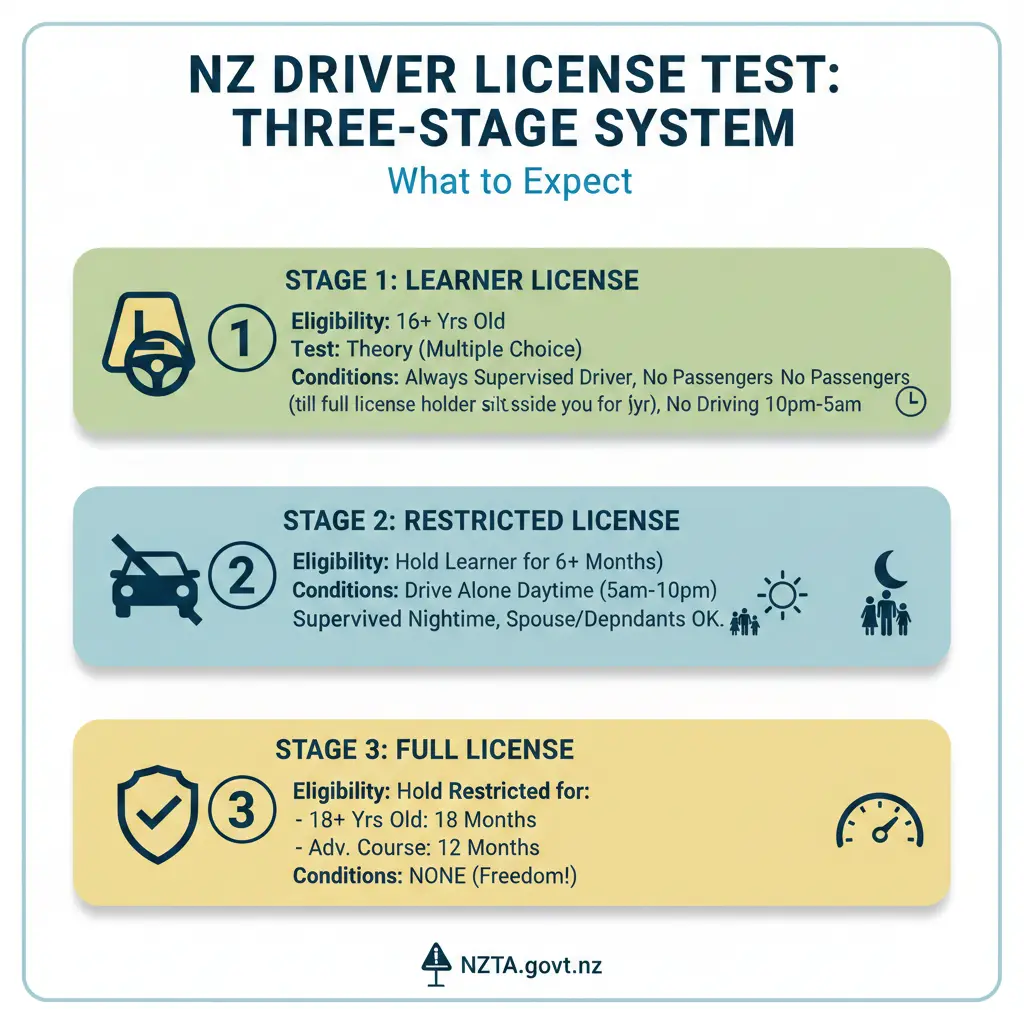
New Zealand's driver licensing system works in three distinct stages: learner, restricted, and full licence. Each stage has specific requirements, time commitments, and tests you'll need to complete before progressing to the next level.
The current system has been in place since 2011, but significant changes are coming on 25 January 2027. Until then, you'll follow the existing process outlined in this article. After that date, the system will be substantially different—we'll cover those changes later.
Stage 1: Your Learner Licence
Getting Started
You can apply for your learner licence from age 16. To get started, you'll need to visit a driver licensing agent (most AA offices and some VTNZ stations) and complete a theory test and eyesight check.
The theory test covers road rules, road signs, and safe driving practices specific to New Zealand. It's designed to ensure you understand the fundamentals before getting behind the wheel.
Learner Period Requirements
Once you've passed your theory test, you'll be on your learner licence for a minimum period. Currently, learners must complete 120 hours of supervised driving practice, with at least 10 hours in night-time conditions. You'll need a supervising driver aged 16 or over with a full licence present at all times.
This is your foundation stage. Use it to build confidence, understand different road conditions, and develop safe driving habits. Many Kiwis find it helpful to work with a professional driving instructor during this phase—they can identify areas for improvement before you move to the next stage.
Stage 2: Your Restricted Licence
Progression Requirements
After completing your learner period, you'll sit a practical driving test to progress to your restricted licence. You must be at least 17 years old (or 17½ if you've completed an advanced driving course) and have held your learner licence for at least six months.
What the Restricted Test Involves
The restricted licence test is a practical on-road assessment lasting around 30–45 minutes. The testing officer will assess your ability to:
- Control the vehicle safely
- Observe road rules and signs
- Demonstrate hazard awareness
- Perform essential manoeuvres (reversing, parking, hill starts)
- Drive in various traffic conditions
You're allowed to make one critical error during the test. A second critical error means you fail. Immediate failure errors—such as hitting another vehicle or failing to stop at a red light—will result in an automatic fail.
Restrictions on Your Licence
Once you have your restricted licence, you'll face several limitations designed to keep new drivers safe:
- You can only carry passengers aged 16–19 if they're immediate family members
- You cannot use mobile phones while driving
- You must display a red "R" plate on your vehicle
- You cannot tow a trailer
You'll need to hold your restricted licence for at least 18 months (or 12 months if you've completed an advanced driving course) before you're eligible to sit your full licence test.
Stage 3: Your Full Licence Test
Eligibility and Preparation
To sit your full licence test, you must be at least 18 years old (or 17½ with an advanced course) and have held your restricted licence for the required time. Before booking, spend considerable time driving in varied weather and traffic conditions.
Many Kiwis find a "tidy-up" lesson with a professional instructor helpful in the weeks before their test. This gives you feedback on any weak areas and boosts your confidence.
What to Expect in the Full Licence Test
The full licence test is more demanding than the restricted test and typically lasts 40–50 minutes. The key difference is hazard perception—you'll be asked to identify and describe potential hazards during your drive.
The testing officer will assess:
- Advanced vehicle control
- Hazard recognition and response
- Decision-making in complex traffic situations
- Defensive driving techniques
- Compliance with road rules
Like the restricted test, you're allowed one critical error. A second critical error results in failure. The standards are stricter than the restricted test—for example, not coming to a complete stop at a Stop sign is an immediate failure (rather than just a critical error).
Booking Your Test
You can book and pay for your full licence test online through the NZTA website, but you'll still need to visit a driver licensing agent to complete your application form before test day. Make sure you bring proof of identity and ensure your vehicle has a current warrant of fitness (WoF), registration, and road user charges (RUC) label if applicable.
The Cost of Getting Your Licence
Getting your full Class 1 (car) licence involves several fees across the three stages. While these vary slightly depending on your provider, you're looking at a total investment of several hundred dollars. The exact breakdown depends on whether you use professional instruction and how many test attempts you need.
The good news is that from 25 January 2027, the total cost will reduce by $80, making it more accessible for young Kiwis.
Major Changes Coming in 2027
The Government has announced significant reforms to the driver licensing system, effective from 25 January 2027. These changes were developed following public consultation with over 4,100 submissions and aim to balance cost, efficiency, and road safety.
Key Changes Ahead
No More Full Licence Test
From 2027, you'll no longer need to sit a second practical test to move from restricted to full licence. This saves time and money while reducing the overall burden on the licensing system. However, you'll still need to demonstrate safe driving behaviour on your restricted licence to progress.
Longer Learner Period for Under 25s
The learner period for drivers under 25 will increase from six months to 12 months. However, you'll have the option to reduce this back to six months by recording supervised driving hours or completing an approved practical course.
Extended Restricted Period
The restricted period will be 12 months for under 25s and six months for over 25s. If you receive demerit points while restricted, you'll face an additional six months on your restricted licence.
Hazard Perception Moves Earlier
The hazard perception component of the current full licence test will be moved to the restricted licence test, ensuring you develop these critical skills earlier in your driving journey.
Expanded Zero-Alcohol Rule
All learner and restricted drivers, regardless of age, will be subject to a zero-alcohol limit.
Fewer Eyesight Checks
Eyesight screenings will only be required at your first licence application and at each renewal.
Tips for Success at Each Stage
Learner Stage
- Log your 120 hours diligently—keep a record to track progress
- Practise in varied conditions: wet weather, night driving, busy traffic
- Consider professional instruction from a NZTA-approved provider
- Study road rules thoroughly—the theory test requires solid knowledge
- Build a relationship with your supervising driver; consistency helps
Restricted Stage
- Don't rush to your test—the time requirement exists for good reason
- Practise hazard spotting actively during every drive
- Book a professional lesson before your full licence test
- Maintain a clean demerit record—points will extend your restricted period
- Drive defensively and anticipate other road users' actions
Full Licence Stage
- Focus on hazard perception in the weeks before your test
- Get comfortable with motorway driving if you haven't already
- Practise in challenging conditions: heavy rain, peak-hour traffic
- Ensure your vehicle is well-maintained and roadworthy
- Arrive early and stay calm—nerves are normal but manageable
Getting Ready for Your Journey
Getting your New Zealand driver's licence is an achievable goal with the right preparation and mindset. Whether you're just starting your learner period or preparing for your full licence test, focus on building genuine skills rather than just passing the test. Safe driving habits developed now will serve you for life.
Start by visiting the NZTA website to access study materials, find a driver licensing agent near you, and book your tests. If you're preparing for the 2027 system changes, keep an eye on the NZTA website for updated information on approved practical courses and supervised driving hour requirements.
Remember, every Kiwi on the road started exactly where you are now. Take your time, practise consistently, and approach each stage with focus and determination. Your full licence is within reach.
Frequently Asked Questions
Sources & References
-
1
Changes to the driver licensing system announced — Beehive.govt.nz — www.beehive.govt.nz
-
2
Driver licence test changes confirmed — NZ Herald — www.nzherald.co.nz
-
3
Preparing for and booking the full licence test — Drive.govt.nz — drive.govt.nz
-
4
Moving to the new car licence system — NZTA — nzta.govt.nz
-
5
New Zealand Driving Licence Rules Change — IJ Services — ijservices.co.nz
-
6
New Zealand Driving Licence Rules Change — Korako Speckle Park — korakospecklepark.co.nz
Related Articles

Industry Bodies and Professional Associations NZ
Whether you're launching a business, advancing your career, or navigating financial regulations, industry bodies and professional associations in New Zealand offer invaluable support. These organisati...

Emergency Benefit NZ: When You Have No Other Options
When you're struggling financially and don't qualify for other benefits, the Emergency Benefit might be your lifeline. It's a discretionary payment designed for Kiwis in genuine hardship who've exhaus...

Unpaid Internships NZ: Are They Legal?
Unpaid internships are a common pathway for students and graduates to gain work experience in New Zealand, but there's often confusion about whether they're actually legal. The short answer is: unpaid...

Estate Administration NZ: Managing Someone's Affairs After Death
Losing a loved one is one of life's toughest challenges, and stepping in to manage their estate can feel overwhelming. In New Zealand, estate administration—the process of handling someone's affairs a...