Primary School Guide NZ: Choosing the Right School
Choosing the right primary school in New Zealand can feel overwhelming, but it's one of the most important decisions you'll make for your child's future. With thousands of options across the country,...
The Lifetimes NZ editorial team curates, fact-checks, and updates guides on personal finance, property, health, immigration, legal, business, and lifestyle topics relevant to Lifetimes NZ readers. Articles are produced with AI assistance and reviewed by the editorial team before publication.
Choosing the right primary school in New Zealand can feel overwhelming, but it's one of the most important decisions you'll make for your child's future. With thousands of options across the country, from bustling city state schools to boutique private institutions, this guide equips Kiwi parents with practical steps, key factors, and 2026 updates to find the perfect fit for your tamariki.
Understanding Primary School in New Zealand
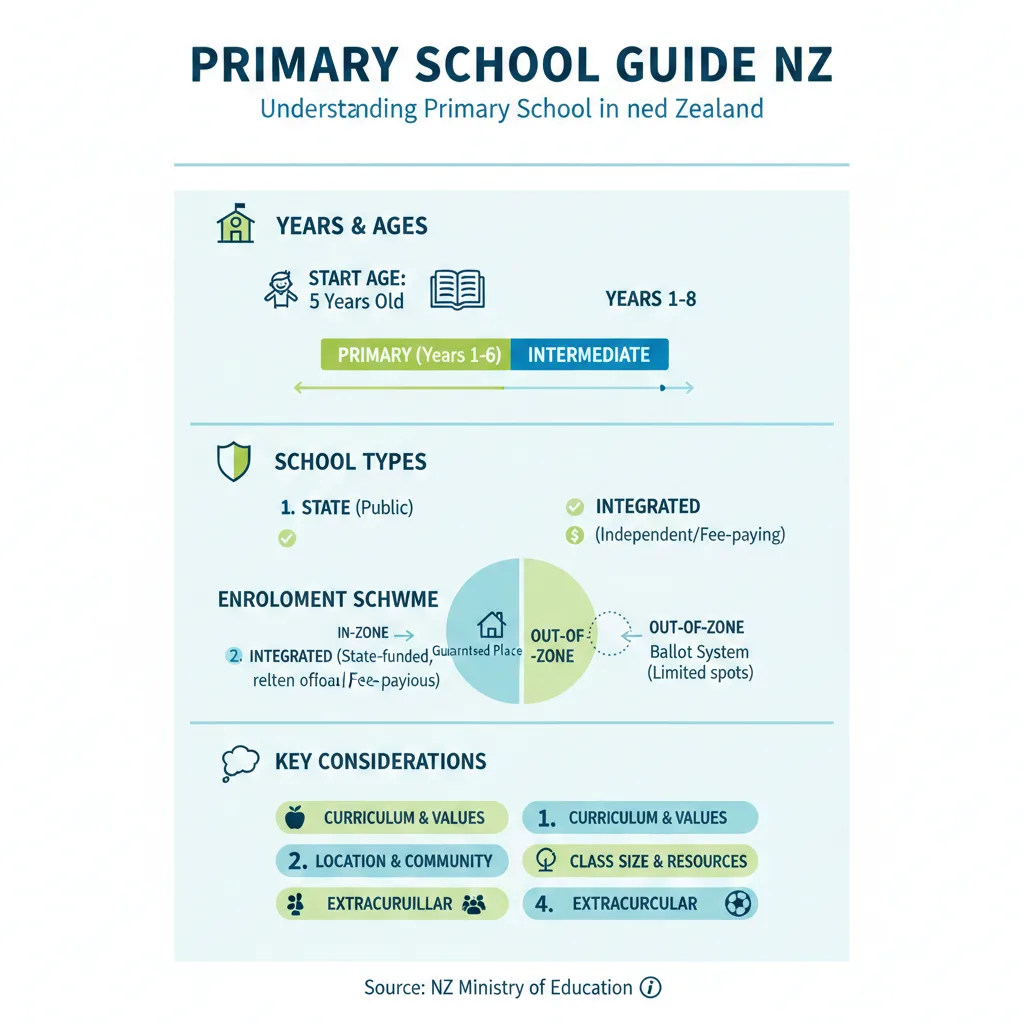
Primary school in Aotearoa covers Years 1 to 6 (ages 5 to 10), though many kids start earlier in Year 0 or kura programmes.Education is compulsory from your child's 6th birthday, but most begin at 5, with flexible enrolment dates. All schools follow the New Zealand Curriculum, a flexible framework that emphasises key competencies like thinking, relating to others, and using language, symbols, and texts.
Schools have autonomy to tailor their delivery, so programmes vary widely. Core learning areas include English, Mathematics and Statistics, Science, Social Sciences, Technology, The Arts, Health and Physical Education, and Languages. From 2026, updated curriculum content for Years 0-10 in English, Te Reo Rangatira, Mathematics, and Pāngarau becomes mandatory, ensuring alignment with Te Mātaiaho, the refreshed curriculum.
Types of Primary Schools
- State schools: Free, funded by the Ministry of Education, open to all. Most common choice for Kiwi families.
- State-integrated schools: Faith-based or special character, with compulsory donations (around $300-$1,000/year).
- Private/independent schools: Fee-paying, often with smaller classes and extras like specialist teachers.
- Kura Kaupapa Māori: Immersion in te reo Māori, focusing on tikanga Māori.
Check the Education Counts Find a School tool for options near you.
Key Factors to Consider When Choosing a Primary School
Every child is unique, so prioritise what matters most for yours—academic rigour, community vibe, or cultural fit. Here's how to evaluate.
Academic Performance and Curriculum
Review school reports on the Education Review Office (ERO) website for insights into teaching quality and student achievement.ERO reports highlight strengths in literacy and numeracy, crucial foundations. Look for evidence-based programmes like structured literacy (e.g., iDeaL) and systematic maths (e.g., PR1ME), aligned with international best practices.
Ask about 2026 updates: Schools must implement refreshed content for English and maths, with tools like Maths—No Problem! adapted for Te Mātaiaho. Progress is tracked flexibly across eight curriculum levels, not strictly by year—your Year 3 tamariki might work at Level 2 or 4.
Location, Zone, and Enrolment
Most state schools have a home zone—live in it for priority enrolment. Out-of-zone applications depend on ballots if oversubscribed. Factor in travel time; kids under 11 shouldn't walk more than 1.6km alone in urban areas or 3.2km rural.Proximity reduces stress and boosts attendance.
Visit during peak hours to gauge traffic and playground buzz.
Class Sizes and Teacher Quality
Average class size is 25-28 students, but smaller in Years 1-2 (max 23 in 2026 under current entitlements).Learning Support Coordinators (LSCs) are now standard in many schools, aiding Years 0-1 referrals to Early Intervention Services. Chat with principals about teacher-student ratios and professional development.
Wellbeing, Culture, and Extracurriculars
Look for strong hauora (wellbeing) programmes, including sun safety—compulsory hats and sunblock in Terms 1 and 4. Schools like Marsden emphasise Te Reo Māori, French, music, and PE weekly, plus co-curriculars. Healthy School Lunches roll out to more primaries in Term 1 2026, providing nutritious kai at lower cost.
Decile ratings (1-10, based on socio-economic factors) were phased out in 2015; focus on equity funding instead.
Facilities and Community
Modern schools offer science labs, gyms, and EOTC (Education Outside the Classroom) trips. Attend open days to feel the whānau vibe—strong parent communities often mean better support.
Steps to Choose and Enrol in a Primary School
- Research online: Use Education Counts, ERO reports, and school websites. Note 2026 term dates—Term 1 starts 27 January.
- Visit schools: Book tours, observe classes, meet teachers. Ask about homework policies (light in early years) and reporting—e.g., learning journals with feedback.
- Talk to parents: Join local Facebook groups or school gate chats for honest insights.
- Check enrolment: Submit applications by deadlines (often Term 4 prior). Include birth certificate, address proof.
- Prepare your child: Practice routines like named lunch boxes, drink bottles, and uniforms.
New Zealand-Specific Resources and 2026 Updates
The Ministry's Parent Portal offers year-by-year guides for Years 0-8, with home support ideas. From Term 1 2026, expect easier EIS referrals for early learners and Healthy Lunches expansion. Attendance rules tighten, with new closing settings.
For Māori-medium options, explore local kura via Te Kura Māori resources.
Practical Tips for Kiwi Parents
- Label everything—lost property piles grow fast!
- Pack healthy kai: Named lunch boxes with no glass bottles.
- Stay connected via school apps or newsletters.
- Support at home: Read daily, play maths games aligned to the curriculum.
- Monitor progress: Expect six-week updates in new schools.
FAQ
When does my child have to start school?
Compulsory from age 6, but enrol at 5. Flexible start dates within Term 1.
How do I know if a school is good?
Check ERO reports, curriculum alignment (especially 2026 updates), and parent feedback. Focus on wellbeing and progress tracking.
What are 2026 curriculum changes?
Updated English, maths, and te reo content mandatory from Term 1, plus EIS referrals and lunches.
Are uniforms compulsory?
Yes in most schools; check requirements like sun hats.
How much homework in primary?
Minimal early on—focus on reading and play-based learning.
What if my child needs extra support?
New LSCs and EIS referrals help from Year 0.
Next Steps for Your Family
Start today: Shortlist three schools, book visits, and review ERO reports. Enrol early to avoid ballots, and chat with your network for tips. With the right choice, your child's primary years will spark a love of learning that lasts a lifetime. You've got this, Kiwi whānau—ka pai!
Related Articles

Screen Time Guidelines for Kiwi Kids
Ever caught your little one glued to a tablet, eyes wide and fingers flying? In Aotearoa, where Kiwi kids spend more screen time than most—up to 42 hours a week for teens—it's time to hit pause and re...

School Zones NZ: How They Work and Why They Matter
Choosing the right school for your tamariki can feel like navigating a map of coloured zones—literally. In Aotearoa, **school zones NZ** dictate where your child is guaranteed a spot, helping prevent...

Best Playgrounds in Christchurch: Family Guide
Christchurch has some of the best family playgrounds in Aotearoa, offering everything from award-winning attractions to hidden gems perfect for a weekend adventure. Whether you're looking for thrillin...

Kids Sports NZ: Costs and Options by Age
Getting your kids active in sports is one of the best gifts you can give them as a Kiwi parent—building fitness, teamwork, and lifelong habits. But with rising costs biting into household budgets, und...