The "No-Spend" Month: How One Kiwi Saved $2;000 in 30 Days

Imagine looking at your bank account at the end of the month and seeing an extra $2,000 staring back at you—all because you said "no" to impulse buys, takeaways, and those sneaky coffee runs. That's e...
The Lifetimes NZ editorial team curates, fact-checks, and updates guides on personal finance, property, health, immigration, legal, business, and lifestyle topics relevant to Lifetimes NZ readers. Articles are produced with AI assistance and reviewed by the editorial team before publication.
Imagine looking at your bank account at the end of the month and seeing an extra $2,000 staring back at you—all because you said "no" to impulse buys, takeaways, and those sneaky coffee runs. That's exactly what happened to Sarah, a 32-year-old teacher from Auckland, when she tackled a no-spend month. In just 30 days, she transformed her spending habits, ditched non-essentials, and boosted her savings without feeling deprived. If you're a Kiwi feeling the pinch from rising living costs, this challenge could be your ticket to financial freedom.
Sarah's story isn't unique. With New Zealand's cost of living up 4.7% in 2025 according to Stats NZ, many of us are hunting for ways to stretch our dollars further. A no-spend month—where you ban all non-essential spending for 30 days—helps reset your habits, uncover hidden leaks in your budget, and build a healthier relationship with money. In this guide, we'll break down how Sarah saved $2,000, share practical tips tailored for Kiwi life, and give you a step-by-step plan to try it yourself in 2026.
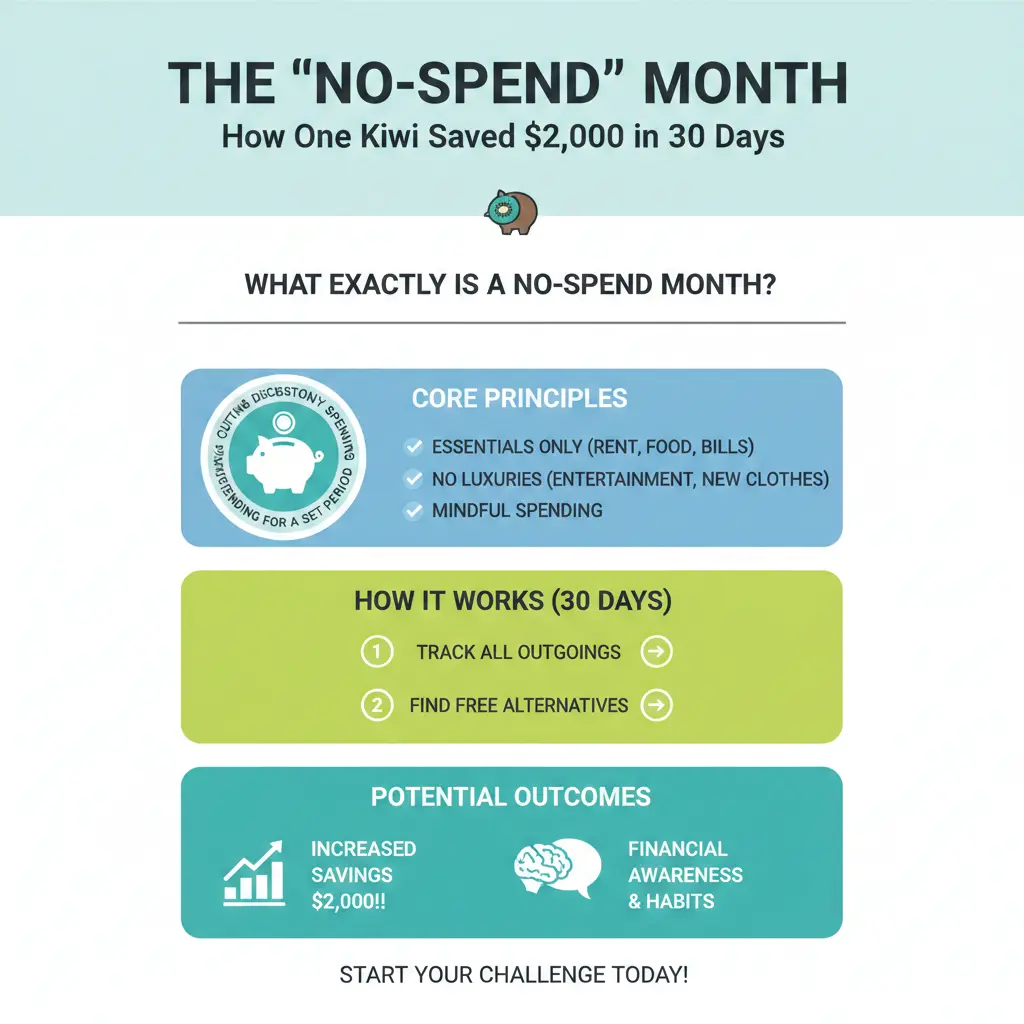
What Exactly is a No-Spend Month?
A no-spend month is a deliberate challenge to avoid buying anything that's not absolutely essential for a set period, typically 30 days. It's not about starving yourself or skipping bills—think of it as a spending detox. Essentials like rent, power bills, groceries, petrol for work, and medications stay on the table. But that shiny new gadget, weekend brunch, or impulse supermarket treats? They're off-limits.
For Kiwis, this means navigating our unique expenses: no extra trips to the New World checkout for magazines, no Uber Eats on busy nights, and definitely no popping into Briscoes for "bargains." Sarah focused on her big leaks—weekly cafe coffees ($15 each) and online clothes shopping—which added up to $800 a month alone. By month-end, she'd saved $2,000, enough for three months' KiwiSaver boost or an emergency fund top-up.
Why It Works for New Zealanders
- Combats inflation: With food prices rising 5.2% last year, skipping non-essentials frees up cash fast.
- Builds discipline: Prepares you for IRD tax time or unexpected ACC claims without stress.
- Reveals habits: Many Kiwis overspend on subscriptions—Sarah cancelled Netflix and Spotify, saving $50/month.
Sarah's Story: From Impulse Buyer to $2,000 Saver
Sarah, juggling teaching in South Auckland and family life, was spending $3,500 monthly on necessities but leaking another $2,200 on "wants." Tracking via her bank's app revealed the culprits: $600 on takeaways, $400 on clothing, $300 on beauty, and $900 scattered on coffees, gifts, and hobbies. "I was shocked," she says. "One no-spend month changed everything."
She started January 1, 2026, with a freezer stocked from Countdown specials and a pantry audit. By day 30, her ASB account showed $2,000 more. That cash went straight into KiwiSaver, growing at 5.5% projected returns for 2026. Her tip? "Treat it like a game—track daily wins in a journal."
"The first week was tough, but by week two, I felt empowered. No more guilt over statements." — Sarah, Auckland teacher
Step-by-Step Guide: How to Do Your Own No-Spend Month
Ready to save like Sarah? Follow these six Kiwi-proof steps, adapted for 2026 living costs.
Step 1: Set Your Rules and Exceptions
Define "essential" clearly. Sarah's rules:
- Yes: Mortgage ($2,200), groceries ($600), petrol ($200), WINZ payments if applicable.
- No: Takeaways, clothing, entertainment, gifts (switch to cards).
- Wiggle room: $50 emergency fund for true surprises, like car rego.
Check your IRD myIR app for fixed costs first. Pro tip: Use a printable tracker from Etsy NZ shops for $2-5 to log daily.
Step 2: Audit Your Budget and Cancel Subscriptions
Review three months' bank statements. Kiwis waste $1,200/year on unused subs like gym memberships or streaming, per Consumer NZ. Sarah axed three, saving $150 instantly.
- Log into internet banking (ASB, BNZ, etc.).
- List all auto-payments.
- Cancel via apps—Spark, Lightbox, etc.
Step 3: Meal Plan and Stock Up Smart
Groceries are 30% of Kiwi budgets. Sarah batch-cooked from Pantry staples: mince casseroles, vege soups. Shop once weekly at Pak'nSave for specials—saved $200 vs. daily shops.
- Apps: My Food Bag basics or New World app coupons.
- Freezer meals: 7-day plan under $100/person.
Step 4: Find Free Entertainment
Ditch paid outings. Sarah hosted potlucks (BYO food), used Wellington Libraries' free ebooks, and hiked free DOC tracks. Socialise with "no-spend dates"—picnics at Cornwall Park.
Step 5: Tackle Temptations
Delete shopping apps. Use "30-day rule": Want it? Wait 30 days. Sarah sold old clothes on Trade Me first—"one in, one out funded by sales."
Step 6: Track and Celebrate Wins
Daily check-ins via Google Sheets or Etsy no-spend printables. End with a non-spend reward: home spa night. Transfer savings to high-interest account (4.5% at Kiwibank 2026 rates).
Real Kiwi Challenges and How to Overcome Them
Winter power bills spike? Prepay via Genesis app. Kids' birthdays? Homemade cakes, card gifts. Sarah's family joined in, making it a team effort.
| Common Kiwi Hurdle | Solution |
|---|---|
| Cafe culture addiction | Brew at home—$5/day saving = $150/month. |
| Weekend sports/events | Free community games or radio streams. |
| Unexpected costs (e.g., vet bills) | Use saved wiggle room or WINZ hardship grant. |
Next Steps: Start Your No-Spend Challenge Today
Grab a notebook, audit your spends, and commit to February 2026. Download a free budget template from MoneyHub or buy a $3 printable. In 30 days, you could have $2,000 extra—like Sarah—for debt paydown, holidays, or retirement. Track progress, share wins with mates, and watch your financial stress melt away. You've got this, Kiwi—time to save big.
Frequently Asked Questions
Sources & References
-
1
How to Save Money in 2026 With a No-Spend Challenge — www.thepennyhoarder.com
-
2
How to prep for a no spend year 2026 #nospendchallenge — www.youtube.com
-
3
2025/2026 No Spend Challenge Printable Planner — www.etsy.com
-
4
No Spend Challenge - Etsy New Zealand — www.etsy.com
-
5
Consumer NZ Subscriptions Report — www.consumer.org.nz
-
6
Kiwibank Notice Saver Rates 2026 — www.kiwibank.co.nz
Related Articles

How to Calculate Your Take-Home Pay with the NZ Salary Calculator
Ever wondered why your bank account doesn't match that shiny new job offer? You're not alone—many Kiwis scratch their heads over the gap between gross salary and actual take-home pay. With New Zealand...

Budgeting for Beginners: The "50/30/20 Rule" Adjusted for NZ Salaries
Struggling to make your Kiwi paycheck stretch further? You're not alone—many of us feel the pinch from rising rents, grocery bills, and that tempting flat white habit. But what if a simple rule could...

How to Travel the World on a NZ Salary
Ever dreamed of sipping cocktails on a Thai beach or exploring the ancient ruins of Machu Picchu, all while earning a solid Kiwi wage? With New Zealand's average monthly salary hitting 5,666 NZD in 20...
The Hidden Costs of Credit Cards: How to Escape the NZ Debt Trap
Ever swiped your credit card for a quick coffee or online shop, only to watch the balance creep up month after month? You're not alone—many Kiwis are caught in a subtle debt trap fuelled by credit car...