NCEA vs Cambridge vs IB: Choosing for Your Child

As Kiwi parents, you're likely weighing up the best secondary school qualifications for your child's future—whether it's uni in Auckland, Wellington, or even overseas. With NCEA under the spotlight an...
Sarah covers personal finance, tax, and KiwiSaver topics for Lifetimes NZ. She focuses on making money management straightforward and practical for everyday Kiwis.
As Kiwi parents, you're likely weighing up the best secondary school qualifications for your child's future—whether it's uni in Auckland, Wellington, or even overseas. With NCEA under the spotlight and changes afoot in 2026, comparing it to Cambridge and IB has never been more relevant. This guide breaks down NCEA vs Cambridge vs IB to help you choose wisely for your tamariki.
Understanding New Zealand's Education Landscape in 2026
New Zealand's secondary education system offers choices beyond the standard NCEA, especially as reforms reshape qualifications. NCEA remains the most common pathway, but international options like Cambridge International and the International Baccalaureate (IB) are gaining traction in schools across Auckland, Christchurch, and beyond. These alternatives appeal to families eyeing global opportunities or seeking structured rigour.
In 2026, the Ministry of Education continues refining NCEA amid critiques of its credit-based model, prompting more schools to offer Cambridge and IB alongside or instead. All three are recognised by New Zealand universities via the New Zealand Qualifications Authority (NZQA), but they differ in structure, assessment, and university fit.
What is NCEA?
NCEA (National Certificate of Educational Achievement) is New Zealand's national qualification, offered at Levels 1, 2, and 3 in Years 11–13. Students earn credits through a mix of internal assessments (spread throughout the year) and external exams, aiming for 80 credits per level plus literacy and numeracy requirements.
It's flexible, allowing breadth across subjects like te reo Māori, trades, or sciences, which suits diverse career paths—from KiwiSaver-backed apprenticeships to university degrees. However, some parents note less depth per subject and variability in grading.
What is Cambridge International?
Cambridge, from Cambridge Assessment International Education (CAIE), provides a pathway from IGCSE (Year 11 equivalent) to AS and A Levels (Years 12–13). It's exam-heavy, with linear assessments at course end, focusing on in-depth mastery of 4–6 subjects.
Offered in over 160 countries, it's popular in NZ schools like ACG Strathallan and Parnell for its global recognition—valued by Oxbridge, Ivy League, and local unis like Otago and Canterbury. In 2026, Pearson Edexcel A Levels complement it, offering modular flexibility.
What is the IB Diploma?
The IB Diploma Programme (Years 12–13) requires six subjects: three at Higher Level (HL), three at Standard Level (SL), plus core components like Theory of Knowledge (TOK), Extended Essay, and Creativity, Activity, Service (CAS). Scored out of 45 points, it's holistic and breadth-focused.
While less common in NZ than NCEA or Cambridge, IB schools emphasise critical thinking and international-mindedness, with strong entry to unis worldwide, including NZ's.
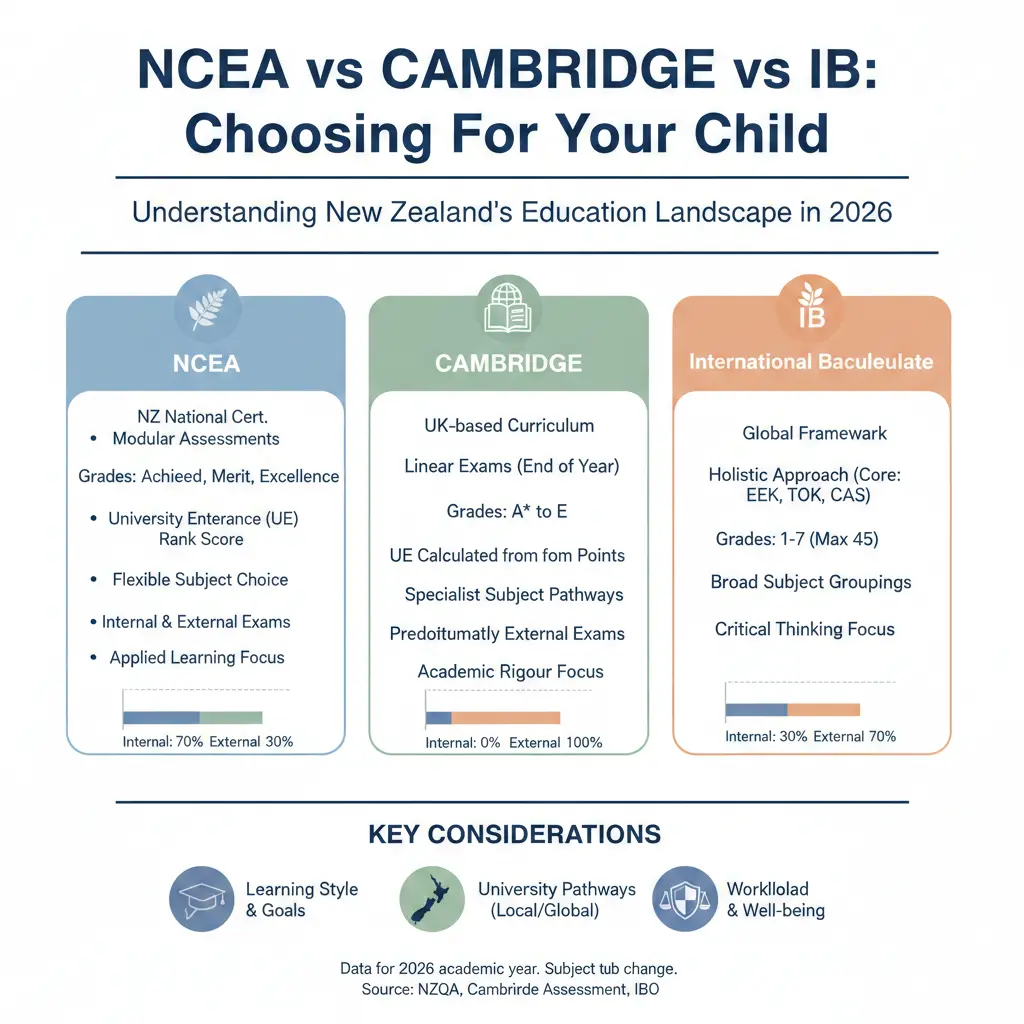
NCEA vs Cambridge vs IB: Key Differences
Choosing starts with comparing core features. Here's a breakdown tailored to Kiwi families.
Assessment Styles
- NCEA: 50–70% internal (coursework, projects), external exams spaced out. Reduces exam pressure but can lead to credit accumulation mindset.
- Cambridge: Mostly external end-of-year exams (linear for Cambridge A Levels, modular for Pearson). Builds exam stamina for competitive entry.
- IB: Mix of internal (orals, essays) and external exams, plus rigorous core. Balanced but demanding.
Subject Depth and Breadth
| Feature | NCEA | Cambridge | IB |
|---|---|---|---|
| Subjects | Broad (20+ standards), flexible electives | 4–6 in depth (fewer but specialised) | 6 balanced (3 HL, 3 SL) |
| Focus | Breadth, credits | Depth, mastery | Breadth + skills (TOK, CAS) |
Grading and Recognition
NCEA uses Not Achieved (N), Achieved (A), Merit (M), Excellence (E) on standards; overall endorsement at levels. Cambridge: A*–E grades; IB: 1–7 per subject, total /45. All equate to University Entrance (UE) via NZQA, but Cambridge and IB often shine for international apps—e.g., Medicine at Auckland requires high IB/Cambridge scores.
NZ unis like Victoria and Massey accept all equally, but global employers value Cambridge/IB's benchmarking.
Costs and Accessibility in NZ
NCEA is free at state schools (fees ~$100–300/year for materials). Cambridge/IB often at private or integrated schools (e.g., ACG network, King's College), with fees $15,000–$25,000/year in 2026. Scholarships via Ministry of Education or school aid help; homeschool/online options like Crimson Global Academy offer Cambridge affordably (~$10,000/year).
Check school zones via Education Counts or contact NZQA for equivalence.
"Cambridge offers a structured academic journey... instantly recognised by top universities." — Nathan Villars, Principal, ACG Sunderland
Pros and Cons for Kiwi Families
NCEA Pros and Cons
- Pros: Flexible for vocational paths (e.g., WINZ apprenticeships), low stress with internals, aligns with NZ jobs market.
- Cons: Perceived shallower depth, grade variability; 2026 reforms aim to fix but uncertainty lingers.
Cambridge Pros and Cons
- Pros: Global prestige, depth for STEM/uni prep, clear grading. Ideal for overseas study or competitive NZ courses.
- Cons: High exam pressure, fewer subjects limit breadth, higher costs.
IB Pros and Cons
- Pros: Well-rounded (skills beyond academics), fosters thinkers for global roles.
- Cons: Intense workload, less flexibility, limited NZ schools (e.g., Auckland International College).
Financial Considerations: Is It Worth the Investment?
Private Cambridge/IB fees impact family budgets—factor in KiwiSaver contributions or student allowances via StudyLink for Year 13. Long-term, these quals boost earning potential: IB/Cambridge grads earn 10–20% more overseas, per global data, aiding IRD-taxed salaries back home.
Actionable tip: Use the IRD child rebate and school payment plans. Seek free advice from NZQA on costs vs benefits. Disclaimer: This isn't personalised financial advice; consult a licensed adviser for your situation.
How to Choose the Right Qualification for Your Child
Assess your child's learning style, career goals, and mobility. Practical steps:
- Year 9–10: Trial via school options; NCEA Level 1 suits most.
- Interests: Depth-seeker? Cambridge. Balanced? IB. Flexible? NCEA.
- Uni plans: Check entry reqs on university sites (e.g., 14+ IB credits for Auckland Med).
- Visit schools: ACG, IB World Schools; online like CGA for flexibility.
- Transition: Cambridge/IB students can sit NCEA Scholarship for top NZ competition.
For expat-returning families or international jobs, Cambridge/IB edge out.
Real Kiwi Stories and School Examples
At ACG Strathallan (Tauranga), Cambridge students thrive with deep learning, per Principal Danny O’Connor. IB at Macleans College (Auckland) suits holistic developers. NCEA shines at state schools like Pakuranga High for practical paths.
Next Steps for Your Family
Chat with your child's school counsellor, attend open days, and review NZQA's qualification comparator tool. Whichever path—NCEA's flexibility, Cambridge's depth, or IB's balance—align it to dreams, from local trades to global careers. Your informed choice sets them up for success.
Frequently Asked Questions
Sources & References
-
1
NCEA Changes in NZ: Why the Cambridge International Curriculum and Pearson A Levels Offer World-Class Alternatives — www.crimsonglobalacademy.school
-
2
What's Next for NZ Education? Cambridge vs NCEA - 10 Key Differences Parents Need to Know — www.strathallan.acgedu.com
-
3
Cambridge vs. IB vs. NCEA Qualifications - YouTube — www.youtube.com
-
4
New Zealand's NCEA vs Other High School Qualifications — www.pakuranga.school.nz
-
5
NCEA under scrutiny: Schools turn to Cambridge, IB options — www.nzherald.co.nz
- 6
Related Articles

Industry Bodies and Professional Associations NZ
Whether you're launching a business, advancing your career, or navigating financial regulations, industry bodies and professional associations in New Zealand offer invaluable support. These organisati...

Emergency Benefit NZ: When You Have No Other Options
When you're struggling financially and don't qualify for other benefits, the Emergency Benefit might be your lifeline. It's a discretionary payment designed for Kiwis in genuine hardship who've exhaus...

Unpaid Internships NZ: Are They Legal?
Unpaid internships are a common pathway for students and graduates to gain work experience in New Zealand, but there's often confusion about whether they're actually legal. The short answer is: unpaid...

Estate Administration NZ: Managing Someone's Affairs After Death
Losing a loved one is one of life's toughest challenges, and stepping in to manage their estate can feel overwhelming. In New Zealand, estate administration—the process of handling someone's affairs a...