Special Needs Grants: One-Off Help from WINZ

Imagine you're a Kiwi family staring down an unexpected bill for urgent dental work or a fridge breakdown right when food's running low. That's where Special Needs Grants from WINZ step in as a vital...
The Lifetimes NZ editorial team curates, fact-checks, and updates guides on personal finance, property, health, immigration, legal, business, and lifestyle topics relevant to Lifetimes NZ readers. Articles are produced with AI assistance and reviewed by the editorial team before publication.
Imagine you're a Kiwi family staring down an unexpected bill for urgent dental work or a fridge breakdown right when food's running low. That's where Special Needs Grants from WINZ step in as a vital one-off lifeline, helping cover essential or emergency costs when you've got nowhere else to turn.
These grants aren't ongoing benefits but targeted payments designed to bridge immediate gaps, ensuring you can meet basic needs without spiralling into debt. In 2026, with living costs rising, understanding how to access this help is crucial for eligible Kiwis facing tough spots. We'll break down eligibility, what you can get, how to apply, and tips to boost your chances—all tailored to New Zealand's current rules.
What Are Special Needs Grants?
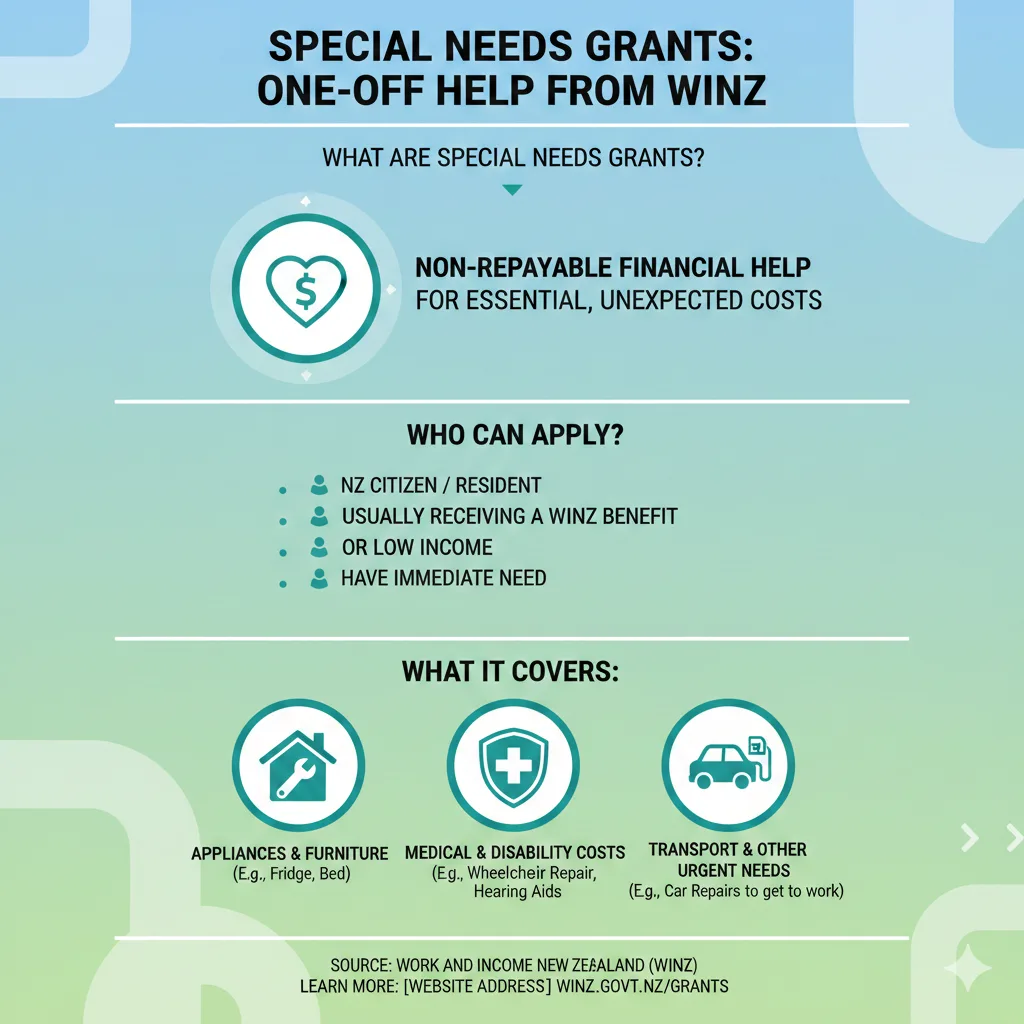
Special Needs Grants (SNGs) are one-off payments from Work and Income (WINZ) to help with immediate, essential, or emergency costs you can't cover otherwise. They're not loans—you don't repay them—and they're available if you're on a benefit or meet strict income and asset tests, even if you're not.
Unlike regular benefits like Jobseeker Support, SNGs target specific, short-term crises. For example, they can fund food when your cupboard's bare after an unexpected expense, or ambulance fees in a health scare. In 2026, WINZ processes these quickly for 'immediate' needs, often same-day if you apply in person.
Key Features in 2026
- One-off nature: Generally once per need, but exceptions apply (e.g., multiple food grants over six months).
- No repayment: Free money if approved, but you must prove no other resources.
- Fast processing: Urgent cases prioritised—call 0800 599 009 for phone applications.
Who Qualifies for Special Needs Grants?
To get a Special Needs Grant, you must tick these boxes: face an immediate/essential cost or emergency, have no other means to pay, hold NZ citizenship/permanent residency/residence class visa, and live in NZ with intent to stay.
Income and asset limits apply strictly in 2026. Exceed them, and you're ineligible unless exceptional circumstances apply.
Current Income Limits (Weekly Before Tax, 2026)
| If you are: | Weekly income before tax is less than |
|---|---|
| Single, 16-17 years | $854.30 |
| Single, 18+ years | $981.83 |
| Couple (with/without children) | $1,426.10 |
| Sole parent, 1 child | $1,191.41 |
| Sole parent, 2+ children | $1,255.22 |
Asset Limits (2026)
Assets exclude daily essentials like your home, car, or severe weather payments, but include bank savings or second properties.
| If you are: | Your assets worth less than |
|---|---|
| Single | $1,368.68 |
| Couple or sole parent | $2,280.58 |
Note: These thresholds adjust periodically—check WINZ for your situation, as KiwiSaver or IRD refunds might count as assets.
What Can Special Needs Grants Cover?
The grant amount matches your proven need, up to limits for some items. Here's what's typically covered:
Essential Costs
- Driver licence fees
- Bedding and food
- Dental treatment
- Health travel
- Effluent system repairs
- Laser therapy for birthmarks
- Vasectomies
- Wigs/hairpieces
- Breast pumps (if health issues prevent breastfeeding)
Emergency Costs
- Ambulance fees
- Medical treatment/equipment
- Water tank refills
Food-Specific Grants
Over six months: up to $200 (single), $300 (couple no kids), $450 (1-2 kids), $550 (3+ kids). No limit on applications, and WINZ can exceed for exceptional cases like job loss or disaster.
Re-establishment Grants (Subset of SNG)
For refugees or similar: bond/rent, beds/appliances (fridge, washer), utilities setup, clothing, English classes, translations.
"A Special Needs Grant is a one-off payment to help you pay an essential or emergency cost if you can't pay it another way."
How to Apply for a Special Needs Grant
Applying is straightforward in 2026—WINZ aims for quick turnaround on urgents.
- Choose your method: In-person at a WINZ office, online via My MSD, or phone 0800 599 009.
- Gather proof: Bank statements showing low funds, quotes/invoices for the cost (e.g., dental bill).
- Explain your need: Detail why it's immediate/essential and no alternatives exist.
- Attend if needed: WINZ may request a meeting.
Pro Tip: Apply ASAP—immediate needs get priority. If rural, mention travel barriers for extra consideration.
Special Needs Grants for Kiwis with Disabilities
While SNGs aren't disability-specific, they complement other supports. For instance, if a disability causes an emergency cost like medical equipment, you may qualify alongside Whaikaha funding.
SNGs cover gaps not met by:
- Whaikaha Disability Support: For ongoing needs (physical/intellectual/sensory, lasting 6+ months, under 65).
- Needs Assessment (NASC): First step—contact local provider for eligibility.
- Job Support Funds: Workplace mods/equipment via WINZ.
- Lottery Grants: Community participation equipment (not home items or ACC-covered).
Example: A Kiwi with autism needs urgent dental work—SNG covers it if income/assets qualify, while NASC handles long-term supports.
Practical Tips to Maximise Your Chances
- Track spending: Show all efforts to budget (e.g., no recent luxuries).
- Multiple grants: Allowed for different needs or food repeaters.
- Exceptions: Argue 'unusual circumstances' for limit waivers, like flood recovery.
- Combine supports: Check ACC first (accidents), then SNG.
- Appeal denials: Request a review within time limits—many succeed with more evidence.
Real Kiwi story: Sole parent in Waikato got $450 food grant after car repair wiped savings, plus re-establishment for new bedding post-move.
Common Mistakes to Avoid
- Ignoring asset tests—sell non-essentials first.
- Not proving 'no other means'—bank statements are key.
- Applying late—emergencies worsen without prompt action.
- Missing disability extras—cross-check Whaikaha/NASC.
FAQ
1. Can I get a Special Needs Grant if I'm not on a benefit?
Yes, if you meet income/asset limits and prove the need.
2. How much food grant can I get in 2026?
Up to $200-$550 over six months, depending on family size; more in exceptional cases. Unlimited applications.
3. What's the difference between SNG and Advance Payments?
SNGs are grants (no repay); advances are loans deducted from future benefits.
4. Do assets include my KiwiSaver?
Usually yes, unless withdrawn for hardship—check WINZ.
5. Can SNG help with disability equipment?
Yes for emergencies; ongoing needs via Whaikaha or Lottery funds.
6. How long to hear back?
Immediate needs: same day; others within days.
Next Steps: Get Your Help Today
Don't let an emergency derail your whānau—head to My MSD, call 0800 599 009, or visit your nearest WINZ office now. Gather proofs, know your limits, and explore disability extras if relevant. This could be the quick fix you need.
Disclaimer: Rules change; this is general info for 2026. Seek personalised advice from WINZ or a financial advisor—don't rely solely on this for decisions affecting your KiwiSaver, IRD, or ACC claims.
Related Articles

Industry Bodies and Professional Associations NZ
Whether you're launching a business, advancing your career, or navigating financial regulations, industry bodies and professional associations in New Zealand offer invaluable support. These organisati...

Emergency Benefit NZ: When You Have No Other Options
When you're struggling financially and don't qualify for other benefits, the Emergency Benefit might be your lifeline. It's a discretionary payment designed for Kiwis in genuine hardship who've exhaus...

Unpaid Internships NZ: Are They Legal?
Unpaid internships are a common pathway for students and graduates to gain work experience in New Zealand, but there's often confusion about whether they're actually legal. The short answer is: unpaid...

Estate Administration NZ: Managing Someone's Affairs After Death
Losing a loved one is one of life's toughest challenges, and stepping in to manage their estate can feel overwhelming. In New Zealand, estate administration—the process of handling someone's affairs a...