Tenancy Tribunal: How to Prepare and What to Expect

Imagine this: you've poured your hard-earned cash into rent every week, only to face a landlord dragging their feet on urgent repairs, or perhaps you're a landlord chasing months of unpaid rent from t...
Sarah covers personal finance, tax, and KiwiSaver topics for Lifetimes NZ. She focuses on making money management straightforward and practical for everyday Kiwis.
Imagine this: you've poured your hard-earned cash into rent every week, only to face a landlord dragging their feet on urgent repairs, or perhaps you're a landlord chasing months of unpaid rent from tenants who've vanished. Disputes like these are all too common in New Zealand's rental market, but there's a straightforward path to resolution—the Tenancy Tribunal. This specialist court offers a fast, affordable way to sort tenancy disagreements without the hassle and expense of regular courts. Whether you're a tenant in Auckland battling mould issues or a landlord in Christchurch dealing with property damage, knowing how to prepare and what to expect can make all the difference.
In this guide, we'll walk you through everything you need to know about the Tenancy Tribunal: how to prepare and what to expect. From lodging your application to walking out with a binding order, we've got practical tips tailored for Kiwis, backed by the latest 2026 info under the Residential Tenancies Act. Let's dive in and get you ready to tackle your dispute confidently.
What is the Tenancy Tribunal?
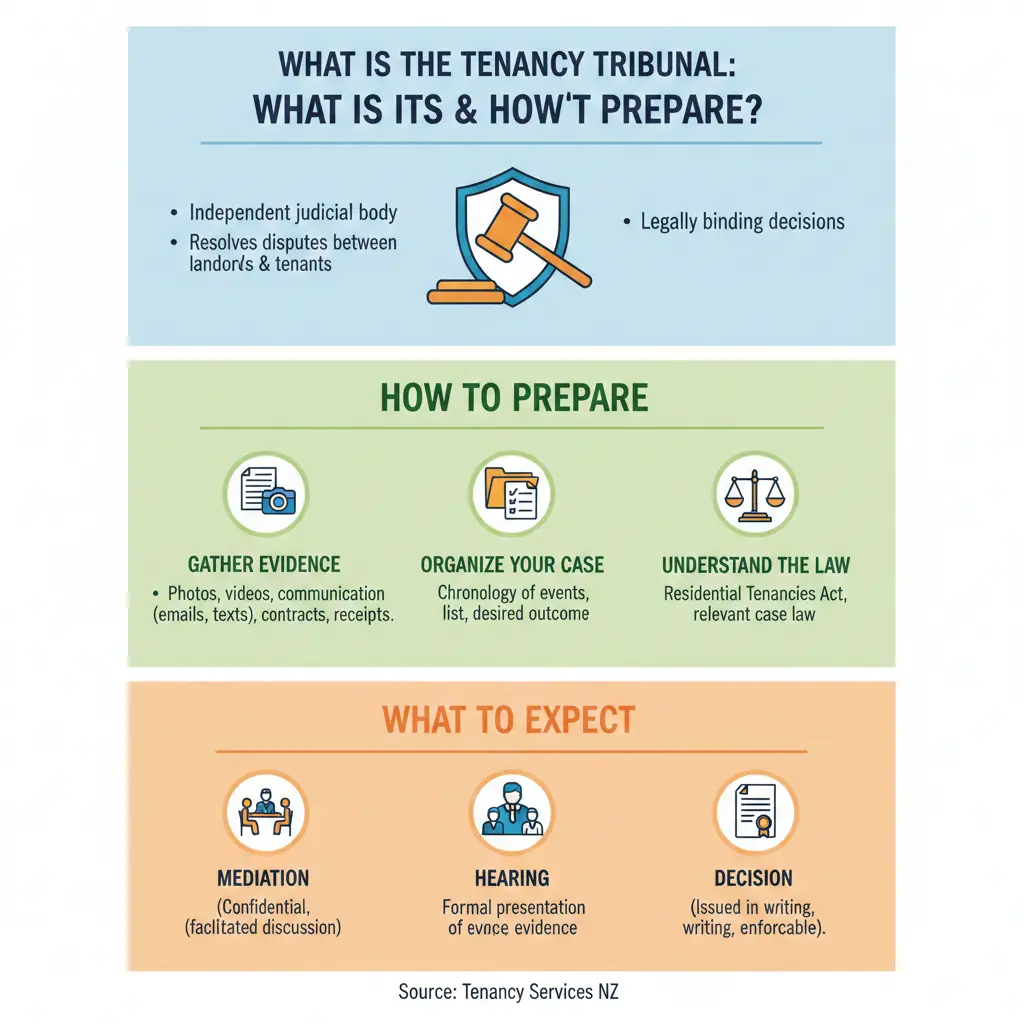
The Tenancy Tribunal is New Zealand's go-to court for resolving disputes between landlords and tenants in residential tenancies covered by the Residential Tenancies Act 1986 (RTA). It's designed to be quicker and cheaper than the District Court, with application fees around $20.44 (including GST)—a small price for peace of mind.
Unlike general courts, the Tribunal focuses solely on tenancy matters. It can handle claims up to $100,000, including orders for unpaid rent, repairs, compensation, or even possession of the property. For example, if your tenant owes $5,000 in back rent, the Tribunal can order payment directly. Note that it doesn't cover flatmate spats or boarding houses—these go to the Disputes Tribunal.
Who Can Apply?
Both tenants and landlords can apply. Common issues include:
- Overdue rent or overcharged rent
- Property repairs and maintenance
- Invalid tenancy termination notices
- Damage beyond fair wear and tear
- Breach of the tenancy agreement, like unauthorised pets or excessive noise
Pro tip: Check if your situation falls under the RTA first—visit tenancy.govt.nz for a quick eligibility quiz.
Step-by-Step: How to Apply to the Tenancy Tribunal
Applying is straightforward and mostly online, taking just four steps. You'll need a RealMe login (free to set up) via the Tenancy Services portal.
Step 1: Register and Log In
Head to the Tenancy Tribunal application website at tenancy.govt.nz. Create or use your RealMe account to log in securely.
Step 2: Gather Your Documents
Before starting, collect digital copies of key evidence:
- Your signed tenancy agreement
- Any 14-day notices served (e.g., for rent arrears)
- Rent records, bank statements, or photos of damage
- Correspondence like emails or texts about the dispute
- Bond lodgement details from Tenancy Services
Important: From recent updates, nearly all documents you submit will be shared with the other party automatically.
Step 3: Fill Out the Application Form
Detail your claim clearly—what happened, when, and what remedy you seek (e.g., "$2,500 compensation for unrepaired leaks"). Be factual and specific to strengthen your case.
Step 4: Pay and Submit
The fee is $20.44. If you've already tried mediation, this might be waived. Submit, and Tenancy Services processes it promptly.
Paper forms are available from Tenancy Services offices if online isn't an option, but digital is faster.
Preparing for Your Tenancy Tribunal Hearing
Once submitted, the Tribunal may offer mediation first—a free, confidential chat to settle without a hearing. Opt for it if you want a quick fix; it's successful in many cases. If not, or if it fails, expect a hearing notice within 20 working days, detailing the date, time, and venue (often local, like in Wellington or Dunedin).
Gather Rock-Solid Evidence
Your preparation hinges on evidence. Bring originals plus two copies for the adjudicator and the other party:
- Tenancy agreement and bond docs
- Photos/videos of issues (e.g., mouldy walls with timestamps)
- Repair quotes from licensed tradespeople
- Witness statements (e.g., neighbour on noise)
- Rent ledger showing arrears
For tenants, include IRD records if disputing overcharges; for landlords, ACC-safe repair reports add weight.
Practice Your Presentation
Hearings are informal—no wigs or gowns. You'll represent yourself (lawyers only for claims over $6,000). Bring a support person, like a whānau member or advocate from Community Law. Rehearse: state facts chronologically, stick to evidence, and stay calm. Example script: "On 15 January 2026, I served a 14-day notice for rent arrears—here's the proof via tracked post."
On the Day: What to Expect
Hearings last 30-60 minutes, open to the public unless privacy is needed. The adjudicator (a trained expert) hears both sides equally, asks questions, and decides on the spot or soon after. From March 2025 updates, some cases now resolve on documents alone for efficiency.
"The adjudicator will analyse all evidence and apply the law to your dispute, issuing a binding order." LegalVision NZ
Arrive early, dress smart-casual, and don't miss it—cases can be dismissed in absentia.
The Hearing Process in Detail
Expect a structured flow:
- Opening: Adjudicator explains rules and confirms identities.
- Your Case: Present evidence first (applicant goes first).
- Other Side's Turn: They respond; you can question politely.
- Questions: Adjudicator probes for clarity.
- Decision: Verbal on the day, written order emailed soon after—legally binding like a court judgement.
Orders might say: "Tenant pays landlord $3,200 for damage by 1 March 2026" or "Landlord completes repairs within 14 days."
2026 Updates to Know
Keep an eye on tweaks: Tribunal hours adjust over holidays (e.g., reopening staggered in January), and document handling is more transparent. No major fee hikes noted for 2026, but check tenancy.govt.nz.
After the Hearing: Orders, Appeals, and Enforcement
The order outlines decisions and deadlines. Comply, or face penalties. If the other party doesn't, apply to the District Court for enforcement—no extra Tribunal fee.
Challenging the Decision
Options include:
- Rehearing: Within 5 working days if procedural errors (e.g., missed evidence). Free, but not for mere disagreement.
- Appeal: To District Court for orders over $1,000 if facts or law were wrong. Starts from the Tribunal's decision.
In a real Kiwi case, tenants won against extra rent hikes after a District Court appeal upheld the Tribunal's "reasonableness" call.
Practical Tips for Success
- Act Fast: Time limits apply—e.g., 14 days to remedy breaches.
- Try Mediation: Saves time and stress; specify it on application.
- Free Help: Contact Community Law Centres or Citizens Advice Bureau for advice. Tenants.org.nz offers templates.
- Track Everything: Use apps like Splitwise for rent or photo logs for issues.
- Healthy Homes: Reference compliance if disputing standards—mandatory since 2019.
Disclaimer: This isn't legal advice. Consult a professional like a tenancy lawyer or Community Law for your situation.
Next Steps: Take Control Today
Don't let a tenancy dispute drain your wallet or wellbeing. Start by reviewing your tenancy agreement and gathering evidence. Lodge via tenancy.govt.nz, prepare thoroughly, and approach the hearing with facts on your side. Most cases resolve fairly, helping Kiwis get back to stable housing. For urgent help, call Tenancy Services at 0800 836 262 or visit a local office. You've got this—fair tenancies build strong communities.
Frequently Asked Questions
Sources & References
-
1
What is the Tenancy Tribunal in New Zealand? — legalvision.co.nz — legalvision.co.nz
-
2
The Tenancy Tribunal: A court to decide tenancy disputes — communitylaw.org.nz — communitylaw.org.nz
-
3
Overview of the disputes process and the Tenancy Tribunal — tenant.aratohu.nz — tenant.aratohu.nz
-
4
Dispute resolution process: Tenancy Tribunal — unittitles.govt.nz — www.unittitles.govt.nz
-
5
Tenancy Tribunal — tenancy.govt.nz — www.tenancy.govt.nz
-
6
Important change: How the Tenancy Tribunal handles documents — tenancy.govt.nz — www.tenancy.govt.nz
-
7
Big Changes Coming to the Disputes Tribunal in 2026 — cooneyleesmorgan.co.nz — cooneyleesmorgan.co.nz
-
8
Court and Tribunal hours — justice.govt.nz — www.justice.govt.nz
-
9
Tenant Rights in 2025: Key Changes — rwsilverdale.co.nz — rwsilverdale.co.nz
Related Articles

Industry Bodies and Professional Associations NZ
Whether you're launching a business, advancing your career, or navigating financial regulations, industry bodies and professional associations in New Zealand offer invaluable support. These organisati...

Emergency Benefit NZ: When You Have No Other Options
When you're struggling financially and don't qualify for other benefits, the Emergency Benefit might be your lifeline. It's a discretionary payment designed for Kiwis in genuine hardship who've exhaus...

Unpaid Internships NZ: Are They Legal?
Unpaid internships are a common pathway for students and graduates to gain work experience in New Zealand, but there's often confusion about whether they're actually legal. The short answer is: unpaid...

Estate Administration NZ: Managing Someone's Affairs After Death
Losing a loved one is one of life's toughest challenges, and stepping in to manage their estate can feel overwhelming. In New Zealand, estate administration—the process of handling someone's affairs a...