Healthy Homes Standards: What Your Rental Must Have

If you're renting out a property in New Zealand or hunting for a healthier home, the Healthy Homes Standards are non-negotiable. These rules ensure every rental is warm, dry, and safe, protecting tena...
James writes about the New Zealand property market, renting, home ownership, and housing costs. He breaks down complex property topics into practical advice for renters and buyers.
If you're renting out a property in New Zealand or hunting for a healthier home, the Healthy Homes Standards are non-negotiable. These rules ensure every rental is warm, dry, and safe, protecting tenants from cold, damp conditions that lead to health issues like respiratory illnesses.
Introduced in 2019 under the Residential Tenancies (Healthy Homes Standards) Regulations 2019, the standards became mandatory for new or renewed tenancies from 1 July 2021, with full compliance required for all private rentals by 1 July 2025. As of 2026, every rental property must meet these minimums—no exceptions unless you qualify for a specific exemption. Whether you're a landlord ticking off compliance or a tenant checking your rights, here's everything you need to know.
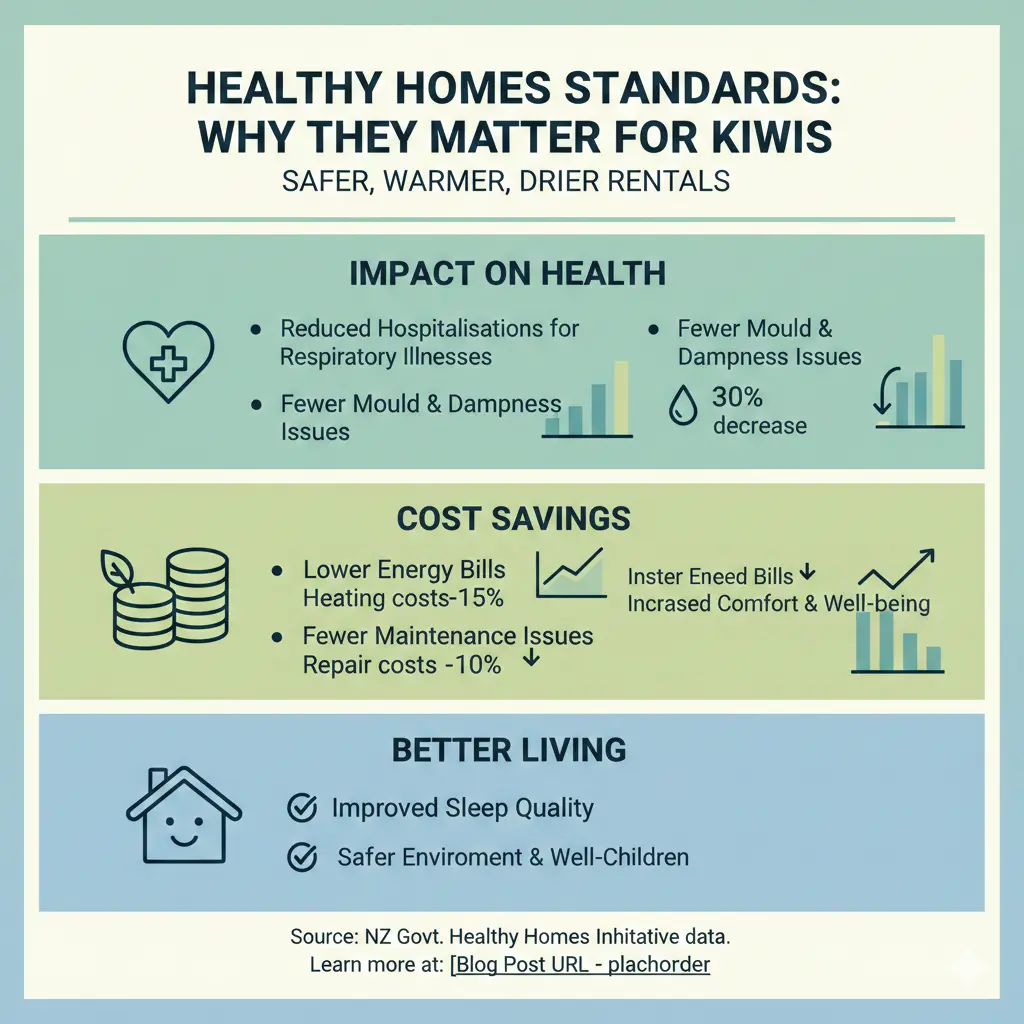
Why Healthy Homes Standards Matter for Kiwis
Rentals make up about a third of New Zealand homes, and before these standards, many were cold and mouldy, contributing to higher hospital visits for kids with breathing problems. The standards bridge the gap between rental and owner-occupied housing, making rentals warmer, drier, and healthier.
For landlords, compliance avoids hefty fines—up to $7,200 for small portfolios (under six properties) or $50,000 for larger ones. Tenants gain better living conditions, and everyone benefits from fewer health costs via ACC and the health system. Recent 2025 updates clarified exemptions and prioritised these standards over older 1947 housing rules.
The Five Healthy Homes Standards Explained
There are five core standards: heating, insulation, ventilation, moisture ingress and drainage, and draught stopping. Each sets clear, measurable requirements. Let's break them down with practical advice.
1. Heating: Warmth in the Main Living Area
Every rental must have one or more fixed heaters that can heat the main living room to at least 18°C, even on a chilly winter morning. Portable heaters don't count—think heat pumps, wood burners, flued gas heaters, pellet burners, or certain electric panel heaters with thermostats.
- Calculate capacity in kW based on room size, ceiling height, insulation, and location (e.g., a 20m² room in Auckland might need 1.5–2kW).
- For open-plan areas, multiple heaters may be needed.
- Install a thermostat or timer for efficiency.
Tip for landlords: Get a heating assessment from a professional—keep the report for your records. Tenants, test the heater and note if it struggles to hit 18°C.
2. Insulation: Keeping Heat In and Damp Out
Ceiling and underfloor insulation must meet minimum R-values (thermal resistance): typically R2.9 for ceilings and R1.3 for floors, though existing insulation in good condition can sometimes suffice if topped up. Compulsory since 1 July 2019, with exemptions for inaccessible areas.
- Check via an insulation assessment—photos and quotes prove compliance.
- 2025 updates allow compensation with wall, floor, or window insulation if ceiling space is limited.
- No insulation? Install to the higher new-build standards.
Practical step: Use the Tenancy Services toolkit to assess your property. Warmer homes mean lower power bills for tenants and fewer mould complaints.
3. Ventilation: Fresh Air to Fight Mould
Every habitable room needs at least one openable window, door, or skylight (at least 5% of floor area) that fixes open. Kitchens and bathrooms require extractor fans venting outside, or whole-home mechanical systems.
- Open-plan kitchens? Ensure fans cover the space effectively.
- Test fans: they must exhaust to outside, not the roof cavity.
- Liveable rooms include bedrooms, living rooms, and studies—not laundries or garages.
Landlord action: Install compliant fans (e.g., those meeting airflow rates). Tenants, report stuffy rooms early to avoid mould buildup.
4. Moisture Ingress and Drainage: No Leaks or Puddles
Rentals need efficient gutters, downpipes, and drainage to handle rainwater, plus ground moisture barriers under enclosed floors. No pooling water near foundations or leaking roofs/windows.
- Inspect annually: clear gutters, fix spouting, ensure stormwater drains away.
- Sub-floor? Add plastic sheeting or similar if needed.
- Recent clarifications confirm these standards override older rules.
This prevents the dampness that breeds mould and health woes common in Kiwi weather.
5. Draught Stopping: Seal the Gaps
Block unreasonable draughts from gaps in walls, floors, ceilings, windows, doors, or unused fireplaces. Seal around pipes, cables, and fittings—no whistling winds through your home.
- Common fixes: weatherstripping on doors, blocking letterboxes, capping open fireplaces.
- "Unreasonable" means noticeable cold air affecting comfort.
- Document with before-and-after photos.
Compliance Timeline and Exemptions
By 1 July 2025, all private rentals must comply, even without a new tenancy. No more extensions—Tenancy Services enforces this strictly in 2026.
Exemptions are limited:
- Properties slated for demolition/rebuild (with consent applied, up to 12 months).
- Tenant who was the previous owner (first 12 months only).
- Apartments in shared buildings where you don't control common areas.
Always check with Tenancy Services if unsure.
Documentation and Tenancy Agreements
Include a signed compliance statement in every new, renewed, or varied tenancy agreement detailing each standard. Use the official template from Tenancy Services—omitting it risks a $500 fine per tenancy.
Keep records for at least 2 years:
- Assessments and calculations (e.g., heating kW).
- Invoices, photos, and installer certs.
- Compliance statement copies.
Pro tip: Digital folders make audits easy if Tenancy Services or the Tenancy Tribunal comes knocking.
Costs, Grants, and Getting Help
Upgrading varies: a heat pump might cost $3,000–$6,000, insulation $2,000–$5,000, but efficiencies pay back over time. Check for Warmer Kiwi Homes grants if eligible (low-income tenants qualify for retrofits).
Steps to comply:
- Self-assess using govt checklists.
- Hire Healthy Homes assessors via tenancy.govt.nz.
- Budget now—trades are busy post-deadline.
Next Steps for Landlords and Tenants
Landlords: Audit your property today using the Tenancy Services toolkit, book assessors, and update agreements. Tenants: Request your compliance statement and report issues promptly via the Tenancy Tribunal if needed. Healthier rentals mean healthier Kiwis—let's make it happen.
Visit tenancy.govt.nz/healthy-homes for templates, calculators, and contacts. Your rental's future starts now.
Frequently Asked Questions
Sources & References
-
1
NZ Healthy Homes Standards: Compliance Guide for Landlords — taurangapropertymanagers.co.nz
-
2
Healthy homes standards – what a landlord needs to know — www.tenancy.govt.nz
-
3
Healthy Homes Deadline: Landlords Must Comply by 1 July 2025! — www.christchurchelectrical.co.nz
-
4
Healthy homes standards - Aratohu Tenant Advocacy — tenant.aratohu.nz
-
5
Healthy homes standards updated to improve clarity — www.hud.govt.nz
-
6
NZ rental homes must now be Healthy Homes compliant ... - YouTube — www.youtube.com
- 7
-
8
Healthy Homes Compliance: What Every Landlord Needs to Know ... — www.greenside.co.nz
Useful Tools
Related Articles

The Ultimate Rental Inspection Checklist for NZ Tenants
Moving into a rental in New Zealand can feel like a big step, but nothing prepares you quite like acing that first property inspection—or preparing for the regular ones that follow. As a tenant, knowi...

Healthy Homes Standards: A Guide for NZ Landlords & Renters
If you're renting or managing a property in Aotearoa, you've probably heard about the Healthy Homes Standards. These legal requirements aren't just bureaucratic boxes to tick—they're designed to ensur...

Renter's Rights in New Zealand: Know Your Protections
Imagine signing a lease only to face unexpected repairs, unfair rent hikes, or eviction threats—that's the reality too many Kiwis have faced. But with the Renters' Rights in New Zealand evolving throu...

Tenancy Law Changes 2025: What Renters Need to Know
If you're renting in New Zealand, the tenancy law changes kicking in from early 2025 could reshape your rights and responsibilities as a tenant. These updates to the Residential Tenancies Act (RTA) br...