Healthy Homes Standards: A Guide for NZ Landlords & Renters

If you're renting or managing a property in Aotearoa, you've probably heard about the Healthy Homes Standards. These legal requirements aren't just bureaucratic boxes to tick—they're designed to ensur...
James writes about the New Zealand property market, renting, home ownership, and housing costs. He breaks down complex property topics into practical advice for renters and buyers.
If you're renting or managing a property in Aotearoa, you've probably heard about the Healthy Homes Standards. These legal requirements aren't just bureaucratic boxes to tick—they're designed to ensure every Kiwi has access to warm, dry, healthy housing. Whether you're a landlord navigating compliance or a tenant understanding your rights, this guide will walk you through everything you need to know about these important standards.
What Are the Healthy Homes Standards?
The Healthy Homes Standards are a set of minimum legal requirements introduced by the Government to improve the quality of rental housing across New Zealand. They aim to close the gap between rental properties and owner-occupied homes, ensuring tenants live in warmer, drier, healthier environments.
As of 1 July 2021, all private rental properties must comply with these standards. From 1 July 2025, public housing and all remaining rental properties—including boarding houses and social housing—must also meet these requirements. The standards cover five key areas that directly impact your health and wellbeing.
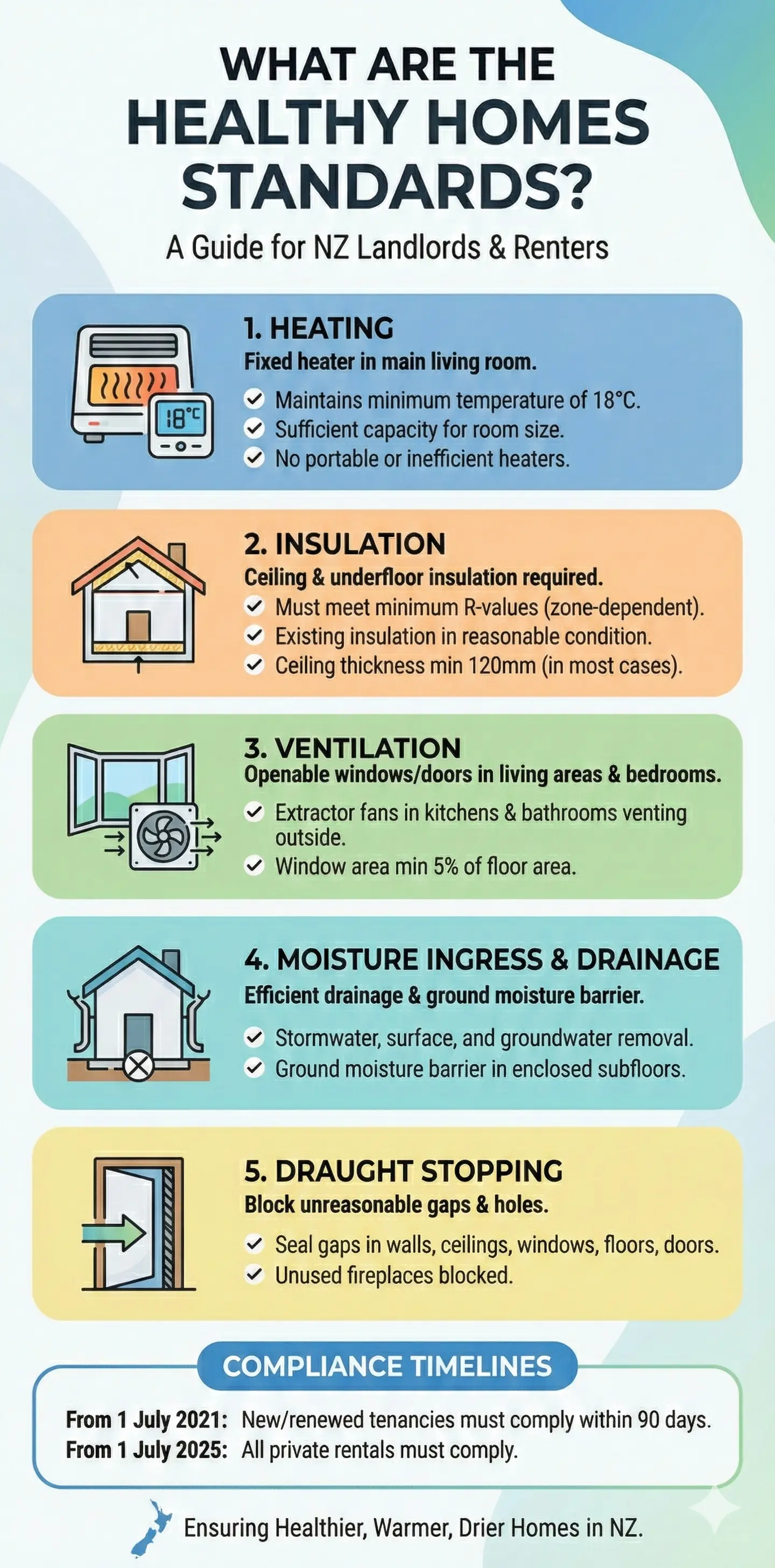
The Five Key Standards Explained
1. Heating
Every rental property must have fixed heating installed in the main living room capable of warming the space to at least 18°C. This isn't about comfort—it's about health. Cold homes are linked to increased rates of respiratory illness, cardiovascular disease, and other health problems.
Acceptable heating options include:
- Heat pumps
- Wood burners
- Pellet burners
- Flued gas heaters
- Electric heaters with thermostats (in specific cases)
Portable heaters don't meet the standard—landlords must install permanent, fixed heating solutions.
2. Insulation
Proper insulation keeps heat in and moisture out. Landlords must ensure ceiling and underfloor insulation meets the insulation standard NZ, which is based on 2008 R-value standards. Recent updates to the standards (effective from 25 September 2025) provide more flexibility for homes with limited ceiling space—they can meet the standard by adding extra insulation to walls, floors, and windows instead.
3. Ventilation
Good ventilation prevents moisture build-up, mould, and structural damage. The ventilation standard requires:
- Openable windows, doors, or skylights in all habitable rooms (living rooms, bedrooms, dining areas), with openings equal to at least 5% of the room's floor area
- Windows or doors that can stay fixed in an open position when needed
- Extractor fans vented to the outside in kitchens and bathrooms, or continuous mechanical ventilation systems that meet the standard
4. Moisture Ingress and Drainage
Effective drainage systems and ground moisture barriers prevent water from entering the home, which can lead to costly repairs and health issues like mould and dampness. This standard ensures the property has proper systems in place to manage water ingress.
5. Draught Stopping
Draughts make homes colder and increase heating costs for tenants. All rental properties must follow the draught stopping standard to minimise heat loss.
Key Dates and Deadlines for Landlords
Understanding the timeline is crucial for compliance:
- 1 July 2021: All private rental properties must comply
- 1 July 2025: All public housing, boarding houses, and remaining rental properties must comply
- 25 September 2025: Minor technical updates to the standards took effect to improve clarity and reduce unnecessary costs
If you're a private landlord, the compliance deadline has already passed. However, if you haven't yet upgraded your property, it's essential to take action immediately to avoid penalties.
Penalties for Non-Compliance
This isn't optional. Failing to meet the Healthy Homes Standards is a breach of the Residential Tenancies Act 1986. Landlords who don't comply can face financial penalties of up to $7,200 per breach. Beyond the financial risk, non-compliance can damage your reputation and lead to disputes with tenants.
The good news? Recent data shows that 87% of landlords now say their properties fully comply with the Healthy Homes Standards, indicating that most of the sector has successfully adapted to these requirements.
What Tenants Need to Know
Your Right to a Compliance Statement
From 1 December 2020, all new or renewed tenancy agreements must include a compliance statement detailing the property's current level of compliance with the healthy homes standards. This statement must cover all five standards: insulation, heating, ventilation, draught stopping, and moisture/drainage.
Landlords must normally use the healthy homes compliance statement template from Tenancy Services. If they don't provide this statement when required, they can be fined.
What to Do If Your Home Isn't Compliant
If your rental property doesn't meet the standards, here's what you can do:
- Request the compliance statement from your landlord—you're legally entitled to this information
- Document any issues (cold rooms, moisture, poor ventilation) with photos and dates
- Contact your landlord in writing to request specific upgrades needed
- If your landlord doesn't respond, reach out to Tenancy Services or local tenant advocacy organisations like Aratohu for guidance
Exemptions: When Properties Can Be Exempt
There are limited situations where a property may be exempt from complying with one or more of the healthy homes standards. These exemptions are specific and require documentation. If you believe your property qualifies for an exemption, check Tenancy Services for details about your situation.
Recent clarification (effective 25 September 2025) also confirms that the healthy homes standards take priority over older housing rules from the Housing Improvement Regulations 1947 for residential tenancies, providing clarity about heating, ventilation, and drainage requirements.
Practical Steps for Landlords to Achieve Compliance
Assess Your Current Situation
Start by using the Healthy Homes Standards Toolkit for Landlords, which provides essential resources like checklists and guides to help you stay on track. Work through each of the five standards systematically.
Prioritise Based on Impact
Some upgrades have a bigger impact on tenant health and wellbeing than others. Heating and insulation are typically the most important, as they directly affect your ability to maintain a warm home.
Budget for Upgrades
While upgrade costs are a consideration, the financial risk of non-compliance (up to $7,200 per breach) is far greater. Additionally, warm, dry homes are less prone to issues like mould and dampness, which can lead to costly repairs over time.
Document Everything
Keep records of all upgrades, maintenance, and compliance checks. This documentation protects you if any disputes arise and demonstrates your commitment to meeting the standards.
Frequently Asked Questions
When did the Healthy Homes Standards become law?
The standards were introduced on 1 July 2019, with compliance requirements phased in over time. Private rentals have been required to comply since 1 July 2021, and all other rental properties (including public housing) since 1 July 2025.
Do I need to provide a compliance statement to my tenant?
Yes, if you're a landlord. All new or renewed tenancy agreements must include a compliance statement detailing your property's current level of compliance with the healthy homes standards. Use the template from Tenancy Services to ensure you cover all required information.
What if my property can't meet the heating standard because it's too expensive?
You're still legally required to install fixed heating capable of reaching 18°C in the main living room. This is a non-negotiable requirement. If cost is a genuine barrier, consult with Tenancy Services about your specific situation, but exemptions are rare and require documentation.
Can I charge my tenant extra rent to cover the cost of upgrades?
No. Meeting the Healthy Homes Standards is a landlord's legal obligation under the Residential Tenancies Act. You cannot pass these costs on to tenants through increased rent. These are baseline requirements, not optional improvements.
What should I do if my landlord hasn't provided a compliance statement?
Request it in writing. If they don't respond within a reasonable timeframe, contact Tenancy Services or a local tenant advocacy organisation like Aratohu for guidance on your rights and next steps.
Are there any recent changes to the standards I should know about?
Yes. Minor updates took effect on 25 September 2025 to improve clarity and reduce unnecessary costs. These include reinstatement of an exemption for ceiling insulation in homes with limited ceiling space (if they have extra insulation elsewhere) and clarification that the healthy homes standards take priority over older housing regulations.
Moving Forward: What Comes Next?
The Healthy Homes Standards represent a significant step forward in ensuring all Kiwis have access to warm, dry, healthy housing. If you're a landlord, compliance isn't just about avoiding penalties—it's about providing your tenants with homes that support their health and wellbeing. If you're a tenant, understanding these standards empowers you to advocate for your rights and hold landlords accountable.
Start by reviewing your current situation against the five standards. Access the resources available through Tenancy Services, use the compliance statement template, and take action to address any gaps. The investment you make now will pay dividends in reduced maintenance costs, healthier tenants, and peace of mind knowing you're meeting your legal obligations.
For more information, visit Tenancy Services' healthy homes page or consult the Ministry of Housing and Urban Development website.
Related Articles
The Ultimate Rental Inspection Checklist for NZ Tenants
Moving into a rental in New Zealand can feel like a big step, but nothing prepares you quite like acing that first property inspection—or preparing for the regular ones that follow. As a tenant, knowi...

Renter's Rights in New Zealand: Know Your Protections
Imagine signing a lease only to face unexpected repairs, unfair rent hikes, or eviction threats—that's the reality too many Kiwis have faced. But with the Renters' Rights in New Zealand evolving throu...

Tenancy Law Changes 2025: What Renters Need to Know
If you're renting in New Zealand, the tenancy law changes kicking in from early 2025 could reshape your rights and responsibilities as a tenant. These updates to the Residential Tenancies Act (RTA) br...

Healthy Homes Standards: What Your Rental Must Have
If you're renting out a property in New Zealand or hunting for a healthier home, the Healthy Homes Standards are non-negotiable. These rules ensure every rental is warm, dry, and safe, protecting tena...