Zoning and School Enrolment: How the System Works

Imagine discovering that the house you've set your heart on falls just outside the zone for your top-choice school, leaving your child's education up in the air. For Kiwi families, understanding zonin...
Sarah covers personal finance, tax, and KiwiSaver topics for Lifetimes NZ. She focuses on making money management straightforward and practical for everyday Kiwis.
Imagine discovering that the house you've set your heart on falls just outside the zone for your top-choice school, leaving your child's education up in the air. For Kiwi families, understanding zoning and school enrolment isn't just academic—it's a practical necessity that can shape house hunting, family moves, and long-term planning. With school zones influencing property decisions and enrolment guarantees, grasping how the system works empowers you to make informed choices.
In New Zealand, most state schools operate under enrolment schemes that define clear geographical boundaries, ensuring local children have priority access while managing capacity. This article breaks down the mechanics, from home zones to out-of-zone ballots, with tools, tips, and updates relevant to 2026.
What Are School Zones and Enrolment Schemes?
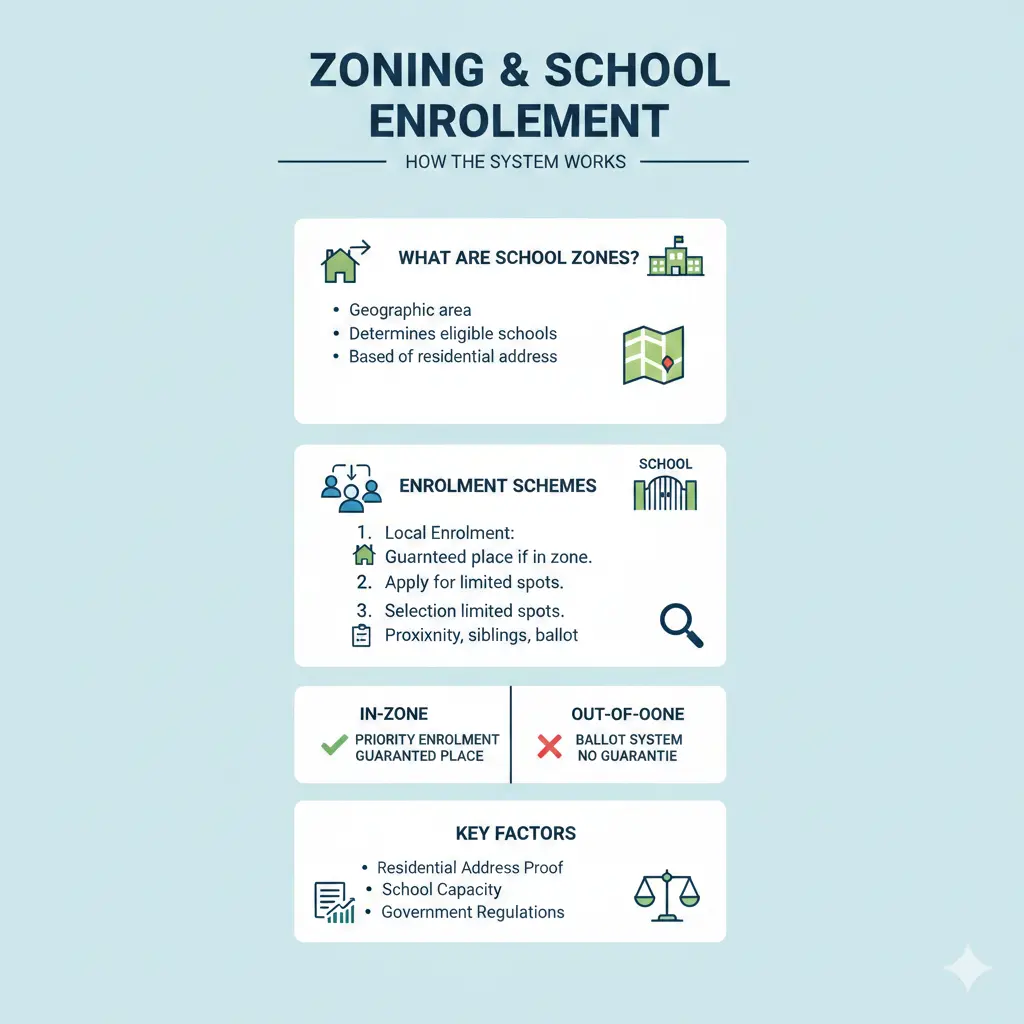
School zones, formally known as enrolment schemes, are geographical areas around state schools that guarantee places for children living inside them. These schemes prevent overcrowding, balance rolls across local schools, and ease traffic congestion during peak times.
Under the Education and Training Act 2020, the Secretary of Education defines home zones based on accessibility for students in that area. Zones must be clearly delineated so any address is unambiguously inside or outside. This clarity is crucial for families renting, buying, or relocating.
Who Do Enrolment Schemes Apply To?
Enrolment schemes cover state and state-integrated schools, which make up the majority in New Zealand. Private schools and some state-integrated ones set their own criteria, often tied to special character like religious affiliation, without zones.
- State schools: Free, zoned, funded by government.
- State-integrated: Maintain special character (e.g., Catholic), may have zones or priority for aligned families.
- Private/independent: Fees apply, no zones, selective entry.
Not all state schools have zones—some accept enrolments from anywhere if capacity allows—but most primaries, intermediates, and secondaries do.
How Home Zones Are Determined and Changed
The Ministry of Education approves zones after community consultation, considering factors like population growth, housing developments, transport, and nearby school capacity. Zones aren't static; they evolve with communities.
Factors Influencing Zone Boundaries
- Population shifts and new subdivisions (e.g., Rolleston and Flat Bush saw new schools in 2026 due to roll pressures).
- Balancing enrolments to avoid overcrowding.
- Accessibility via walking, cycling, or public transport.
- Demographic changes, like family sizes or migration patterns.
Each zone includes details like school ID, type (primary blue, secondary purple on maps), approval date, and effective date. Boundaries can shrink or expand, so if school access sways your property choice, confirm with the school for proposed reviews.
Interactive Tools to Check Your Zone
Use official and interactive maps for instant checks:
- Education Counts 'Find a School' tool—enter your address for zoned schools.
- Interactive maps like Mapscaping's, showing coloured boundaries by school type (blue for primary, etc.). Click markers for roll data, demographics, and schemes.
Proof of address (utility bills, tenancy agreements) is required for in-zone guarantees.
In-Zone Enrolment: Your Guarantee
If your home address is inside the home zone, your child gets automatic priority, subject to age eligibility (e.g., turning 5 by a set date). No applications needed beyond standard enrolment forms.
Schools fill in-zone places first, ensuring local access. This system supports community ties and reduces long commutes.
School Types and Gender Policies
Zones align with school character:
| School Type | Zone Colour (Maps) | Gender Policy Examples |
|---|---|---|
| Primary | Blue | Mostly co-educational |
| Secondary | Purple | Co-ed, boys/girls, or senior co-ed |
| Composite | Green | Years 1-13, varied policies |
| Intermediate | Orange | Years 7-8 |
Out-of-Zone Enrolment: The Ballot Process
Spaces left after in-zone enrolments go to out-of-zone applicants via a strict priority system and ballot if oversubscribed.
Priority Categories (Education and Training Act 2020)
- Special programmes (arts, sports, etc.).
- Siblings currently enrolled.
- Siblings of former students.
- Children of former students.
- Children of staff/board members.
- All others—ballot.
Schools advertise available places (e.g., September via newsletters, apps) and dates. Request an enrolment pack for details.
Timelines for Applications
- Year 7/Intermediate: May-August in Year 6, finalise by October-November.
- Primaries/Secondaries: Vary; check early for popular schools.
"Schools fill all spaces with in-zone students first, then allocate remaining spaces through out-of-zone applications, often using a ballot."
Equity Index: Funding Beyond Zones
Replacing the old decile system, the Equity Index (EQI) scores schools 344-569 based on socioeconomic challenges via Stats NZ data. Higher EQI means more per-student funding for support.
Check EQI on Education Counts. This levels the playing field, but zones remain key for access.
Practical Tips for Kiwi Families
Navigating zones ties into finances—properties in desirable zones command premiums, impacting mortgages and budgeting. Here's actionable advice:
- Before buying/renting: Verify zones with schools and maps; ask about reviews.
- Proof of residence: Gather bills early; use parent's/guardian's address if applicable.
- Multiple zones: You might overlap—choose wisely.
- Appeals: If denied, contact the school board or Ministry.
- New developments: Watch for zone expansions in growth areas like Rolleston.
- No zone schools: Explore state-integrated for alternatives.
For financial planning, factor zone premiums into KiwiSaver withdrawals or first-home grants via IRD and Kāinga Ora. Always consult a financial adviser for personalised advice.
Next Steps for Your Family
Start by entering your address on Education Counts to identify zoned options. Contact schools directly for 2026 intakes, enrolment packs, and updates. Track Ministry announcements for zone reviews, especially in growing areas. For tailored financial impacts—like budgeting for zone premiums or relocation costs—speak to a registered adviser. Knowledge of zoning and school enrolment puts you in control of your child's educational future.
Frequently Asked Questions
Sources & References
-
1
Enrolment schemes (school zones) - Community Law — communitylaw.org.nz
-
2
New Zealand School Zones Map: Interactive School Finder — mapscaping.com
-
3
School zones and enrolment schemes - Ministry of Education — www.education.govt.nz
-
4
NZ school zoning explained (and how to get into a school from out of zone) — clueylearning.co.nz
-
5
New Zealand's School System Explained - Wise Move — www.wisemove.co.nz
- 6
-
7
Enrolment schemes - Ministry of Education — www.education.govt.nz
- 8
Related Articles

Industry Bodies and Professional Associations NZ
Whether you're launching a business, advancing your career, or navigating financial regulations, industry bodies and professional associations in New Zealand offer invaluable support. These organisati...

Emergency Benefit NZ: When You Have No Other Options
When you're struggling financially and don't qualify for other benefits, the Emergency Benefit might be your lifeline. It's a discretionary payment designed for Kiwis in genuine hardship who've exhaus...

Unpaid Internships NZ: Are They Legal?
Unpaid internships are a common pathway for students and graduates to gain work experience in New Zealand, but there's often confusion about whether they're actually legal. The short answer is: unpaid...

Estate Administration NZ: Managing Someone's Affairs After Death
Losing a loved one is one of life's toughest challenges, and stepping in to manage their estate can feel overwhelming. In New Zealand, estate administration—the process of handling someone's affairs a...