How to Create a Budget That Actually Works (NZ Guide)

Ever stared at your bank account mid-month wondering where all your hard-earned cash disappeared to? You're not alone—around half of Kiwis worry about money regularly, with rising costs hitting househ...
Sarah covers personal finance, tax, and KiwiSaver topics for Lifetimes NZ. She focuses on making money management straightforward and practical for everyday Kiwis.
Ever stared at your bank account mid-month wondering where all your hard-earned cash disappeared to? You're not alone—around half of Kiwis worry about money regularly, with rising costs hitting households hard in 2026.Creating a budget that actually works isn't about restriction; it's about gaining control, reducing stress, and building a secure future tailored to New Zealand life.
In this guide, we'll walk you through practical steps to build a budget that fits your reality—from tracking Kiwi-specific expenses like power bills and KiwiSaver contributions to using free tools from IRD and WINZ. Whether you're in Auckland facing sky-high rents or saving for a South Island adventure, these strategies will help you spend smarter, save more, and thrive.
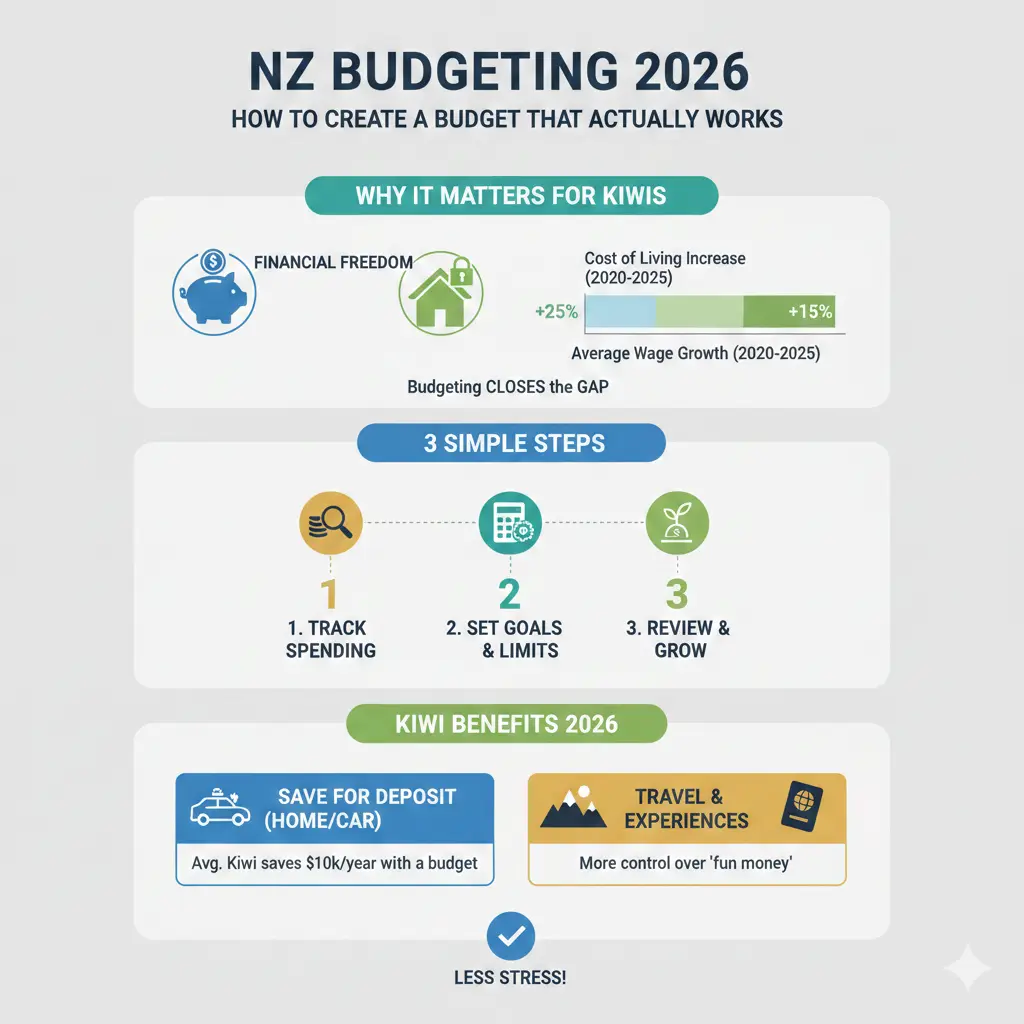
Why Budgeting Matters for Kiwis in 2026
With inflation easing but everyday costs like groceries and fuel still biting—think $15 NZD for a fast food meal or $120-175 NZD weekly groceries at Pak'nSave or Countdown—many households feel the squeeze.A solid budget acts as your financial GPS, helping you navigate seasonal spikes (hello, power bills in winter) and unexpected hits like car rego or ACC levies.
Budgeting empowers you to prioritise what matters: topping up KiwiSaver, paying off debt, or stashing cash for that family holiday. It's especially crucial now, as New Zealanders grapple with debt and financial stress amid economic shifts outlined in the latest Budget Policy Statement.Start budgeting today, and you'll sleep better knowing you're in charge.
Step 1: Assess Your Current Financial Situation
Before diving in, get a clear picture of your money flow. Track every dollar for one month using a free app or spreadsheet—this reveals hidden leaks like daily coffees adding up to $100 monthly.
Gather Your Numbers
- Income: List all sources—salary, benefits from WINZ, rental income. Factor in tax via your IRD payslip summary. Aim for after-tax take-home pay.
- Fixed Expenses: Rent/mortgage (average Auckland rent ~$600/week), power (~$300/month winter), council rates, insurance.
- Variable Expenses: Groceries ($15 NZD healthy meal for two), fuel (save with SmartFuel card at BP or Caltex), transport (AT HOP card in Auckland).
- Debts: Student loans (StudyLink), credit cards, personal loans—check interest rates via IRD myIR portal.
Pro Tip: Use the Sorted.org.nz budget planner, a free government-backed tool customised for NZ expenses including KiwiSaver and ACC.
Step 2: Choose the Right Budgeting Method for You
Not one-size-fits-all—pick a system that suits your lifestyle. Here's a breakdown of popular methods adapted for Kiwis.
The 50/30/20 Rule: Simple and Effective
Allocates 50% to needs, 30% to wants, 20% to savings/debt. Perfect for starters.
| Category | Percentage | NZ Example ($5,000 monthly take-home) |
|---|---|---|
| Needs (rent, bills, groceries) | 50% | $2,500 |
| Wants (dining out, entertainment) | 30% | $1,500 |
| Savings/Debt (KiwiSaver, emergency fund) | 20% | $1,000 |
This method accounts for NZ realities like high housing costs (up to 40% of income in cities).Adjust as needed—if rent eats 35%, trim wants to 25%.
Zero-Based Budgeting: Every Dollar Assigned
Assign every dollar a job until you hit zero. Ideal for debt payoff. Example: $5,000 income minus $4,200 expenses leaves $800 for savings—assign it specifically (e.g., $400 KiwiSaver, $400 emergency fund).
Envelope System: Cash is King
Divide cash into envelopes for categories like groceries or fuel. Once empty, stop spending. Digital version: Use apps like PocketSmith (NZ-based) to mimic this.
Step 3: Track and Categorise Your Expenses
List categories relevant to NZ life:
- Housing: 30-35% (mortgage/rent).
- Utilities: Power, internet (~$150/month), water.
- Food: $100-150/person weekly at New World or Countdown. Cook to save vs. $20-30 cafe meals.
- Transport: Fuel ($2.50/litre), public transport, WOF/rego.
- Debt & Savings: Minimum payments + extra; 10-20% to KiwiSaver.
- Insurance: Health, contents, car (shop via Get Ahead).
- Lifestyle: Gym, streaming, hobbies.
NZ Hack: Factor seasonal costs—Christmas, back-to-school, rates. Use IRD's tax calculator for accurate net income.
Step 4: Set Realistic Goals and Build Your Budget
Make goals SMART: Specific, Measurable, Achievable, Relevant, Time-bound. E.g., "Save $5,000 for emergency fund by December 2026 via $200/month auto-transfer."
Create Your Budget Spreadsheet
Use Google Sheets or Excel:
- Column 1: Category.
- Column 2: Budgeted Amount.
- Column 3: Actual Spent.
- Column 4: Difference.
Start conservative—under-budget income by 10% for surprises like vet bills or car repairs.
Incorporate KiwiSaver and Government Support
Contribute at least 3% to KiwiSaver (employer matches 3%). Check eligibility for Winter Energy Payment via WINZ if on benefits. Use the official KiwiSaver calculator on sorted.org.nz.
Step 5: Tools and Apps for Kiwi Budgeters
Leverage free or low-cost NZ-friendly tools:
- Sorted Budget Planner: Free from Commission for Financial Capability.
- PocketSmith: NZ-made, forecasts cash flow.
- Trail Wallet: Great for multi-currency if travelling.
- BANKS: Link ASB, BNZ apps for auto-tracking.
- myIR Portal: Track tax, refunds.
Track Weekly: Review Sundays—adjust if food overspends, cut dining out.
Step 6: Common Pitfalls and How to Avoid Them
Avoid these budget-busters:
- Lifestyle Inflation: New job raise? Save half, don't splurge.
- Ignoring Small Expenses: Lattes ($6 each) x 20 = $120/month.
- No Emergency Fund: Aim for 3-6 months expenses in high-interest savings (e.g., Rabobank 5%+ p.a.).
- Seasonal Blind Spots: Budget extra for July power spikes.
Debt Tip: Prioritise high-interest debt first (credit cards 20%+). Consider debt consolidation via Harmoney.
Step 7: Review and Adjust Monthly
Treat budgeting as alive—review end of month. Celebrate wins like staying under groceries by $50 (reward: movie night home). Tweak for life changes: new baby, job loss (apply WINZ early).
For 2026 goals, align with national fiscal strategy: focus on surplus building and debt reduction.Reassess quarterly.
Next Steps to Make Your Budget Stick
Grab a coffee (brew it yourself to save!), download Sorted, and track this week. Share your budget with a whānau member for accountability. In three months, you'll see real progress—less stress, more freedom. Remember, consistency beats perfection. Start today, and watch your financial future brighten.
Frequently Asked Questions
Sources & References
- 1
-
2
New Zealand on a Budget: 2026 Trip Cost + Money-Saving Tips! — www.twowanderingsoles.com
-
3
Guide to the Budget process | The Treasury New Zealand — www.treasury.govt.nz
-
4
How Does it Cost to Travel New Zealand in 2026? - Nomadic Matt — www.nomadicmatt.com
-
5
10 Things to Do Differently with Money in 2026 - MoneyHub NZ — www.moneyhub.co.nz
-
6
Budget Policy Statement 2026 - Budget 2025 — budget.govt.nz
-
7
Budget 2026 | The Treasury New Zealand — www.treasury.govt.nz
Related Articles

The "No-Spend" Month: How One Kiwi Saved $2;000 in 30 Days
Imagine looking at your bank account at the end of the month and seeing an extra $2,000 staring back at you—all because you said "no" to impulse buys, takeaways, and those sneaky coffee runs. That's e...

How to Calculate Your Take-Home Pay with the NZ Salary Calculator
Ever wondered why your bank account doesn't match that shiny new job offer? You're not alone—many Kiwis scratch their heads over the gap between gross salary and actual take-home pay. With New Zealand...

Budgeting for Beginners: The "50/30/20 Rule" Adjusted for NZ Salaries
Struggling to make your Kiwi paycheck stretch further? You're not alone—many of us feel the pinch from rising rents, grocery bills, and that tempting flat white habit. But what if a simple rule could...

How to Travel the World on a NZ Salary
Ever dreamed of sipping cocktails on a Thai beach or exploring the ancient ruins of Machu Picchu, all while earning a solid Kiwi wage? With New Zealand's average monthly salary hitting 5,666 NZD in 20...