Notice to Vacate: What You Need to Know

Getting a notice to vacate in New Zealand can feel overwhelming, whether you're a tenant facing unexpected news or a landlord navigating the rules. With recent changes to the Residential Tenancies Act...
The Lifetimes NZ editorial team curates, fact-checks, and updates guides on personal finance, property, health, immigration, legal, business, and lifestyle topics relevant to Lifetimes NZ readers. Articles are produced with AI assistance and reviewed by the editorial team before publication.
Getting a notice to vacate in New Zealand can feel overwhelming, whether you're a tenant facing unexpected news or a landlord navigating the rules. With recent changes to the Residential Tenancies Act effective from 30 January 2025, understanding your rights and obligations is crucial to avoid disputes or trips to the Tenancy Tribunal.
We'll break down everything you need to know about notice to vacate NZ rules, from notice periods and reasons to practical steps for a smooth transition. Whether you're renting in Auckland, Wellington, or anywhere else in Aotearoa, these guidelines will help you stay informed and protected.
What is a Notice to Vacate?
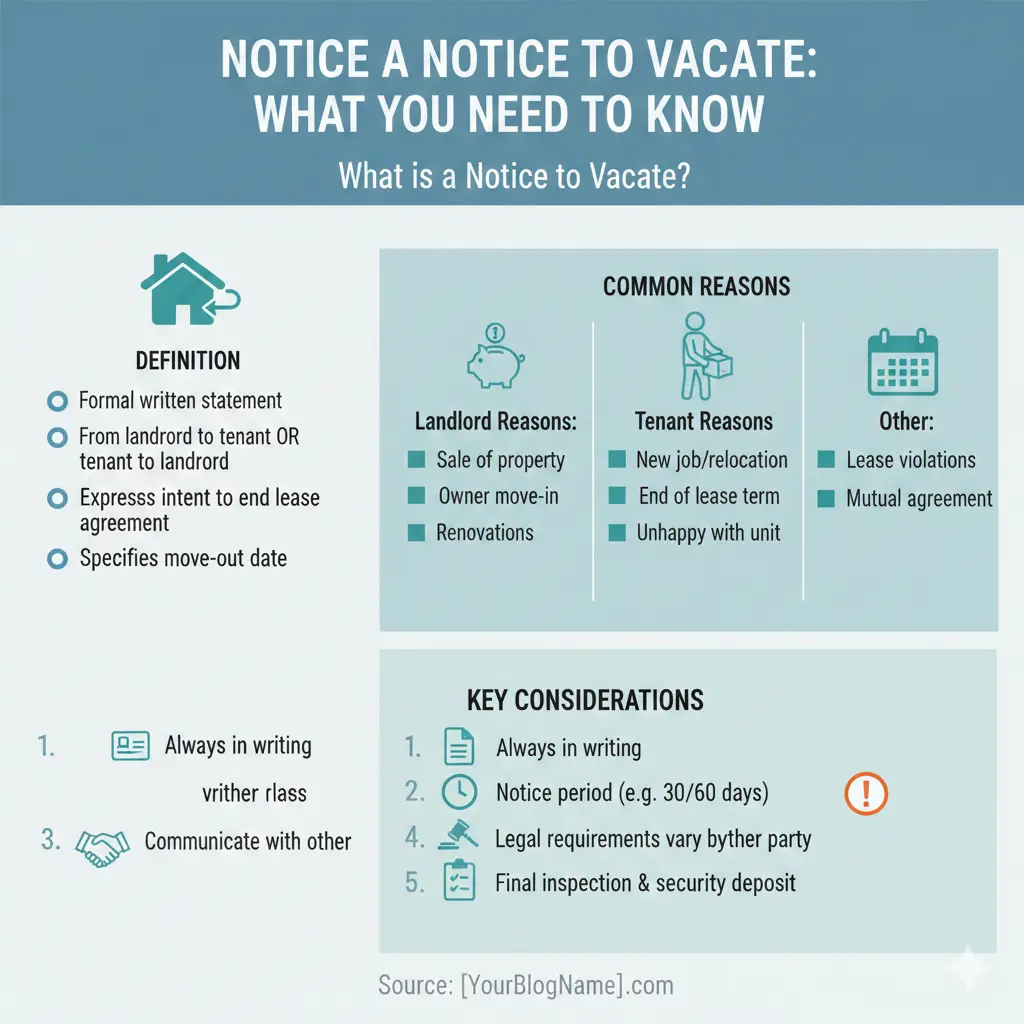
A notice to vacate is a formal written document that ends a tenancy agreement. It can come from either the landlord or tenant and must follow strict rules under the Residential Tenancies Act 1986 (RTA). In NZ, these notices apply mainly to periodic tenancies—those that roll over week-to-week or month-to-month after a fixed term ends.
Key requirements for every notice include:
- Being in writing (email or post to the provided address works, including electronic addresses for service).
- Stating the tenancy property address.
- Specifying the exact end date.
- Being signed by the giver.
Notices can be given any day of the week, and the tenancy doesn't have to end on the same day it started or rent is due. Download official templates from Tenancy Services: 90-day notice [PDF] or 42-day notice [PDF].
Recent Changes to Notice Periods (2025/2026 Updates)
The Residential Tenancies Amendment Act, effective 30 January 2025, brought significant updates to make the system fairer and more flexible. Here's what's new:
- Tenants now give just 21 days' notice to end a periodic tenancy, down from 28 days.
- Landlords can issue a 90-day no-cause notice to end periodic tenancies.
- 42-day notices for specific grounds, reduced from 63 days (previously 90 days in some cases).
These changes apply to tenancies ongoing in 2026. Fixed-term tenancies automatically become periodic unless renewed or ended with proper notice.
Notice Periods Table
| Reason/Situation | Landlord Notice | Tenant Notice | Notes |
|---|---|---|---|
| Periodic tenancy – no cause | 90 days | N/A | No reason required; cannot be retaliatory or discriminatory. |
| Specific grounds (landlord/family moving in, property sold with vacant possession, employee housing) | 42 days | N/A | Reason must be stated; family must live there 90+ days. |
| Periodic tenancy – tenant ending | N/A | 21 days | Landlord can agree to shorter; writing recommended. |
| Service tenancy (e.g., renting from employer) | 14 days (or less) | 14 days (or less) | Applies if job ends. |
| Student hostel | N/A | 14 days | If no longer a student. |
| Family violence | N/A | Shorter than 21 days | Confirmed right for tenants or dependents. |
Landlord-Issued Notices: What Tenants Need to Know
If you're a tenant, a notice to vacate NZ from your landlord typically means 90 days unless it's for a special reason. Landlords must give written notice and can't use it to punish you for complaining about repairs or discrimination.
90-Day No-Cause Notice
Landlords can end a periodic tenancy without reason after giving 90 days' notice. This is new from 2025 and gives flexibility, but you can challenge it at the Tenancy Tribunal if it's unfair (e.g., retaliatory). You still need to give your own 21 days' notice if leaving earlier.
42-Day Notice for Specific Grounds
Shorter notice applies if:
- The landlord or family needs it as their main home for 90+ days.
- It's for an employee/contractor (must be in the tenancy agreement).
- The property sold with vacant possession required.
The notice must explain the reason. If circumstances change (e.g., family doesn't move in), you may claim compensation via the Tribunal.
Other Landlord Notices
- 14 days for serious issues like assault or repeated damage (using approved form).
- Social housing like Kāinga Ora: Usually 90 days, shorter if unsafe.
Tenant-Issued Notices: How to Leave Properly
As a tenant, give at least 21 days' written notice to end your periodic tenancy. Your landlord can't refuse unless agreed otherwise in writing. Exceptions include:
- Family violence: Shorter notice allowed.
- Agreement for less notice.
- Kāinga Ora tenants: Use their form and expect a move-out checklist within 48 hours.
Practical tip: Photograph the property before leaving and complete a condition report to avoid bond disputes.
How to Serve and Respond to a Notice
Serving notice: Post, deliver, or email to the address in the tenancy agreement (electronic OK if provided). Keep proof of sending.
If you receive notice:
- Check it's valid (written, correct details, proper period).
- Apply to Tenancy Tribunal within 21 days if challenging (previously 28 days).
- Negotiate with your landlord—many disputes resolve amicably.
- Prepare to move: Update addresses with Work and Income, power companies, etc.
For landlords: Issue promptly and document reasons to avoid Tribunal challenges.
Special Situations and Exceptions
- Fixed-term tenancies: End automatically or convert to periodic; notice needed post-conversion.
- Social housing: Kāinga Ora requires 21 days from tenants, gives 90+ usually.
- Boarding houses: Different rules—check Tenancy.govt.nz.
- Disputes: Tribunal applications cost $20.80 online; free mediation first.
Practical Tips for a Smooth Move
To make notice to vacate NZ less stressful:
- For tenants: Start house-hunting early. Use Trade Me Property or Tenancy.govt.nz's rental search. Clean thoroughly and repair minor damage to get your full bond back.
- For landlords: Give clear communication. Arrange viewings only with 48 hours' notice. Help with references for good tenants.
- Both: Get bond refunded via Tenancy Services portal within 14 days of move-out.
Next Steps for Peace of Mind
Whether issuing or receiving a notice to vacate NZ, act quickly and document everything. Download templates from Tenancy.govt.nz, keep records, and seek free advice from Community Law Centres or Citizens Advice Bureau. If in doubt, apply to the Tenancy Tribunal early—it's straightforward and low-cost. Staying informed under the updated RTA keeps our rental market fair for everyone in 2026.
Frequently Asked Questions
Sources & References
-
1
Updates to the residential tenancies legislation — gifforddevine.co.nz
-
2
Giving notice to end an indefinite (“periodic”) tenancy — communitylaw.org.nz
-
3
Ending a periodic tenancy — www.tenancy.govt.nz
-
4
Giving notice to end a tenancy — www.tenancy.govt.nz
-
5
What's New in the Residential Tenancies Act - 2025 Update — www.pointpropertymanagement.co.nz
-
6
Moving out :: Kāinga Ora – Homes and Communities — kaingaora.govt.nz
-
7
Tenancy Termination Rules 2025 | NZ Law Changes — www.crockers.co.nz
-
8
Residential tenancy laws have changed. What you need to know as a tenant — www.heskethhenry.co.nz
-
9
Tenancy legislation changes — www.comprende.co.nz
-
10
Changes to the Residential Tenancies Act become law — www.hud.govt.nz
Related Articles

The Ultimate Rental Inspection Checklist for NZ Tenants
Moving into a rental in New Zealand can feel like a big step, but nothing prepares you quite like acing that first property inspection—or preparing for the regular ones that follow. As a tenant, knowi...

Healthy Homes Standards: A Guide for NZ Landlords & Renters
If you're renting or managing a property in Aotearoa, you've probably heard about the Healthy Homes Standards. These legal requirements aren't just bureaucratic boxes to tick—they're designed to ensur...

Renter's Rights in New Zealand: Know Your Protections
Imagine signing a lease only to face unexpected repairs, unfair rent hikes, or eviction threats—that's the reality too many Kiwis have faced. But with the Renters' Rights in New Zealand evolving throu...

Tenancy Law Changes 2025: What Renters Need to Know
If you're renting in New Zealand, the tenancy law changes kicking in from early 2025 could reshape your rights and responsibilities as a tenant. These updates to the Residential Tenancies Act (RTA) br...