Job Search Strategy for 2026: How to Navigate New Zealand's Competitive Market

Navigating New Zealand's job market in 2026 feels like a rugby match in the final quarter—intense competition, but with smart plays, you can score that winning try. Job ads are ticking up after eight...
The Lifetimes NZ editorial team curates, fact-checks, and updates guides on personal finance, property, health, immigration, legal, business, and lifestyle topics relevant to Lifetimes NZ readers. Articles are produced with AI assistance and reviewed by the editorial team before publication.
Navigating New Zealand's job market in 2026 feels like a rugby match in the final quarter—intense competition, but with smart plays, you can score that winning try. Job ads are ticking up after eight months of growth, signalling a stronger start to the year, yet applications per ad remain elevated, making it tougher than ever to stand out.
Whether you're a Kiwi returning from overseas, a recent grad eyeing your first role, or a mid-career switcher, this guide delivers job search tips New Zealand style: practical, localised, and tuned to our recovering economy. From Auckland's early recovery to regional hotspots like Otago, we'll cover how to find a job NZ in this competitive job market, with a solid job application strategy and fresh career advice 2026.
Understanding the 2026 NZ Job Market Landscape
New Zealand's workforce is shifting out of stagnation into slow recovery, with job ads up 1.3% in January alone and annual growth at its highest in over three years. Filled jobs hit 2.35 million in January, up 0.2% or 4,217 roles month-on-month, driven by construction, trades, and ICT. Auckland (38% of GDP) and Wellington lead the charge, though public sector contractions linger in the capital.
South Island regions like Otago and Southland shine with over 23% annual job ad growth, fuelled by construction demand. Nationally, consumer spending is rebounding in retail, hospitality, and logistics—industries hiring ahead of the curve.
Hot Sectors and In-Demand Roles
- Construction and Trades: Up 20.1% in job ads annually—think drivers, labourers, and trades workers.
- Healthcare: Registered nurses, GPs, practice managers—driven by our ageing population.
- Education: Teachers, centre managers amid population growth.
- ICT and Tech: Software developers, AI skills surging as businesses adopt slowly.
- Business Services: Accountants, category managers (up to $125k), sourcing specialists.
Check Immigration NZ's Green List for skill shortages offering visa pathways like Straight to Residence—vital if you're on a working holiday or skilled migrant visa.
Lower-skilled roles grow slower (1.2% annually), so upskill where possible via StudyLink or free TTA courses.
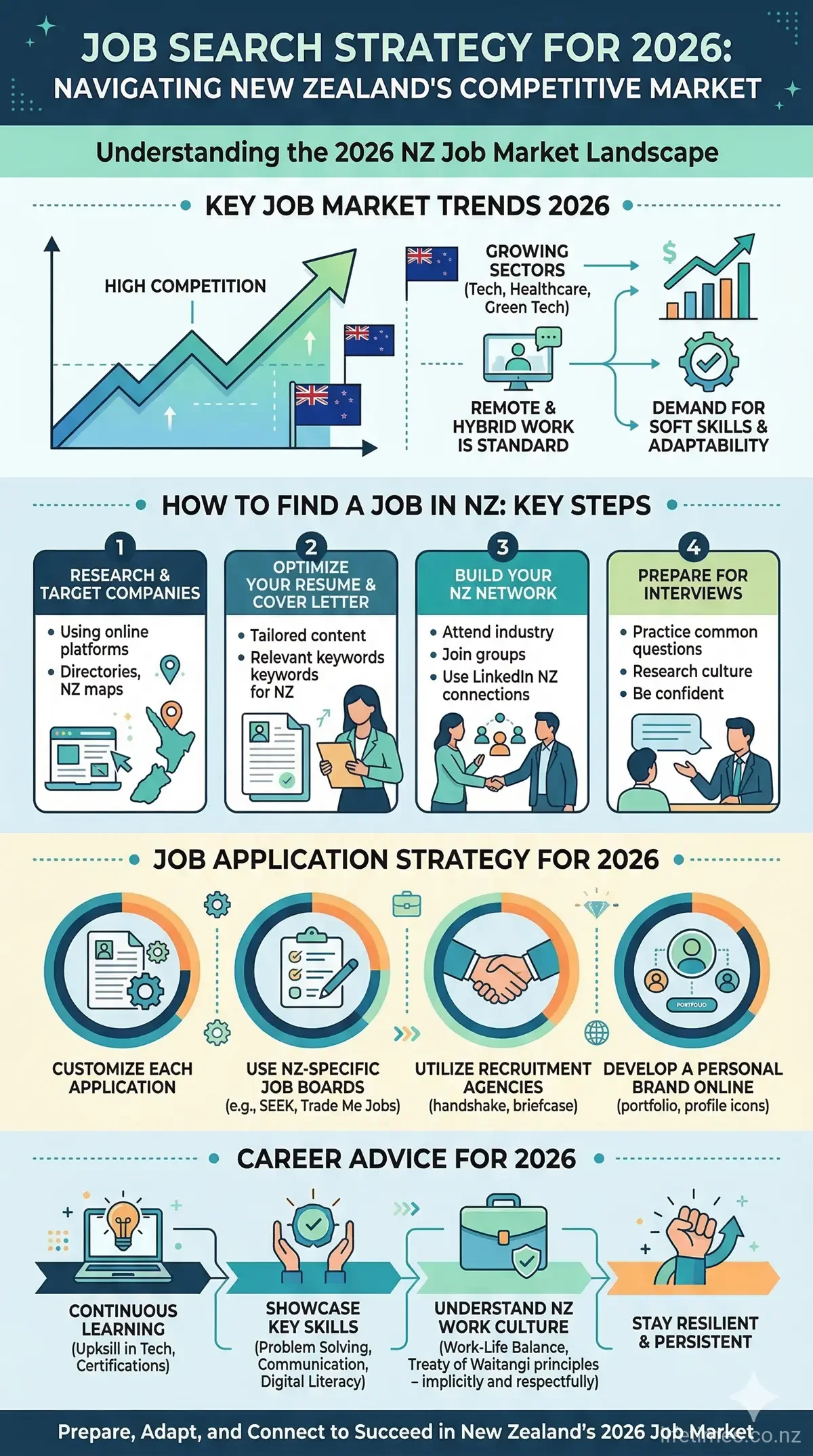
Build a Standout Job Application Strategy
In this competitive job market, generic applications won't cut it. Tailor everything to Kiwi employers who value practical skills and cultural fit.
Optimise Your CV and Cover Letter for NZ Employers
- Keep it concise: One-two pages max. Use NZ format: contact details top, then summary, skills, experience reverse-chronological.
- Keywords matter: Scan job ads on SEEK or Trade Me Jobs and mirror phrasing—ATS systems filter 75% of apps pre-human eyes.
- Quantify achievements: "Boosted sales 20% at Warehouse" beats "Handled sales."
- Cover letter hack: One page, address to hiring manager (LinkedIn stalk if needed), link your skills to their pain points like cost savings or AI integration.
Highlight KiwiSaver contributions or ACC familiarity in professional services roles to show local savvy.
Leverage Key Job Platforms and Networks
- SEEK.co.nz: Dominant with rising ads—set alerts for your region.
- Trade Me Jobs: Great for entry-level and regional gigs.
- LinkedIn: 80% of NZ recruiters use it. Optimise profile with Green List skills, join groups like "NZ Jobs" or "Auckland Tech."
- Government hubs: Careers.govt.nz for advice; WINZ for job clubs if eligible.
- Recruiters: Hays, Randstad for hot sectors like IT and healthcare.
Network at industry events via Meetup or events.govt.nz. 70% of jobs aren't advertised—coffee chats land hidden gems.
Master the Interview Process in 2026
With AI reshaping expectations, prep for behavioural and skills-based questions. Virtual interviews dominate; test Zoom on Starlink if rural.
Common Pitfalls and How to Ace Them
- Research the employer: Know their IRD compliance or KiwiSaver provider—shows diligence.
- AI twist: "How would you use AI in this role?" Practice with free tools like ChatGPT for mock responses.
- Cultural fit: Emphasise teamwork ("whanau vibe") and adaptability—NZ bosses hate divas.
- Salary talk: Research via SEEK Salary Checker. Minimum wage hits $23.95/hr from April 2026.
Follow up with a thank-you email recapping your value-add.
Upskilling and Long-Term Career Advice 2026
Highly-skilled roles grow fastest (27,400 annually), so invest now. Free options:
- Digital: The Digital Hub for AI, coding.
- Trades: BCITO apprenticeships in construction hotspots.
- Healthcare/Education: Pathways via Te Whatu Ora or TeachNZ.
Track KiwiSaver for career breaks; use StudyLink for formal quals.
Regional Job Search Tips
| Region | Hot Spots | Tips |
|---|---|---|
| Auckland | IT, Logistics | Target recovery firms; commute via AT. |
| Wellington | Govt & Defence (+3.3%) | Public sector thaw—update security clearance. |
| Otago/Southland | Construction (+23%) | Relo incentives common. |
| Gisborne | General (+3.9%) | Agri links via local iwi. |
Next Steps to Land Your 2026 Role
Update your CV today, set five job alerts on SEEK, and book a recruiter coffee. Track progress weekly—persistence pays in our tightening market. You've got the strategy; now execute like a All Black. Kia kaha!
Frequently Asked Questions
Sources & References
-
1
New Zealand hiring market: Workforce outlook for 2026 — www.talentinternational.com
- 2
-
3
Medium to long-term employment outlook: Looking ahead to 2026 — www.mbie.govt.nz
-
4
The 2026 list of most in demand jobs in New Zealand for skilled... — www.pssremovals.com
-
5
New Zealand IT Job Market looking promising as 2026 kicks off — www.youtube.com
-
6
Most In-Demand Jobs In New Zealand 2026 - Hays NZ — www.hays.net.nz
-
7
Employment indicators: January 2026 - Stats NZ — www.stats.govt.nz
Related Articles

AI Skills in Demand: How to Future-Proof Your Career in New Zealand
Imagine landing a job in 2026 where your salary jumps by 30% just because you've got the right AI skills. That's the reality for Kiwis tuning into the tech wave right now, as demand surges across IT,...

Minimum Wage Increase April 2026: What It Means for NZ Job Seekers & Employers
Imagine finishing a long shift at your local café or warehouse, knowing that from April 1, 2026, every hour you work will be worth a bit more. New Zealand's adult minimum wage is rising from $23.50 to...

Beating the Aussie Exodus: How to Negotiate Better Salaries & Benefits in New Zealand
Thinking about packing your bags for Australia? You're not alone—thousands of Kiwis cross the ditch each year chasing higher pay and sunnier skies. But with New Zealand's job market heating up in 2026...

Gene Technology & Life Sciences Jobs: New Zealand's Emerging Career Sector
Imagine a career where you're at the forefront of editing genes to cure diseases, developing sustainable biotech solutions for New Zealand's farms, or ensuring our cutting-edge science complies with t...