Job Searching in Auckland 2026: Tips for the Early Recovery Phase

Auckland's job market is turning a corner. After experiencing one of the sharpest rises in unemployment over the past year, the city is now showing early signs of recovery with job ads lifting and hir...
The Lifetimes NZ editorial team curates, fact-checks, and updates guides on personal finance, property, health, immigration, legal, business, and lifestyle topics relevant to Lifetimes NZ readers. Articles are produced with AI assistance and reviewed by the editorial team before publication.
Auckland's job market is turning a corner. After experiencing one of the sharpest rises in unemployment over the past year, the city is now showing early signs of recovery with job ads lifting and hiring activity beginning to rebuild. If you're job searching in Auckland right now, you're entering a pivotal moment—one where timing, strategy, and the right approach can make a real difference to your chances of landing a role.
The good news? Industries like IT, logistics, construction, and professional services are already showing stronger demand, and as mortgage pressures ease and business investment improves, more opportunities are expected to emerge throughout 2026. The challenge is that competition remains fierce, with applications per job ad rising significantly as both local and offshore candidates vie for positions. This guide will help you navigate Auckland's emerging job market with practical, actionable strategies tailored to Kiwis.
Understanding Auckland's Labour Market Right Now
To job search effectively, you need to understand what's actually happening in Auckland's economy. The city has been through a tough period—job ads fell significantly from their post-COVID highs, and hiring demand was subdued across professional services, construction, retail, and customer-facing sectors. But the tide is turning.
Early indicators show stabilisation is underway. Job ads are lifting, discretionary spending is picking up, and employers are becoming more active. This matters because Auckland drives approximately 38% of the country's GDP, so when Auckland recovers, New Zealand as a whole benefits. Employment growth is forecast to increase by 80,000 people across 2026 nationally, with Auckland playing a central role in this recovery.
The shift is gradual rather than dramatic, which means you're not looking at a sudden rush of jobs—but rather a steady increase in opportunities as the year progresses. This is actually an advantage for savvy job seekers who act now, before competition intensifies.
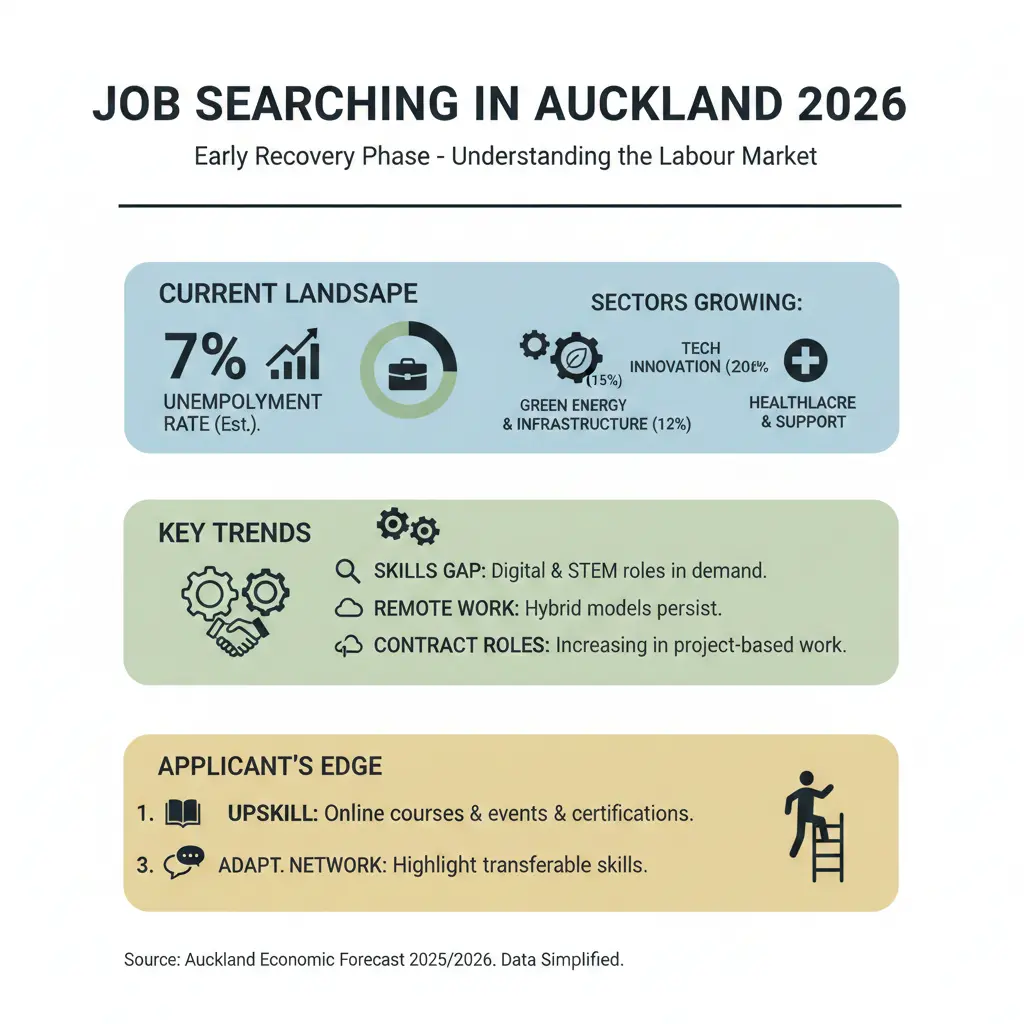
Industries and Roles with the Strongest Demand
Not all sectors are recovering at the same pace. Knowing where the growth is happening helps you focus your search effectively.
IT and Technology
Demand for AI-related skills has surged, especially in IT, marketing, and strategy roles. While only a small share of New Zealand jobs can be fully automated, most will see tasks change, elevating the importance of capability building. If you have IT skills—particularly in software development, data analysis, or emerging tech areas—you're in a strong position. Specialised software developers are among the top roles most in demand in 2026.
Construction and Logistics
These sectors are leading employment growth nationally, with business services and construction forecast to have the strongest employment gains. In Auckland specifically, construction demand is expected to strengthen as business investment improves and residential investment continues. If you're in construction management, trades, or logistics coordination, opportunities are expanding.
Professional Services
Accountants and executive assistants are among the top roles most in demand in 2026. As business confidence improves and companies rebuild after the downturn, they're investing in professional support roles to manage growth and compliance.
Consumer Services and Hospitality
As discretionary spending picks up and mortgage pressures ease, consumer-facing businesses are beginning to hire again. Retail, hospitality, and service roles are expected to see stronger demand as the year progresses.
Practical Job Search Strategies for Auckland 2026
Timing Your Applications Strategically
Applications per job ad have risen significantly, meaning competition is real. Rather than applying to every role you see, focus on quality over quantity. Target roles that align with your skills and the sectors showing growth. Apply early—within 24–48 hours of a job being posted, when your application is more likely to stand out in a smaller initial pool.
Highlight Relevant Skills, Especially AI and Digital Capability
Even if you're not in a tech role, demonstrating familiarity with digital tools and AI applications is increasingly valuable. On your CV and LinkedIn profile, emphasise any experience with automation tools, data analysis, or digital transformation projects. This shows you're adaptable and future-ready, which matters in a recovering market where businesses are rebuilding with new priorities.
Leverage Your Network Actively
With heavy application pipelines, getting your CV in front of hiring managers through personal connections matters more than ever. Attend industry events, reconnect with former colleagues on LinkedIn, and let people know you're actively job searching. Many roles are filled through networks before they're advertised widely.
Consider Contract and Temporary Roles
As businesses test the waters during early recovery, they often hire contractors or temporary staff before committing to permanent roles. These positions can be a foot in the door and provide valuable recent experience on your CV, making you more competitive for permanent roles later.
Tailor Your Applications to Each Role
With more applications per ad, generic cover letters don't cut it. Take time to customise your application to each role, highlighting specific skills and experience that match the job description. Mention your understanding of Auckland's market recovery and how you're positioned to contribute to growth.
Frequently Asked Questions
Sources & References
-
1
Trade Me Job — lifetimes.co.nz
-
2
workandincome.govt.nz — www.workandincome.govt.nz
-
3
[1] — www.talentinternational.com
-
4
Talent International – New Zealand hiring market: Workforce outlook for 2026 — www.talentinternational.com
-
5
MBIE – Medium to long-term employment outlook: Looking ahead to 2026 — www.mbie.govt.nz
- 6
-
7
Hays NZ – Most In-Demand Jobs In New Zealand 2026 — www.hays.net.nz
-
8
Work and Income – Official New Zealand employment support — www.workandincome.govt.nz
Useful Tools
Related Articles

Using Case Converters for Professional NZ Emails
This article references the following sources for accuracy and further reading:

Highest Paying Jobs in NZ 2026: Industries That are Desperate for Staff
If you're considering a career change or planning your next move in the New Zealand job market, you'll want to know where the money is—and more importantly, where employers are actively hiring. The go...

The Perfect NZ CV: A Free Template for 2026 Job Seekers
Your CV is your first chance to impress employers and land that job interview you're after. Whether you're a school leaver, career changer, or experienced professional, having a well-crafted CV tailor...
Best Recruitment Agencies for Tech Jobs in NZ
Searching for your next tech role in New Zealand's buzzing job market? With Kiwi tech hubs like Auckland, Wellington, and Christchurch leading the charge in cloud computing, cybersecurity, and softwar...