Upskilling for AI Jobs in New Zealand: Essential Skills for 2026 Hirings

Artificial intelligence is reshaping New Zealand's job market faster than ever before. With 87% of Kiwi companies reporting AI-driven changes to job roles and 42% of hiring managers now prioritising A...
The Lifetimes NZ editorial team curates, fact-checks, and updates guides on personal finance, property, health, immigration, legal, business, and lifestyle topics relevant to Lifetimes NZ readers. Articles are produced with AI assistance and reviewed by the editorial team before publication.
Artificial intelligence is reshaping New Zealand's job market faster than ever before. With 87% of Kiwi companies reporting AI-driven changes to job roles and 42% of hiring managers now prioritising AI-related skills, the time to upskill isn't tomorrow—it's now. Whether you're looking to stay competitive in your current role or transition into a new career, understanding what employers want and how to develop those skills could be the difference between thriving and struggling in 2026's evolving workforce.
The AI Skills Boom: What's Actually Happening in New Zealand
New Zealand's job market is experiencing a significant shift. References to AI skills in job advertisements have surged, particularly in IT, marketing, and consulting roles. But this isn't just hype—it's backed by real hiring decisions. Nearly half of New Zealand employers are prepared to offer AI specialists salary premiums averaging 21% above comparable technology roles, with additional incentives including access to new technology and clear career progression pathways.
The demand is genuine and growing. According to recent research, 62% of workers now have a more favourable view of AI compared to 12 months ago, with 76% of respondents reporting a positive outlook on AI's role in their work. This optimism reflects a broader recognition that AI isn't replacing jobs—it's transforming them.
However, there's a catch. While job displacement directly attributed to AI remains limited at around 10%, two-thirds of workers anticipate that some of their current responsibilities will be automated within three years. This means upskilling isn't optional; it's essential for career security.
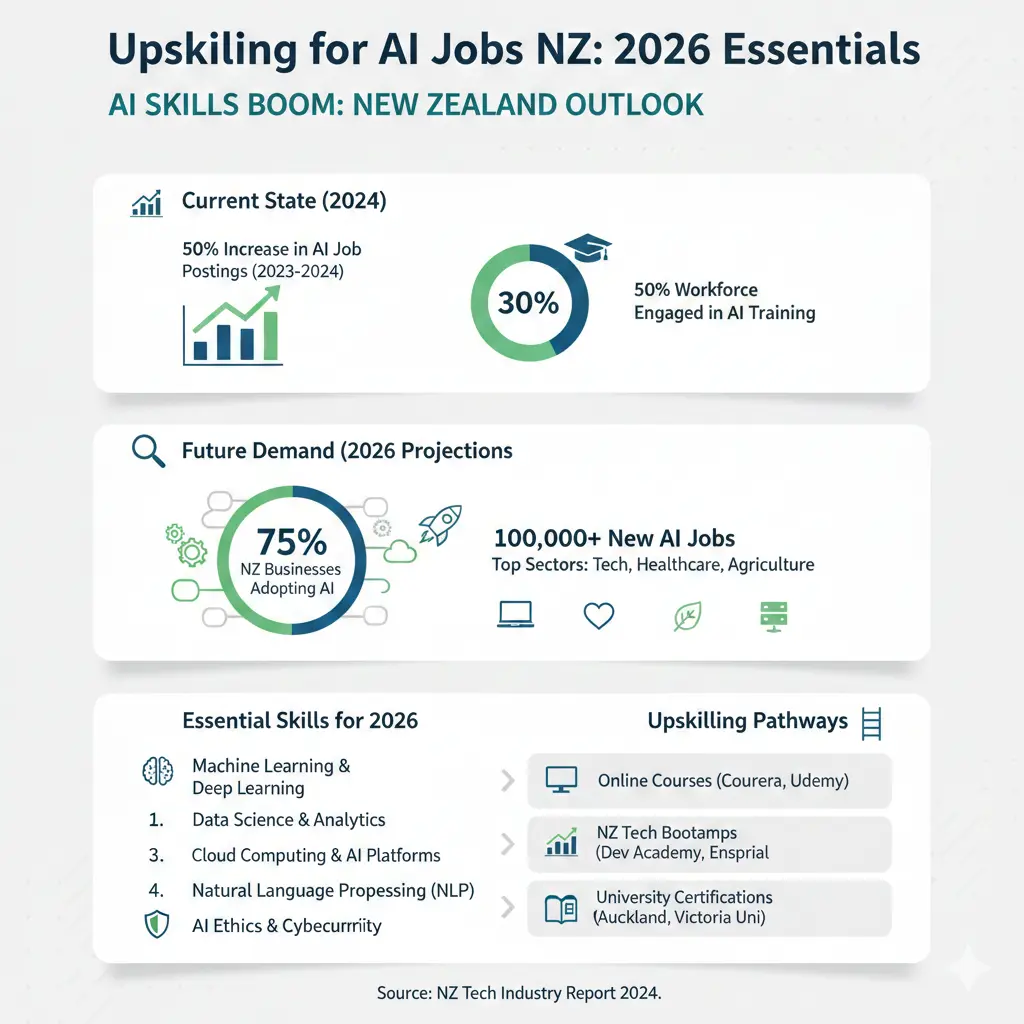
Which Skills Are Employers Actually Looking For?
If you're wondering what to focus on, here's what New Zealand employers are prioritising right now:
Technical and AI-Specific Skills
For entry-level roles, 65% of New Zealand companies now say technical certifications in AI tools or coding bootcamps are critical. The roles in highest demand include AI and Machine Learning Engineers, Data Analysts, and Analytics Engineers. These aren't niche positions—they're becoming mainstream requirements across industries.
The shift is dramatic. Only 5% of organisations globally now view traditional university degrees as essential for entry-level positions, compared to the importance placed on practical credentials. This is a game-changer for Kiwis who might not have formal qualifications but can demonstrate real skills.
Soft Skills That Matter More Than Ever
Technical know-how alone isn't enough. Employers are seeking candidates who can:
- Think critically and solve problems (61% of companies prioritise this)
- Evaluate AI outputs critically and apply sound judgment
- Demonstrate a portfolio of work (59% of companies value this)
- Communicate effectively and manage information
The message is clear: combine domain expertise with effective use of automation tools, and you'll be valuable to employers.
AI Literacy Across All Roles
You don't need to become an AI engineer to benefit from upskilling. Only 47% of employers currently encourage staff to use AI at work, yet workers are experimenting with these tools at rising rates. This gap represents an opportunity. Workers who develop AI literacy—understanding how to use these tools effectively in their day-to-day work—may be able to command higher hourly rates than peers.
The Entry-Level Challenge: What Young Kiwis Need to Know
If you're starting your career, pay attention. A third of New Zealand companies have already slowed entry-level hiring, and 88% expect to further reduce such recruitment within the next three years. This sounds daunting, but it's not a reason to panic—it's a reason to be strategic.
The challenge is real: 76% of New Zealand organisations report that opportunities for junior employees to develop through traditional work experience have diminished, higher than in any other country surveyed. This means the traditional pathway of learning on the job is changing.
Here's what this means for you:
- Build a portfolio before you apply. With practical skills now carrying more weight than academic credentials, a portfolio of work demonstrating your abilities is more valuable than ever.
- Get certified in AI tools. Consider coding bootcamps or technical certifications in popular AI platforms. These are now seen as critical by 65% of employers.
- Develop problem-solving skills. Focus on critical thinking and your ability to tackle complex problems—61% of employers prioritise this.
- Show you understand AI's limitations. Employers want candidates who can evaluate AI outputs critically, not just use them blindly.
Practical Upskilling Pathways for Kiwis
Online Learning Platforms and Certifications
The good news? You don't need to quit your job or move cities to upskill. Platforms like Coursera, edX, and LinkedIn Learning offer AI-related courses ranging from beginner-friendly introductions to advanced machine learning specialisations. Many are affordable and flexible around your schedule.
Look for certifications in:
- AI fundamentals and prompt engineering
- Data analysis and visualisation
- Python or other programming languages
- Machine learning basics
- AI ethics and responsible AI use
Coding Bootcamps in New Zealand
New Zealand has several reputable coding bootcamps that offer intensive, practical training. These are particularly valuable if you want to transition into tech roles quickly. Many now include AI modules as standard.
Employer-Sponsored Training
If you're currently employed, check whether your employer offers upskilling opportunities. Across New Zealand, 67% of organisations are investing in AI-related training and reskilling programmes. Ask your manager or HR team what's available. This is often the most accessible and affordable pathway.
However, barriers exist. Limited employee engagement (61%), budget constraints (53%), and a shortage of expert trainers (48%) are the top obstacles organisations face. If your employer isn't offering training, it might be worth raising the conversation—many are looking to expand these programmes.
Self-Directed Learning
You don't need a formal course to start. Experiment with AI tools like ChatGPT, Claude, or industry-specific platforms. Read case studies about how organisations are using AI. Follow industry blogs and podcasts. The key is consistent, deliberate practice.
Navigating the Job Market in 2026
Beyond upskilling, how you apply for jobs matters. New Zealand's job market is experiencing significant friction. Forty-one percent of workers are actively or passively looking for new roles, yet 62% are avoiding applications because they find the hiring process too frustrating.
Common complaints include:
- Vague or confusing job advertisements
- Unrealistic skill requirements
- Slow or inconsistent communication
- Absence of salary benchmarks
Here's how to stand out:
- Be specific about your AI skills. Instead of just listing "AI experience," specify which tools you've used and what you've accomplished with them.
- Tailor your application. Show you understand the role and how your skills address their specific needs.
- Follow up professionally. If you don't hear back within a reasonable timeframe, a polite follow-up can demonstrate your genuine interest.
- Highlight your portfolio and certifications. These matter more than ever in demonstrating competence.
Employers who implement AI-enabled processes and more transparent hiring practices are moving faster in the tight labour market and attracting more selective candidates. This means employers are improving their processes—but you can also benefit by being a clear, well-prepared applicant.
The Wage and Career Growth Opportunity
Let's talk about money. Science and Technology has seen a 3.5% year-on-year wage increase, with the median hourly wage in that sector reaching $55.80 in November. More broadly, workers who can use emerging AI tools may be able to command higher hourly rates than peers.
Beyond immediate pay bumps, developing AI skills opens doors to roles with:
- Access to new technology and advanced tools
- Clear career progression pathways
- Opportunities to work on high-value projects
- Greater job security in an evolving market
Addressing the Policy and Uncertainty Gap
One thing to be aware of: New Zealand's AI governance landscape is still developing. Only 27% of New Zealand organisations state they're very familiar with local AI regulations, and just 24% find these laws clear and business-friendly. Only 21% of New Zealand companies have formal policies governing employee use of AI.
What does this mean for you? As you develop AI skills, also develop an understanding of AI ethics and responsible use. This knowledge will be increasingly valuable as regulations develop and organisations establish clearer policies around AI use.
The Bottom Line: Your 2026 Career Strategy
New Zealand's job market is shifting, and AI is at the centre of that shift. But here's the encouraging part: this is an opportunity, not a crisis. Employers are actively seeking skilled workers. Wages for AI-skilled roles are rising. And the pathways to develop these skills are more accessible than ever.
Your next steps:
- Assess your current skills. What do you already do well? Which AI tools could enhance your work?
- Choose your learning pathway. Whether it's online courses, a bootcamp, or employer-sponsored training, pick something that fits your situation.
- Start small and build momentum. You don't need to become an expert overnight. Begin with foundational knowledge and build from there.
- Document your learning. Build a portfolio of projects and certifications that demonstrate your capabilities.
- Stay curious and adaptable. AI is evolving rapidly. The ability to learn and adapt will serve you better than any single certification.
The Kiwis who upskill now will be the ones leading in 2027 and beyond. The question isn't whether AI will affect your career—it will. The question is whether you'll be ready to embrace it.
Frequently Asked Questions
Sources & References
-
1
AI transforms New Zealand jobs as entry-level hiring slows — itbrief.co.nz
-
2
AI surge leaves New Zealand workplaces racing to catch up — www.insurancebusinessmag.com
-
3
AI, flexibility & friction reshape New Zealand jobs in 2026 — ecommercenews.co.nz
-
4
New Zealand hiring market: Workforce outlook for 2026 — www.talentinternational.com
-
5
AI impacting entry-level jobs – report — www.reseller.co.nz
-
6
NZ Tech Jobs & AI: What Recruiters say is really happening — www.missionreadyhq.com
Related Articles

Using Case Converters for Professional NZ Emails
This article references the following sources for accuracy and further reading:

Highest Paying Jobs in NZ 2026: Industries That are Desperate for Staff
If you're considering a career change or planning your next move in the New Zealand job market, you'll want to know where the money is—and more importantly, where employers are actively hiring. The go...

The Perfect NZ CV: A Free Template for 2026 Job Seekers
Your CV is your first chance to impress employers and land that job interview you're after. Whether you're a school leaver, career changer, or experienced professional, having a well-crafted CV tailor...

Best Recruitment Agencies for Tech Jobs in NZ
Searching for your next tech role in New Zealand's buzzing job market? With Kiwi tech hubs like Auckland, Wellington, and Christchurch leading the charge in cloud computing, cybersecurity, and softwar...