Remote Work in NZ: Which Kiwi Companies Offer True Flexibility?

Remote work in New Zealand has transformed from a pandemic novelty into a permanent fixture of the modern workplace. But while flexibility is increasingly available, the reality for Kiwi workers is mo...
Priya writes about immigration pathways, job searching, and building a career in New Zealand. She covers visa options, CV writing, interview preparation, and workplace culture for newcomers and locals alike.
Remote work in New Zealand has transformed from a pandemic novelty into a permanent fixture of the modern workplace. But while flexibility is increasingly available, the reality for Kiwi workers is more nuanced than headlines suggest. Understanding which companies genuinely offer flexible working arrangements—and how to find them—can help you land a role that truly fits your lifestyle.
The Current State of Remote Work in New Zealand
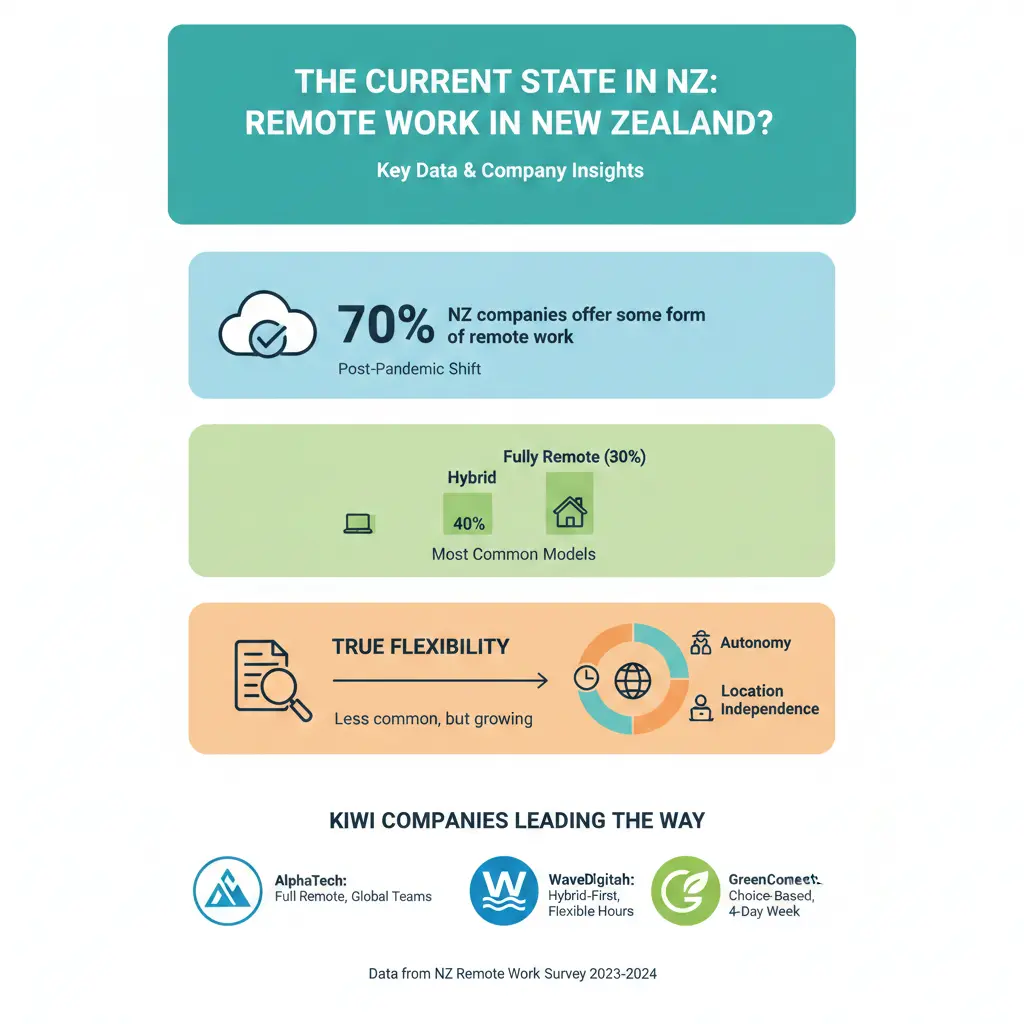
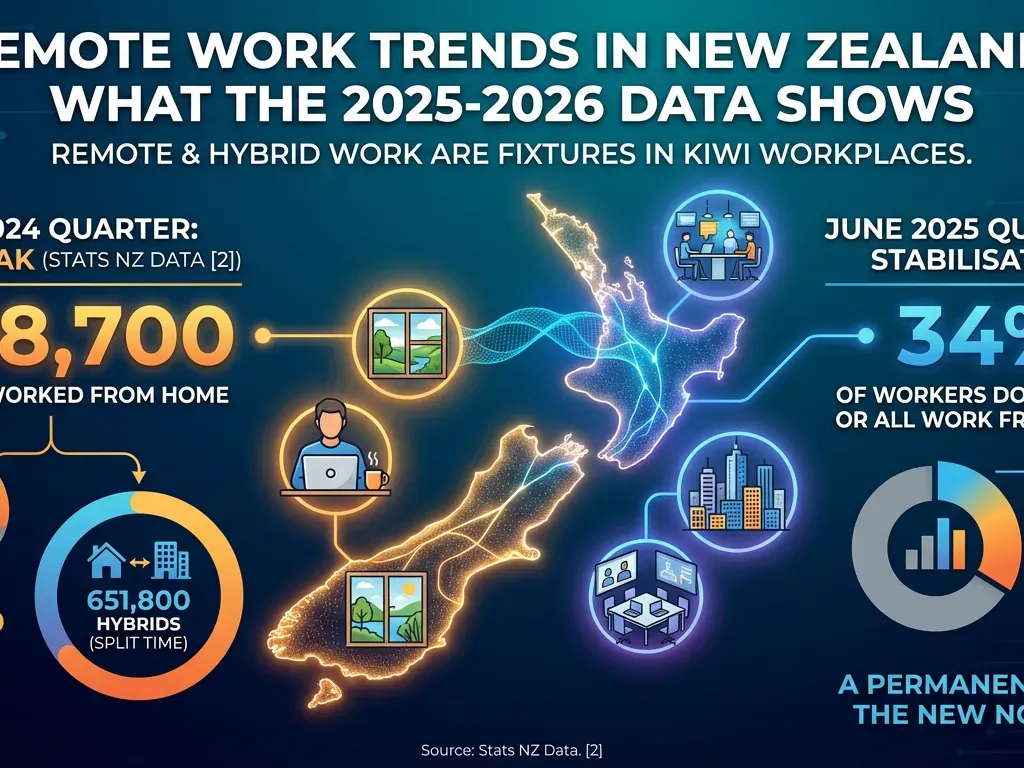
New Zealand's remote work landscape has stabilised at a significantly higher level than pre-pandemic norms. According to the latest data, 34% of workers did some or all of their work from home in the June 2025 quarter. However, this masks important variations in how "remote work" is actually practised across different sectors and company sizes.
The 2023 census revealed that 17.7% of workers "mostly" worked from home—a substantial increase from 11.9% in 2018. Among major regions, 18–20% of workers were primarily based at home. Interestingly, remote work adoption varies significantly by age: only 7.2% of those aged 16–24 teleworked, compared to 25.0% of ages 25–54 and 23.7% of ages 55+.
Public Service Leadership on Flexible Working
New Zealand's public service provides valuable insight into how large organisations are managing flexible work arrangements. Recent data from the 2025 Public Service Census shows that 65% of public servants use some form of flexible working arrangement—whether compressed hours, flexible start times, or working from home.
However, the public service's approach reflects a broader shift in thinking about remote work. On average, public servants now work from home 0.85 days per week, down slightly from 0.89 days in the previous survey. More than half of all public servants (55%) don't typically work from home or do so infrequently. The most common working from home day is Friday, with 21% of public servants typically working remotely on that day.
Importantly, all working from home arrangements in the public service are now agreements between staff and their managers. As Public Service Commissioner Sir Brian Roche noted, this reflects the Government's expectation that working from home is not an entitlement but rather a negotiated arrangement based on role requirements and productivity outcomes.
What This Means for You
If you're considering a public service role, understand that flexibility isn't automatic. You'll need to discuss working arrangements with your manager based on your specific role and team needs. The good news? 49% of managers in the public service said staff working from home either increased productivity or had no impact, suggesting there's genuine openness to flexible arrangements where they make sense.
Private Sector Trends and Company Flexibility
Beyond the public service, New Zealand's private sector is maintaining strong commitment to flexible work. 67% of companies will continue offering some level of flexibility through 2026, and 88% of employers provide at least some hybrid work options to their staff.
This doesn't mean every company offers the same level of flexibility. The shift away from full return-to-office mandates has been less dramatic than some feared. Research shows that only around 12% of executives with hybrid and remote employees actually plan to implement a full return-to-office mandate. The reality is that actual office occupancy rates hover around 50-60% on any given weekday—nowhere near pre-pandemic levels.
Finding Companies That Actually Offer Flexibility
When evaluating potential employers, look beyond the job description. Here's what to investigate:
- Job posting language: Companies genuinely committed to flexibility typically mention it explicitly in their job postings. Vague references to "flexible arrangements" deserve follow-up questions during interviews.
- Manager discretion: Ask specifically whether working from home is a policy-backed entitlement or subject to manager approval. Companies that have formalised flexible working policies tend to be more reliable.
- Team structure: In your interview, ask about your team's current working arrangements. If 80% of your team is in the office daily, you'll likely face pressure to do the same regardless of official policy.
- Role type: Knowledge workers in tech, finance, and professional services typically have more flexibility than roles requiring client-facing interaction or hands-on work.
- Company size: Larger organisations are more likely to have formalised flexible working policies, though they may be more bureaucratic to access.
The Productivity Question: Does Remote Work Actually Work?
One reason companies maintain flexibility is that the evidence supports it. Research shows that remote workers are 35%-40% more productive than their office counterparts, often because they experience fewer interruptions when working from home.
Interestingly, productivity gains aren't universal. 13% of employees are more productive when working from home and tend to request fewer days off, while others thrive with more office collaboration. This variation is why genuine flexibility—where arrangements match individual and team needs—tends to produce the best outcomes.
Employee loyalty is another significant factor. 81% of people said they would be more loyal to their employer because working remotely gives them work-life balance and decreases commuting time. For employers struggling with retention, offering flexibility is increasingly non-negotiable.
Wellbeing and the Hybrid Sweet Spot
While remote work offers clear benefits, it's not without challenges. 79% of remote professionals report lower stress levels, but fully remote workers experience higher rates of loneliness and emotional distress. The evidence suggests that genuine hybrid arrangements—enough in-person connection to combat isolation, enough flexibility to improve work-life balance—represent the optimal balance.
This explains why the Kiwi workplace has largely settled on hybrid models rather than full remote or full office arrangements. Most companies are finding that a mix of in-office and remote days works best for both productivity and employee wellbeing.
Your Rights and Responsibilities
In New Zealand, flexible working isn't a legal entitlement for all workers, but employees have certain protections. The Employment Relations Act allows employees to request flexible working arrangements, and employers must consider these requests genuinely. However, employers can decline if there's a legitimate business reason.
Key points to understand:
- Flexible working arrangements must be agreed between you and your employer—they're not automatic.
- Your employer can set conditions, such as requiring you to be in the office on specific days or for specific meetings.
- If you're unhappy with a decision, you can raise it through your workplace's dispute resolution process or contact the Department of Labour.
- Many companies use flexible working as part of their employment agreements, so check what's actually written into your contract.
Sectors Leading the Flexibility Charge
Some sectors have embraced remote and hybrid work more enthusiastically than others. Technology companies, particularly those in Auckland's tech hub, have been early adopters. Professional services firms (accounting, law, consulting) often offer flexibility, though client-facing requirements may limit it. Finance and insurance sectors have increasingly adopted hybrid models. Creative industries and digital agencies tend to offer strong flexibility options.
Conversely, sectors like hospitality, retail, healthcare, and construction have more limited remote work options due to the nature of the work itself.
Making Remote Work Work for You
If you're seeking a role with genuine flexibility, here's a practical approach:
- Be specific in your job search: Use keywords like "hybrid," "flexible," or "remote" when searching job boards. Websites like Seek, TradeMe Jobs, and LinkedIn allow you to filter by work arrangement.
- Ask detailed questions in interviews: Move beyond "Do you offer flexible working?" to "What does a typical week look like?" and "How many days per week would I be expected in the office?"
- Get it in writing: Once you've agreed on flexible arrangements, ensure they're documented in your employment agreement or a formal arrangement letter.
- Communicate expectations: Once employed, clarify with your manager how your flexible arrangement will work in practice, including any core hours or meeting days.
- Prove your productivity: If you're one of the first in your team to work flexibly, demonstrate that you're meeting deadlines and maintaining communication. This helps normalise flexibility for others.
The Bottom Line
Remote and hybrid working are now permanent features of New Zealand's workplace landscape. 34% of workers do some or all of their work from home, and most companies are committed to maintaining flexibility. However, the level of flexibility varies significantly by company, sector, and role.
Rather than assuming flexibility is available, investigate actively. Ask specific questions during interviews, get arrangements in writing, and choose employers whose values align with how you want to work. The good news? With 67% of companies continuing to offer flexibility through 2026, you have genuine choice in how and where you work.
Start by clarifying what flexibility means to you. Do you want fully remote work, or would 2-3 days from home suit you better? Once you know what you're looking for, you can target companies and roles that genuinely deliver it—rather than discovering after you're hired that "flexible working" means something quite different in practice.
Frequently Asked Questions
Sources & References
-
1
Hybrid Working in New Zealand | What 2026 Data Shows | ZEIL — www.zeil.com
-
2
How Many People Work Remotely [Trends & Insights 2026] — fmcgroup.com
-
3
New data released on public servants working from home — www.publicservice.govt.nz
-
4
Hybrid Work Gets Its Second Act - New Zealand — www.insentragroup.com
- 5
-
6
Hybrid Work Gets Its Second Act - New Zealand — www.insentragroup.com
Related Articles

Best Coworking Spaces in Auckland CBD
If you're a freelancer, startup founder, or remote worker in Auckland CBD, finding the right coworking space can supercharge your productivity and network. In 2026, these top spots offer flexible desk...

The Secret to Getting a Pay Rise in NZ This Year
Ever wondered why your mate down the road just scored a hefty pay bump while you're still grinding the same old wage? In 2026, with wages ticking up across Aotearoa, the secret to getting a pay rise i...

Salary Negotiation Tips for Kiwi Workers
Ever walked away from a job offer or performance review feeling like you left money on the table? You're not alone—many Kiwis hesitate to negotiate their salary, missing out on thousands over their ca...
Remote Work Opportunities NZ 2025
Imagine ditching the daily commute, reclaiming hours for family or adventure, and building a career on your terms—all from a home office in Auckland, Wellington, or even a beachside bach. Remote work...