Salary Negotiation Tips for Kiwi Workers

Ever walked away from a job offer or performance review feeling like you left money on the table? You're not alone—many Kiwis hesitate to negotiate their salary, missing out on thousands over their ca...
The Lifetimes NZ editorial team curates, fact-checks, and updates guides on personal finance, property, health, immigration, legal, business, and lifestyle topics relevant to Lifetimes NZ readers. Articles are produced with AI assistance and reviewed by the editorial team before publication.
Ever walked away from a job offer or performance review feeling like you left money on the table? You're not alone—many Kiwis hesitate to negotiate their salary, missing out on thousands over their career. But with the right preparation and a Kiwi-style approach, you can confidently boost your earnings in New Zealand's competitive job market.
In 2026, with living costs rising and KiwiSaver contributions in focus, mastering salary negotiation tips for Kiwi workers is more crucial than ever. Whether you're eyeing a new role in Auckland's bustling tech scene or a promotion in Wellington's public sector, this guide equips you with practical steps, scripts, and NZ-specific insights to negotiate like a pro.
Why Salary Negotiation Matters for Kiwis
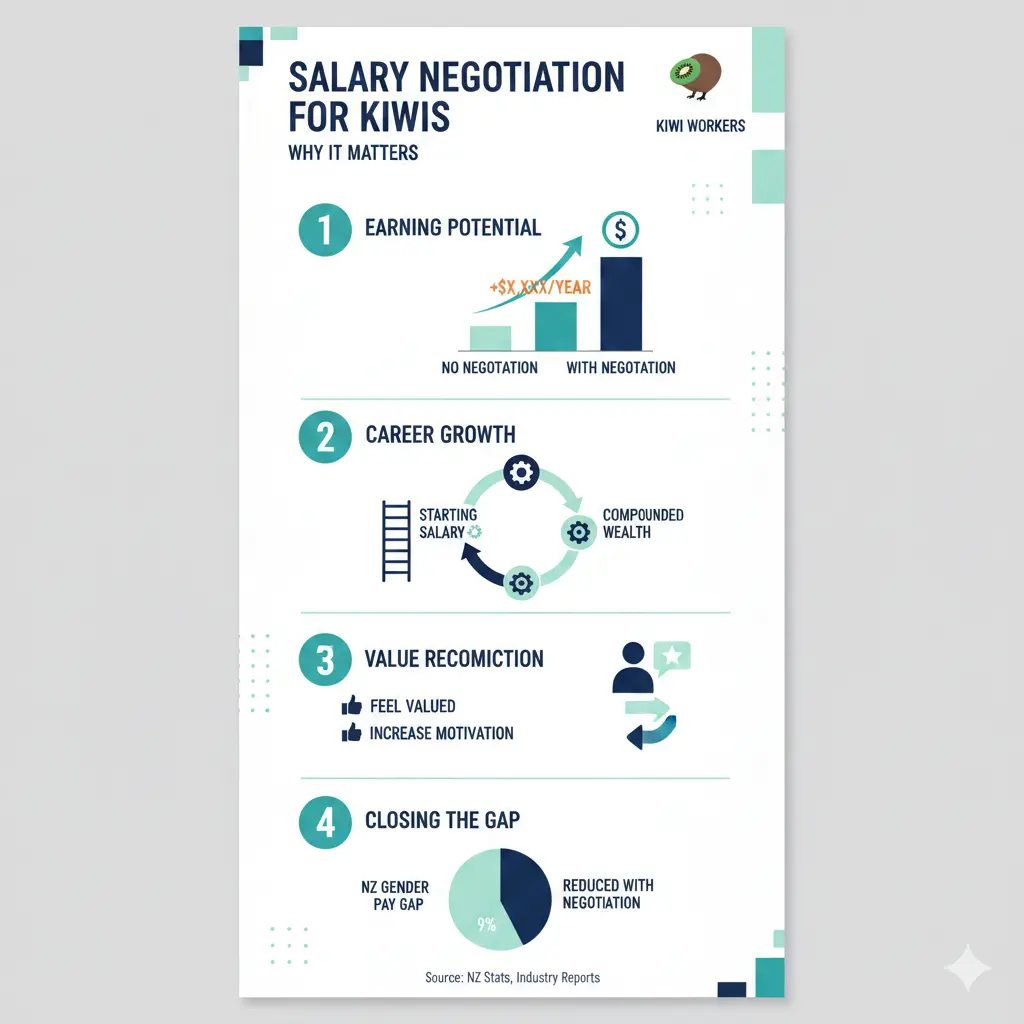
Negotiating your salary isn't just about the immediate pay bump—it's a long-term wealth builder. In New Zealand, where median full-time earnings sit around $65,000–$70,000 annually, a 5–10% increase can add up significantly, especially with compound KiwiSaver growth. Employers expect it; studies show over 80% of offers have room to move if you ask smartly.
Plus, under the Employment Relations Act 2000, you're entitled to fair pay discussions without fear of reprisal. Use resources like Stats NZ's wage data or Seek's salary checker to benchmark your worth.
Step 1: Timing Your Salary Negotiation
Timing is everything in NZ's job market. Don't rush—wait for leverage.
Best Moments to Negotiate
- After a job offer: This is prime time, as you've proven your value. Robert Half advises holding off until the formal offer lands.
- Performance reviews: Tie it to annual appraisals, especially post-budget cycles in March–April when firms allocate raises.
- After big wins: Delivered a project saving your team $50k? Schedule a chat then.
Avoid These Pitfalls
- Early interviews—let them raise salary first.
- End-of-year rushes when budgets are tight.
Pro tip: Email to book a dedicated meeting: "I'd love to discuss my contributions and future with the team—can we chat next week?"
Step 2: Research Your Market Value in NZ
Knowledge is power. NZ salaries vary hugely by region, industry, and experience—$80k median in Auckland vs. $60k in regional areas.
Top Research Tools for Kiwis
- JobSpace Salary Guide: Free NZ-specific ranges by role and city.
- Robert Walters & Robert Half: Industry benchmarks, e.g., IT pros earning $120k+ in 2026.
- Seek.co.nz & TradeMe Jobs: Check 50+ similar listings for real-time data.
- LinkedIn Salary & Glassdoor: Kiwi user-submitted insights.
- Recruiters: Chat with Randstad or local agencies for insider intel.
Calculate your range: Aim 10–20% above the midpoint based on your skills. Factor in cost of living—Wellington rents up 5% in 2026. Decide your walk-away number beforehand.
Step 3: Build Your Case with Achievements
Numbers talk. Quantify your impact to justify the ask.
- Examples: "Boosted sales 25% ($200k revenue)" or "Streamlined processes, saving 15 hours/week."
- Talking points: List education, years' experience, unique skills (e.g., te reo proficiency), and industry knowledge.
Prepare a one-pager: "In my last role at a Kiwi firm, I led a project cutting costs by 18%, directly adding to the bottom line."
Step 4: Salary Negotiation Scripts for Kiwis
Practice makes perfect. Rehearse these NZ-adapted scripts for confidence.
Job Offer Script
"Thanks so much for the offer—I'm excited about joining the team and contributing to [company goal]. Based on my research of NZ market rates for [role] in [city] [$X–$Y range], and my track record of [achievement], is there flexibility to adjust the base to $Z? I'm flexible on the full package."
Raise Request Script
"I've loved delivering [quantified result] this year. Market data shows [role] averages $X now. Could we discuss aligning my salary to $Y to reflect that?"
Handling 'No'
"I understand budgets are tight. What about performance bonuses, extra KiwiSaver contributions, or flex hours instead?"
Stay collaborative—Kiwis value teamwork. Use a positive tone, listen actively, and note their constraints.
Step 5: Negotiate the Full Package
Base salary is just the start. In NZ, where ACC levies and KiwiSaver are standard, holistics matter.
| Component | Why Negotiate? | NZ Example |
|---|---|---|
| Base Salary | Core earnings | Aim 5–15% above offer |
| Bonuses | Performance upside | Quarterly targets, 10–20% of salary |
| KiwiSaver Employer Match | Retirement boost | Push beyond 3% minimum |
| Extra Leave | Work-life balance | 5 extra days post-2026 changes |
| Flex Work/PD | Lifestyle perks | Hybrid options, $2k training budget |
If salary's fixed, pivot: "Can't do base? How about four weeks' leave or remote Fridays?"
Step 6: Handling Counteroffers and Closing
Employers often counter 5–10% below your ask—meet in the middle.
- Low offer response: "Appreciate it. Research shows $X for my experience—can we get closer?"
- Get it in writing: Review offer letter for salary, start date, benefits. Email confirmation.
- Walk away gracefully: If below your baseline, say, "Thanks, but it doesn't align—keep me in mind for future."
Avoid mistakes: No personal sob stories, no vagueness, no aggression.
Common Mistakes Kiwis Make (And How to Dodge Them)
- Accepting first offer—pause 24 hours.
- Ignoring total package—calculate after-tax value.
- Not practising—role-play with a mate.
- Forgetting follow-up—no email, no proof.
Next Steps to Boost Your Pay
Ready to act? Update your CV with achievements today, research your role's 2026 rates on Seek, and practise your script. Track wins in a journal for your next chat. For personalised advice, chat with a recruiter or use free tools from Careers.govt.nz. You've got this—negotiate smarter, earn more, and secure your financial future as a savvy Kiwi worker.
Frequently Asked Questions
Sources & References
-
1
Mastering Salary Negotiation: Maximise Your Earnings - JobSpace — jobspace.co.nz
-
2
The Art of Negotiating Your Next Job Offer's Salary Package — aucklandresume.nz
-
3
How to successfully negotiate your salary this year - Robert Half — www.roberthalf.com
-
4
How to negotiate a salary offer: tips, examples, and advice — www.robertwalters.co.nz
-
5
8 crucial salary negotiation tips for your next job offer (with examples) — www.trademe.co.nz
-
6
Salary negotiation Articles | Career Advice - Randstad New Zealand — www.randstad.co.nz
Useful Tools
Related Articles

Best Coworking Spaces in Auckland CBD
If you're a freelancer, startup founder, or remote worker in Auckland CBD, finding the right coworking space can supercharge your productivity and network. In 2026, these top spots offer flexible desk...

Remote Work in NZ: Which Kiwi Companies Offer True Flexibility?
Remote work in New Zealand has transformed from a pandemic novelty into a permanent fixture of the modern workplace. But while flexibility is increasingly available, the reality for Kiwi workers is mo...

The Secret to Getting a Pay Rise in NZ This Year
Ever wondered why your mate down the road just scored a hefty pay bump while you're still grinding the same old wage? In 2026, with wages ticking up across Aotearoa, the secret to getting a pay rise i...
Remote Work Opportunities NZ 2025
Imagine ditching the daily commute, reclaiming hours for family or adventure, and building a career on your terms—all from a home office in Auckland, Wellington, or even a beachside bach. Remote work...