ACC Mental Injury Claims: When Trauma is Covered

Imagine witnessing a horrific car crash on your way home from work, only to find yourself paralysed by anxiety and flashbacks that derail your daily life. For many Kiwis, this kind of trauma isn't jus...
The Lifetimes NZ editorial team curates, fact-checks, and updates guides on personal finance, property, health, immigration, legal, business, and lifestyle topics relevant to Lifetimes NZ readers. Articles are produced with AI assistance and reviewed by the editorial team before publication.
Imagine witnessing a horrific car crash on your way home from work, only to find yourself paralysed by anxiety and flashbacks that derail your daily life. For many Kiwis, this kind of trauma isn't just emotional—it's a recognised injury under New Zealand's no-fault accident compensation system. ACC mental injury claims cover specific cases where psychological harm stems from physical accidents, sexual abuse, or workplace trauma, offering treatment, weekly compensation, and rehabilitation to help you recover.
With ACC payouts reaching $8.23 billion for the year ending 30 June 2025—up 11.5% from the previous year—understanding when trauma qualifies for cover is crucial for claimants navigating this complex system. This guide breaks down eligibility, the claims process, recent legal changes, and practical steps to secure your entitlements in 2026.
What Counts as a Mental Injury Under ACC?
ACC defines a mental injury as a diagnosable condition like post-traumatic stress disorder (PTSD), anxiety, or depression directly caused by a physical injury, treatment injury, sexual abuse, or specific work-related events. Unlike general stress, ACC cover is tightly regulated by the Accident Compensation Act 2001, particularly sections 20-27, which outline personal injury criteria.
Key Types of Covered Mental Injuries
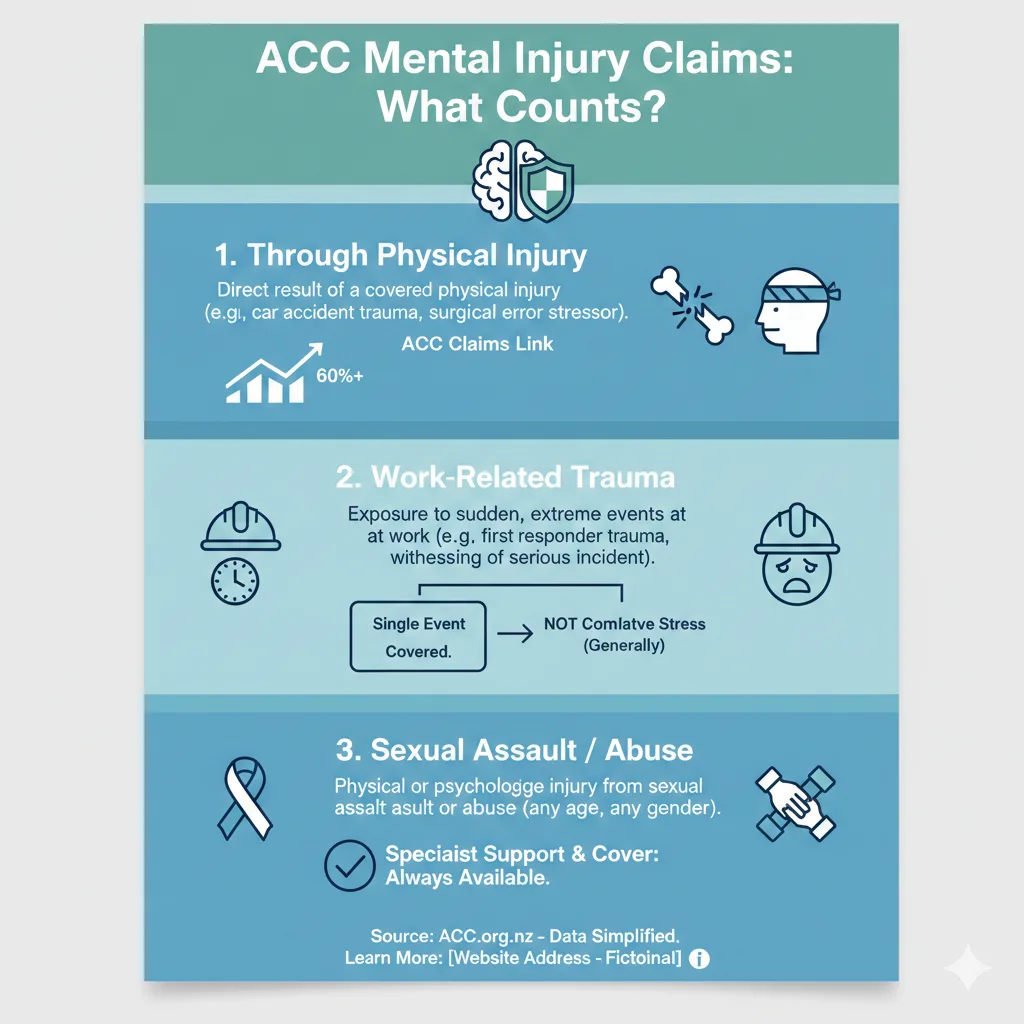
- Mental Injury caused by Physical Injury (MICPI): Psychological harm following a physical accident, such as PTSD after a serious car crash or assault.
- Mental Injury caused by Sexual Abuse (MICSA): Trauma from sexual abuse or assault, eligible regardless of physical injury.
- Work-Related Mental Injury (WRMI): Severe stress from workplace bullying, harassment, or exposure to traumatic events, per section 21B of the Act.
- Treatment Injury Mental Injury (TIMI): Psychological effects from medical treatment errors.
Mental injuries not linked to these triggers—such as gradual process stress or pre-existing conditions—are typically excluded. For instance, everyday workplace anxiety won't qualify, but witnessing a fatal machinery accident might.
Recent Changes: The TN Ruling and Its Impact
The landmark ACC v TN Court of Appeal decision in December 2023 transformed financial entitlements for sensitive claims, especially sexual abuse survivors. Previously, support like weekly compensation or independence allowance was based on the date of first treatment. Now, it's tied to the date of mental injury suffered (DMIS)—usually the abuse event itself or shortly after.
What This Means for Claimants in 2026
- From 29 September 2025, all new financial entitlement requests use DMIS, potentially increasing backdated payments for childhood abuse cases.
- Pending claims may be reassessed; ACC recovery teams contact kiritaki (clients) directly.
- Specialist Cover Assessments now include DMIS questions, with updated guidelines and videos available on ACC's website.
This shift doesn't affect treatment cover but expands financial relief, critical as ACC faces a projected $26 billion deficit by 2030, prompting faster rehabilitation focus.
Eligibility Criteria for ACC Mental Injury Claims
To qualify, your mental injury must meet strict thresholds: a recognised diagnosis from a psychiatrist or psychologist, causation linked to a covered event, and impairment affecting work, study, or daily life.
Common Scenarios Covered
| Scenario | Example | Cover Type |
|---|---|---|
| Car Accident | PTSD after a high-speed collision | MICPI |
| Sexual Assault | Anxiety preventing work return post-assault | MICSA |
| Workplace Trauma | Depression from bullying | WRMI (s21B) |
| Medical Mishap | Phobia after botched surgery | TIMI |
Anyone injured in New Zealand can claim, regardless of nationality—key for our tourism-heavy regions like Otago, where claims run 62% above national averages.
How to File an ACC Mental Injury Claim: Step-by-Step
Filing is straightforward but requires medical evidence. Start online or via your GP within 12 months of the injury event.
Step-by-Step Process
- Report the Incident: Notify your employer (for work claims) or ACC directly. Use the ACC app or call 0800 101 996.
- Get a Diagnosis: See a GP for referral to a psychiatrist. ACC contracts specialists for assessments.
- Submit Cover Application: Provide event details, medical reports, and impact statements. Sensitive claims go through dedicated services.
- ACC Assessment: Expect a Specialist Cover Assessment; approvals lead to treatment plans.
- Financial Entitlements: Apply for weekly compensation (80% of pre-injury earnings after 1 week off), lump sums, or independence allowance if impaired.
Processing takes 4-6 weeks; track via myACC portal.
What Compensation Can You Expect?
ACC entitlements vary by impairment but include:
- Treatment: Counselling, psychiatric care, medication—fully funded.
- Weekly Compensation: 80% of average weekly earnings, up to caps (e.g., $124,053 max in 2026, indexed annually).
- Lump Sums: Up to $1.5 million for permanent impairment over 10%.
- Rehab: Home mods, retraining, attendant care.
Average claim costs $3,585 in 2025, double a decade ago, reflecting longer recoveries.
What If Your Claim is Declined?
Declines happen—e.g., if no clear causation or gradual-onset stress. You have rights:
- Request Reconsideration: Submit new evidence within 3 months.
- Formal Review: Independent reviewer assesses (free, 1-3 months).
- District Court Appeal: Legal aid available; recent cases uphold cover for bullying or backdated allowances.
Courts often grant late appeals if delays stem from errors.
Practical Tips for Successful ACC Mental Injury Claims
- Document everything: Keep GP notes, work diaries, witness statements.
- Act fast: Early claims improve outcomes; DMIS matters post-TN ruling.
- Use myACC: Upload docs, track progress 24/7.
- Seek advocates: Free services via Citizens Advice or lawyers specialising in ACC.
- Combine with support: Access Victim Support or EAP counselling alongside ACC.
For work claims, employers must support return-to-work plans.
FAQ: Common Questions on ACC Mental Injury Claims
1. Can I claim for mental injury without physical harm?
Yes, for sexual abuse (MICSA) or work-related trauma (WRMI), but not standalone stress.
2. How long after the event can I claim?
Up to 12 months for cover, but financial entitlements use DMIS—no strict limit if diagnosed.
3. Does ACC cover therapy costs fully?
Yes, approved plans fund psychiatrists, psychologists, and meds via contracted providers.
4. What if my employer disputes a work-related claim?
ACC decides independently; provide evidence like emails or witness accounts.
5. Are lump sums backdated under the TN ruling?
Potentially yes, to DMIS for sensitive claims decided after 29 September 2025.
6. Can visitors or migrants claim?
Yes, anyone injured here qualifies, no residency required.
Next Steps: Take Control of Your Recovery
If trauma is impacting your life, don't delay—contact ACC at 0800 101 996 or log into myACC today. Gather your medical evidence, consider a specialist referral, and explore financial entitlements. For complex cases, consult an ACC lawyer or advocate. Remember, ACC aims for quicker rehab to cut long-term costs, so proactive claims lead to faster support.
Disclaimer: This is general information, not personalised advice. Tax, financial, or legal situations vary—consult a professional advisor, lawyer, or ACC directly for your circumstances.
Related Articles

Industry Bodies and Professional Associations NZ
Whether you're launching a business, advancing your career, or navigating financial regulations, industry bodies and professional associations in New Zealand offer invaluable support. These organisati...

Emergency Benefit NZ: When You Have No Other Options
When you're struggling financially and don't qualify for other benefits, the Emergency Benefit might be your lifeline. It's a discretionary payment designed for Kiwis in genuine hardship who've exhaus...

Unpaid Internships NZ: Are They Legal?
Unpaid internships are a common pathway for students and graduates to gain work experience in New Zealand, but there's often confusion about whether they're actually legal. The short answer is: unpaid...

Estate Administration NZ: Managing Someone's Affairs After Death
Losing a loved one is one of life's toughest challenges, and stepping in to manage their estate can feel overwhelming. In New Zealand, estate administration—the process of handling someone's affairs a...