Credit Card Debt NZ: Strategies to Pay It Off
If you've ever stared at your credit card statement, heart sinking at the mounting interest, you're not alone. New Zealanders collectively owe $6.3 billion on credit cards, shelling out around $557 mi...
Sarah covers personal finance, tax, and KiwiSaver topics for Lifetimes NZ. She focuses on making money management straightforward and practical for everyday Kiwis.
If you've ever stared at your credit card statement, heart sinking at the mounting interest, you're not alone. New Zealanders collectively owe $6.3 billion on credit cards, shelling out around $557 million in interest each year to banks—money that could be boosting your KiwiSaver or paying down the mortgage instead.
With average credit card interest rates hovering at 19.7%, far outpacing the Official Cash Rate (OCR) at 4.25% as of late 2025, credit card debt can trap you in a cycle of wealth destruction. But there's good news: half of all balances are now paid off in full each month, down from 72% in 2000, showing Kiwis are getting smarter about it. This guide equips you with proven strategies to tackle credit card debt NZ, tailored for our shores—from debt snowball methods to negotiating with banks and leveraging local resources like WINZ and the Financial Markets Authority (FMA).
Understanding Credit Card Debt in New Zealand
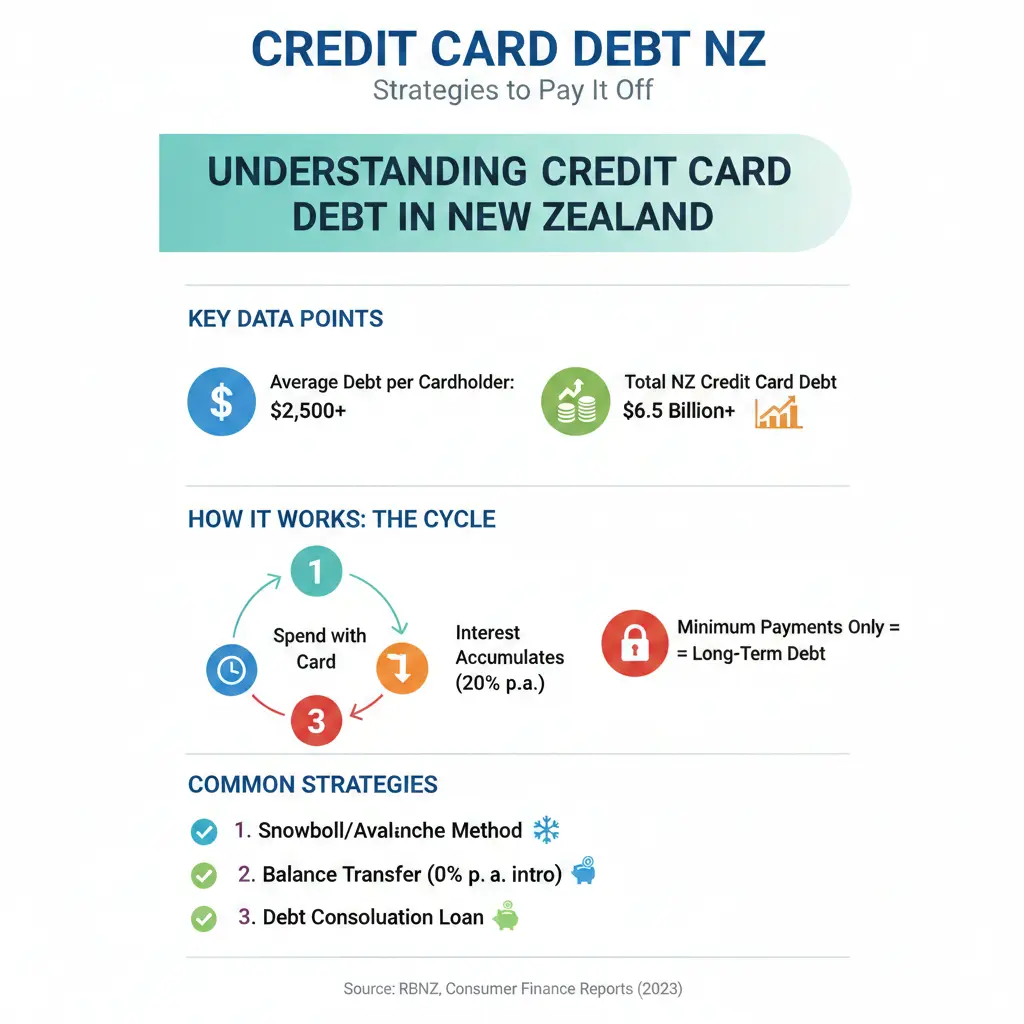
Credit card debt isn't just numbers on a screen; it's a national issue affecting household finances. As of November 2025, total outstanding credit card balances hit $6.3 billion, with $2.8 billion—51%—carrying interest at an eye-watering average of 19.7%. That's despite the OCR dropping to record lows in recent years; banks have kept rates stubbornly high, even when it was 0.25% in 2021.
Annual spending via credit cards totals $54 billion, or $4.6 billion monthly ($4 billion domestic, $671 million overseas including online shops and travel). With total credit limits at $21 billion, utilisation sits at 30.1%—not catastrophic, but a red flag if you're among the half not clearing balances monthly. Peak debt was $7.4 billion in 2019, dipping during COVID as Kiwis paid down balances, but it's creeping back amid cost-of-living pressures.
Relative to discretionary income (what's left after essentials), the ratio of credit card debt is forecast to dip to 6.8% in 2025-26, thanks to RBNZ cash rate cuts from 3.75% to 3.25% early in 2025, boosting disposable cash for repayments. Yet high inflation in 2023-24 pushed the ratio up slightly, highlighting why proactive strategies matter now.
Why Credit Card Debt Hurts Kiwis So Much
At 19.7%, credit card interest dwarfs mortgage rates (around 6-7%) or personal loans (10-15%). Borrow $5,000 and make only minimum payments (2% or $25, whichever greater), and you'll pay $18,570 in interest alone over time—nearly four times the principal. That's working poverty in action: high earners trapped by high-interest revolving debt.
Household debt overall is 168% of disposable income, per recent Reserve Bank data, making credit cards a risky top-up. Buy-now-pay-later (BNPL) services like Afterpay have eased some pressure by competing with cards, contributing to declining debt ratios since the mid-2000s.
Key Strategies to Pay Off Credit Card Debt NZ
Paying off credit card debt requires discipline, but these Kiwi-focused tactics can accelerate your progress. Start by listing all cards, balances, rates, and minimums—use free tools from Sorted.org.nz for trackers.
Strategy 1: Stop the Bleeding—Build a Budget
First, halt new debt. Track spending with apps like PocketSmith or the BNZ Budgeter. Aim for the 50/30/20 rule: 50% needs (rent, groceries), 30% wants, 20% savings/debt. With grocery inflation biting, cut non-essentials: swap café lattes for home brews, meal prep to save $100/week.
- Boost income: Side hustles via Trade Me jobs or Uber—many Kiwis earn $200-500 extra monthly.
- Cut costs: Switch power to low-fixed providers via powerswitch.org.nz; save $200/year average.
- WINZ support: Check eligibility for Accommodation Supplement or Winter Energy Payment if low-income.[Local ref]
Strategy 2: Debt Snowball vs. Avalanche—Which Wins?
Two proven methods:
| Method | How It Works | Best For | Example (Two Cards: $2,000@22%, $3,000@18%) |
|---|---|---|---|
| Debt Snowball | Pay minimums on all, extra on smallest balance first for quick wins. | Motivation-focused Kiwis needing momentum. | Clear $2k first: 6 months, then $3k in 9 months. Total interest: ~$850. |
| Debt Avalanche | Target highest interest rate first, minimums on rest. | Math whizzes minimising costs. | Hit 22% card: 8 months, then 18%: 10 months. Saves ~$200 interest vs. snowball. |
Debt snowball, popularised by Dave Ramsey, builds psychological wins; avalanche saves money long-term. Use Excel or apps like Debt Payoff Pro to simulate.[Inference from standard methods]
Strategy 3: Balance Transfers and Low-Interest Offers
Switch to 0% interest balance transfer cards—common from ANZ, Westpac, ASB. Offers up to 12-18 months interest-free, but watch 3-5% upfront fees. Example: Transfer $5,000 at 4% fee ($200), pay $417/month to clear in 12 months, saving thousands vs. 19.7%.
Compare via Canstar.co.nz. Tip: Don't use the new credit for purchases, or interest kicks in.
Strategy 4: Negotiate with Your Bank
Kiwis, call your bank—they want repayments. Ask for:
- Hardship relief: Under the Credit Contracts and Consumer Finance Act (CCCFA), banks must consider variations if you're struggling (e.g., job loss, illness).[FMA ref]
- Lower rates: Some drop to 15-17% for good payers.
- Payment plans: Fixed amounts over time.
Contact the bank's hardship team; provide income proof. FMA oversees fair treatment—escalate complaints there if needed.
Strategy 5: Debt Consolidation Loans
Combine debts into one lower-rate personal loan (10-15%). Banks like Kiwibank offer these; check eligibility via IRD income docs. Pros: Simplifies payments, cuts interest. Cons: Closing cards might ding your credit score short-term.
Use MoneyHub's calculator: $10k at 19.7% vs. 12% loan saves $3,000+ over 3 years.
Strategy 6: Increase Minimum Payments and Windfalls
Minimums barely dent principal. On $5,000 at 19.7%, minimums take 30+ years. Double to $250/month: clears in ~2.5 years, saves $17,000+ interest.
Direct windfalls—tax refunds (file early via myIR), ACC payouts, KiwiSaver withdrawals (first-home only)—straight to debt.
Free and Low-Cost Help for Kiwis
Don't go it alone. Government-backed options:
- Sorted.org.nz: Free debt calculators, budget tools from Commission for Financial Capability.
- Moneytalks: Helpline (0800 345 123) for confidential advice.
- WINZ Debt Hardship: If on benefits, apply for assistance via MyMSD.
- Insolvency and Trustee Service: No Asset Procedure (NAP) for debts under $50k—write-off option if truly broke.
- Citizens Advice Bureau: Free local sessions.
Avoid debt consolidation scams; stick to FMA-regulated providers.
Preventing Future Credit Card Debt
Once cleared:
- Pay in full monthly—set auto-payments day before due.
- Keep utilisation under 30% for credit score health (Equifax/Veda).
- Use debit/BNPL for small buys; cards for rewards only if paid off.
- Build emergency fund: 3-6 months expenses in high-interest saver (4-5% rates 2026).
FAQ: Credit Card Debt NZ
What if I can't afford minimum payments?
Contact your bank immediately for hardship under CCCFA. Use Moneytalks for plans.[FMA]
Does paying off debt affect my credit score?
Short-term dip from high activity, but long-term boost from zero balances. Check free annually at checkyourcredit.co.nz.
Are balance transfers worth the fee?
Yes if >12 months 0%, saving 19.7% interest. Calculate breakeven: fee vs. interest saved.
Can I include credit card debt in KiwiSaver withdrawals?
No—first-home only. Use for house deposit instead.[IRD]
What’s the average Kiwi credit card debt?
Around $2,500 per cardholder carrying a balance—any is too much at these rates.
Will interest rates drop in 2026?
RBNZ forecasts OCR steady at ~3-4%; card rates unlikely below 18%.
Your Next Steps to Debt Freedom
Grab a coffee (home-brewed), list your debts today, pick snowball or avalanche, and call your bank. Track progress monthly—celebrate milestones like one card cleared. With discipline, you'll join the 49% of Kiwis paying zero interest, freeing cash for what matters: family, adventures, or that bach deposit.
Disclaimer: This is general info, not personalised advice. Consult a financial adviser or accountant for your situation. Rates/balance current to 2025; check latest RBNZ data.
Related Articles

Industry Bodies and Professional Associations NZ
Whether you're launching a business, advancing your career, or navigating financial regulations, industry bodies and professional associations in New Zealand offer invaluable support. These organisati...

Emergency Benefit NZ: When You Have No Other Options
When you're struggling financially and don't qualify for other benefits, the Emergency Benefit might be your lifeline. It's a discretionary payment designed for Kiwis in genuine hardship who've exhaus...

Unpaid Internships NZ: Are They Legal?
Unpaid internships are a common pathway for students and graduates to gain work experience in New Zealand, but there's often confusion about whether they're actually legal. The short answer is: unpaid...

Estate Administration NZ: Managing Someone's Affairs After Death
Losing a loved one is one of life's toughest challenges, and stepping in to manage their estate can feel overwhelming. In New Zealand, estate administration—the process of handling someone's affairs a...