Ending a Fixed-Term Tenancy Early: Your Options

If you're locked into a fixed-term tenancy and circumstances have changed, you might be wondering if there's a way out. The good news is that while you generally can't simply walk away from a fixed-te...
The Lifetimes NZ editorial team curates, fact-checks, and updates guides on personal finance, property, health, immigration, legal, business, and lifestyle topics relevant to Lifetimes NZ readers. Articles are produced with AI assistance and reviewed by the editorial team before publication.
If you're locked into a fixed-term tenancy and circumstances have changed, you might be wondering if there's a way out. The good news is that while you generally can't simply walk away from a fixed-term lease, New Zealand law does provide several legitimate options for ending your tenancy early. Understanding these pathways could save you thousands of dollars and months of unnecessary stress.
The General Rule: You're Locked In
Let's start with the reality: you cannot give notice to end a fixed-term tenancy early unless specific circumstances apply. Once you've signed a fixed-term agreement, you're legally bound to continue paying rent until the agreed end date. This is a fundamental principle of New Zealand tenancy law, and it protects both landlords and tenants by providing certainty about lease commitments.
However, the law recognises that life happens. Job losses, relationship breakdowns, health crises, and unexpected financial hardship can all create situations where continuing a tenancy becomes genuinely difficult. That's where your options come in.
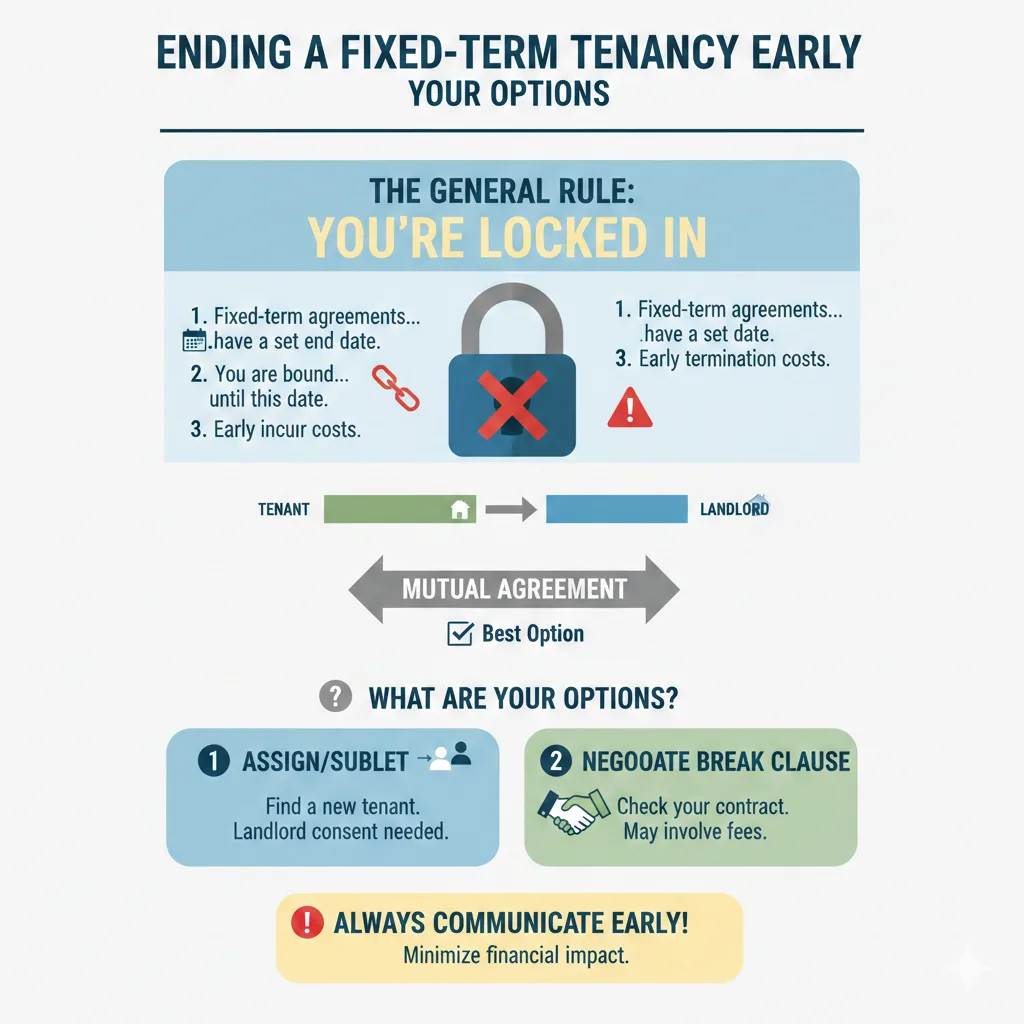
Your Options for Ending Early
1. Mutual Agreement with Your Landlord
The simplest path forward is to reach an agreement with your landlord. If both parties consent in writing, you can end a fixed-term tenancy early. This is straightforward in principle: you and your landlord simply agree to terminate the lease and document it in writing. Both of you should keep a copy of this agreement.
However, there's a catch: your landlord can charge you a fee for ending the tenancy early. The key protection here is that these fees must be actual and reasonable costs only. What does this mean in practice? Your landlord can charge you for:
- Advertising for new tenants
- Hosting property viewings
- Administration costs (background checks, drawing up new tenancy agreements)
- Reasonable lost rent between your departure and a new tenant moving in
What they cannot do is charge you a flat "break fee" or penalty simply because you're leaving early. Your landlord must provide you with a detailed invoice listing these costs. If the costs seem unreasonable, you can dispute them through the Tenancy Tribunal.
Practical tip: Start this conversation early and be honest about your situation. Many landlords are willing to negotiate, especially if you're a reliable tenant. Offering to help find a replacement tenant or staying for a few extra weeks while they find someone new can strengthen your negotiating position.
2. Assigning Your Tenancy to Someone Else
Another option is to find someone else to take over your tenancy. This is called "assigning" a tenancy. Essentially, you're transferring your lease obligations to another person who becomes the new tenant.
This approach works well if you can find a suitable replacement tenant, but it does require your landlord's consent. You'll need to follow proper assignment procedures and ensure the new tenant meets your landlord's requirements. The advantage here is that if your landlord agrees to the assignment, you're released from your obligations without necessarily paying break fees.
3. Applying to the Tenancy Tribunal for Severe Hardship
If circumstances have genuinely changed and you're facing severe hardship, you have the right to apply to the Tenancy Tribunal. This is a formal legal process, but it's designed to help tenants (and landlords) in genuine distress.
What qualifies as severe hardship? The Tribunal will consider situations such as:
- Unexpected job loss and inability to pay rent
- Serious illness or injury affecting your ability to work
- Major relationship breakdown requiring you to move
- Significant rent increases that you couldn't have reasonably anticipated
- Family violence situations requiring you to leave
Importantly, you need to demonstrate two things: first, that you'll suffer severe hardship if the tenancy continues, and second, that your hardship is greater than the landlord's hardship if the tenancy ends early. This is a balancing test. The Tribunal won't simply end your tenancy because you're unhappy; it needs to see genuine, unexpected circumstances that create serious difficulty.
If you're facing a large unexpected rent increase, you also have a specific right to apply to the Tribunal if the increase is an amount you couldn't have reasonably expected when you signed the agreement and it will cause you serious hardship.
What happens if you win? If the Tribunal agrees to end your tenancy early, it will set an appropriate end date. However, you may also be ordered to pay compensation to your landlord to help cover some of their costs in finding a new tenant. This isn't a free pass—it's a recognition that while your hardship justifies early termination, the landlord shouldn't bear the full financial burden of your departure.
Before you apply: The law encourages you to discuss your circumstances with your landlord first and try to reach an agreement. Only apply to the Tribunal if direct negotiation hasn't worked.
4. Landlord Non-Renewal at End of Term
This isn't technically "ending early," but it's worth understanding: as of January 30, 2025, landlords gained the right to end a fixed-term tenancy at the end of the fixed term without needing to meet specific grounds. Previously, they needed justifiable reasons. This change means that when your fixed term is approaching its end, your landlord can choose not to renew simply by giving proper notice (between 90 and 21 days before the fixed term expires).
This doesn't help you end early, but it's important context if you're considering staying beyond your current fixed term.
Special Circumstances: Landlord Non-Compliance
There's one more scenario worth mentioning: if you live in unit title premises (like an apartment or terrace house) and the body corporate rules change in a way that negatively impacts you, you can apply to the Tenancy Tribunal to end your tenancy early. This protects tenants from situations where property rules change after they've signed a lease.
What You Should Do Now
Step 1: Assess your situation. Are you truly facing hardship, or are you simply unhappy with the property or location? The Tribunal's threshold is genuine, unexpected hardship—not buyer's remorse.
Step 2: Talk to your landlord. Before considering formal legal action, have an honest conversation. Explain your circumstances and explore whether you can reach a mutually acceptable solution. Many landlords appreciate transparency.
Step 3: Get the right advice. If you're considering a Tribunal application, contact Community Law or a tenancy advocate. Many offer free initial advice. You can also contact Tenancy Services for information about your rights.
Step 4: Document everything. Keep copies of all communications with your landlord, any agreements you reach, and documentation of your hardship (pay slips showing job loss, medical certificates, etc.).
Frequently Asked Questions
Can my landlord force me to stay in a fixed-term tenancy?
Yes, essentially. A fixed-term tenancy is a binding contract. Your landlord can enforce it by taking you to the Tenancy Tribunal if you simply stop paying rent or abandon the property. However, if you're facing genuine hardship, the Tribunal has discretion to end the tenancy early.
What if I just stop paying rent?
This is a very bad idea. Your landlord can apply to the Tenancy Tribunal to have the tenancy ended on grounds of rent arrears (if you're more than 21 days overdue), and you could face a debt that follows you for years. It will also damage your rental history, making it harder to secure future tenancies. Always explore legitimate options first.
Can I break my lease if I'm moving for a job?
A job relocation alone doesn't automatically qualify as "severe hardship" under Tribunal rules. However, if the move is essential and you'd face genuine financial difficulty continuing the tenancy (for example, if you can't work remotely and can't afford to maintain two households), you might have grounds to apply. The Tribunal will assess each case individually.
How much will it cost to break my lease?
This depends entirely on your agreement with your landlord. If you negotiate mutual termination, costs could range from minimal (if your landlord quickly finds a new tenant) to several weeks' rent. Get a detailed breakdown from your landlord before agreeing to anything. If you apply to the Tribunal and win, you may be ordered to pay compensation, but the Tribunal will consider what's fair.
How long does a Tenancy Tribunal application take?
This varies, but generally you should expect several weeks from application to hearing, and potentially longer depending on the complexity of your case and the Tribunal's workload. It's not a quick process, so plan accordingly.
What if my landlord won't negotiate?
If you're facing genuine hardship and your landlord refuses to discuss early termination, the Tenancy Tribunal is your avenue. You'll need to present a strong case showing severe, unexpected hardship that outweighs the landlord's interests. Legal advice from Community Law or a tenancy advocate can help strengthen your application.
Moving Forward
Ending a fixed-term tenancy early in New Zealand isn't impossible, but it requires either cooperation from your landlord or genuine hardship that meets a legal threshold. The most practical path for most people is honest negotiation with their landlord—many are willing to work with tenants facing real difficulties.
If negotiation fails and you're genuinely struggling, the Tenancy Tribunal exists precisely for these situations. Don't suffer in silence or make rash decisions. Seek advice from Tenancy Services or Community Law, document your circumstances, and understand your rights. New Zealand's tenancy laws, while strict about fixed-term commitments, do recognise that life is unpredictable and provide pathways for those facing genuine hardship.
Related Articles

Industry Bodies and Professional Associations NZ
Whether you're launching a business, advancing your career, or navigating financial regulations, industry bodies and professional associations in New Zealand offer invaluable support. These organisati...

Emergency Benefit NZ: When You Have No Other Options
When you're struggling financially and don't qualify for other benefits, the Emergency Benefit might be your lifeline. It's a discretionary payment designed for Kiwis in genuine hardship who've exhaus...

Unpaid Internships NZ: Are They Legal?
Unpaid internships are a common pathway for students and graduates to gain work experience in New Zealand, but there's often confusion about whether they're actually legal. The short answer is: unpaid...

Estate Administration NZ: Managing Someone's Affairs After Death
Losing a loved one is one of life's toughest challenges, and stepping in to manage their estate can feel overwhelming. In New Zealand, estate administration—the process of handling someone's affairs a...