Orphan's Benefit and Unsupported Child's Benefit NZ

When a child can't live with their parents due to family breakdown or tragedy, Kiwi caregivers often step up without hesitation. But the financial realities of raising tamariki or rangatahi can be dau...
Sarah covers personal finance, tax, and KiwiSaver topics for Lifetimes NZ. She focuses on making money management straightforward and practical for everyday Kiwis.
When a child can't live with their parents due to family breakdown or tragedy, Kiwi caregivers often step up without hesitation. But the financial realities of raising tamariki or rangatahi can be daunting—especially when you're not their natural parent. That's where Orphan's Benefit and Unsupported Child's Benefit NZ come in, providing essential weekly support from Work and Income to help cover costs like bedding, clothing, and celebrations.
These benefits aren't means-tested, meaning your income or assets won't affect eligibility, and they include automatic grants to get you started. In 2026, with living costs rising, understanding these supports is crucial for whānau stepping into caregiving roles. This guide breaks down eligibility, payments, application processes, and tips tailored for New Zealand families.
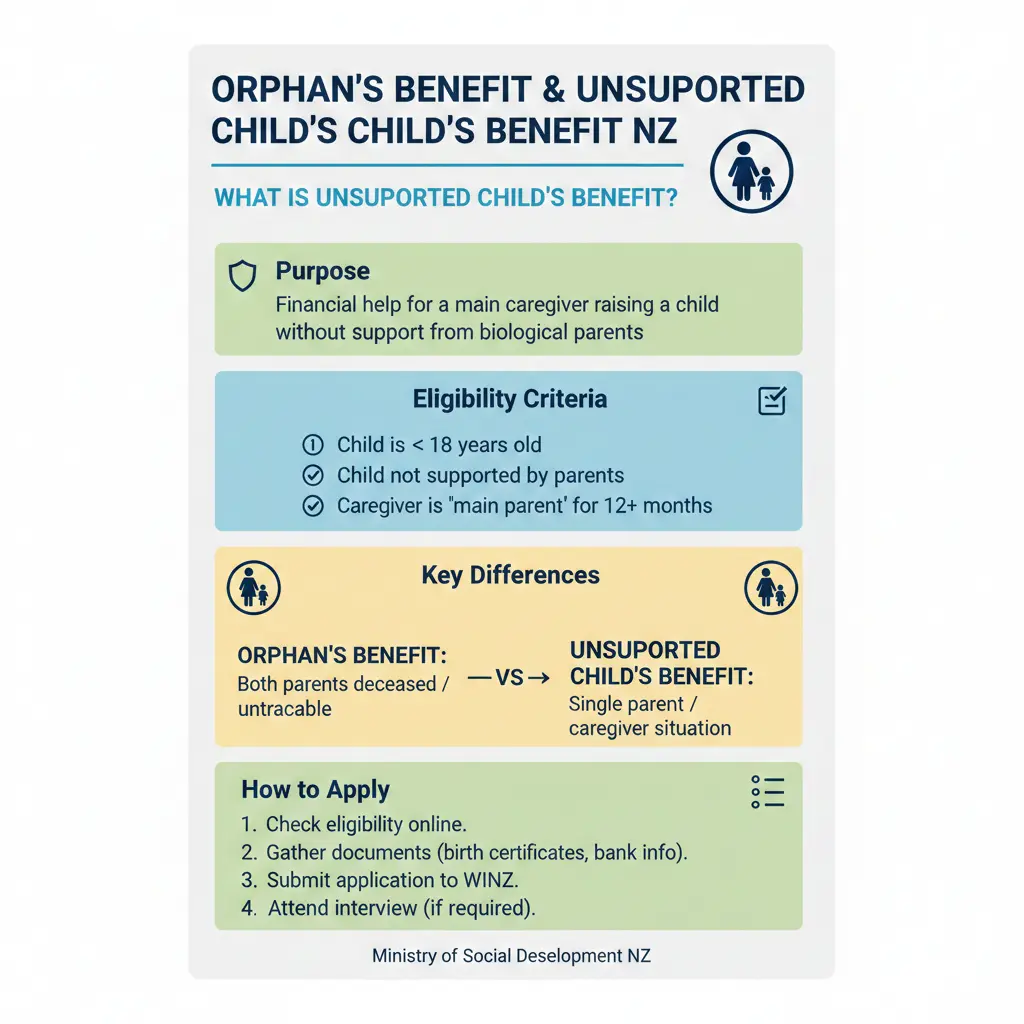
What is Unsupported Child's Benefit?
The Unsupported Child's Benefit is a weekly payment from Te Manatū Whakahiato Ora (Ministry of Social Development) for caregivers supporting a child or young person unable to live with their parents due to whānau or family breakdown. It's designed to support the child's oranga (wellbeing) and covers day-to-day care without income testing—though adjustments may apply if the young person earns income or becomes financially independent.
Who Qualifies for Unsupported Child's Benefit?
To receive this benefit, both the caregiver and child must meet specific criteria:
- The child or rangatahi must be 18 years old or younger (or until the end of the calendar year they turn 18), single, and financially dependent on you.
- They must be primarily cared for by you, even if attending boarding school, special school, or on a student exchange overseas.
- You must be 18 or over, a New Zealand citizen or permanent resident, with primary day-to-day responsibility for their care, and not their natural, adoptive, or step-parent.
- Both you and the child must normally live in New Zealand.
- The child must not receive payments under section 363 of the Oranga Tamariki Act 1989.
Note: Caregivers no longer need to confirm 12 months of care in advance, making it easier for transitioning whānau, such as those taking custody from Oranga Tamariki up to 20 days before discharge.
For family breakdowns, you'll need to apply for Child Support from the parents (which offsets government costs) and may attend a Family Group Conference or hui to confirm arrangements.
What is Orphan's Benefit?
The Orphan's Benefit mirrors the Unsupported Child's Benefit but applies when parents have died, cannot be found, or have a serious long-term health condition or incapacity preventing care. It's a weekly payment for eligible caregivers over 18, ensuring tamariki or rangatahi have stability during tough times.
Eligibility for Orphan's Benefit
Criteria are nearly identical to Unsupported Child's Benefit:
- Child is 18 or younger, single, and financially dependent.
- You are 18+, the main carer with day-to-day responsibility, a NZ citizen or permanent resident, not the natural/adoptive parent, and ordinarily resident in NZ.
- Proof of parental circumstances (e.g., death certificates) may be required.
Unlike Unsupported Child's Benefit, no Family Group Conference is typically needed unless other factors apply.
Payment Rates and Included Allowances (2026)
Both benefits are paid weekly, with amounts based on the child's age. While exact weekly rates are confirmed via Work and Income at application, they aren't income or asset tested. Key automatic inclusions make these benefits comprehensive:
- Establishment Grant: $350 one-off per child (tax-free, no repayment) for essentials like beds, bedding, or clothes—paid with your first benefit payment.
- Clothing Allowance: Weekly amount scaled by age to cover clothing costs.
- Birthday and Holiday Allowances: Automatic annual payments (one in December, one two weeks before birthday) for celebrations, gifts, or experiences.
- School and Year Start-up Payment: Additional support if eligible through partnered programmes.
- Special Needs Grants: Apply separately for skill-building activities, talents, or extras.
Payments start 2-4 weeks after approval or when you begin caregiving (whichever is later)—no backdating, so apply promptly. Child Support from parents may reduce parental income but goes to the government.
How to Apply for Orphan's Benefit and Unsupported Child's Benefit NZ
Applying is straightforward—contact Work and Income first to discuss your situation. They'll guide you and arrange a meeting. Use MyMSD online (my.msd.govt.nz), call 0800 559 009 (or 0800 552 002 if over 65), or visit a service centre.
Required Documents
Prepare these for a smooth process:
| Document | For Unsupported Child's Benefit | For Orphan's Benefit |
|---|---|---|
| Child's full birth certificate | Required | Required |
| Custody/guardianship agreement | Required | Required |
| Child's income details | Required | Required |
| Parents' death certificates (if applicable) | N/A | Required |
| Family Group Conference/Court Orders | Required | May be needed |
| Parents' contact details | Required | If applicable |
Can't get documents? Work and Income can help—don't delay applying. Oranga Tamariki may provide support letters for transitions.
Practical Application Tips for Kiwis
- Apply ASAP upon becoming the main caregiver to avoid gaps.
- Discuss Child Support early—especially at whānau hui.
- If fostering via Oranga Tamariki, seek Foster Care Allowance instead.
- Combine with KiwiSaver, ACC, or WINZ for fuller support—check MyMSD for entitlements.
- Track payments via MyMSD; report changes like child's income immediately.
Additional Support for Caregivers
Beyond core benefits, explore:
- Accommodation Supplement: If renting, via Work and Income.
- Disability Allowance: For child or caregiver health needs.
- Oranga Tamariki Resources: Transition support, counselling.
- Community Law Centres: Free advice on custody.
These benefits are tax-free for grants, but declare in IRD filings if earning.
Next Steps for Kiwi Caregivers
If you're caring for a tamaiti whose parents can't provide due to breakdown or hardship, don't hesitate—contact Work and Income today at 0800 559 009 or via MyMSD. Gather documents, apply early, and pair with whānau support for the best outcomes. These benefits ease the load, letting you focus on what matters: the child's wellbeing. Always seek personalised advice from a financial adviser or WINZ, as rules can change.
Frequently Asked Questions
Sources & References
-
1
Child Support, Unsupported Child's Benefit and Orphan's Benefit — Oranga Tamariki Practice Centre — practice.orangatamariki.govt.nz
-
2
Orphan's Benefit — Work and Income — www.workandincome.govt.nz
-
3
You're Caring for Someone Else's Child — Community Law — communitylaw.org.nz
-
4
How to Apply for Orphan's Benefit — Boost Eligibility Guide — preprod.eligibility-guide.boost.co.nz
-
5
Unsupported Child's Benefit — Work and Income — www.workandincome.govt.nz
-
6
How to Apply for Unsupported Child’s Benefit — MSD Check — check.msd.govt.nz
-
7
Help When You're Raising Children — govt.nz — www.govt.nz
-
8
School and Year Start-up Payment — Caring Families — www.caringfamilies.org.nz
-
9
Orphan’s & Unsupported Child’s Benefit Application Form (PDF) — GRG — www.grg.org.nz
Related Articles

Industry Bodies and Professional Associations NZ
Whether you're launching a business, advancing your career, or navigating financial regulations, industry bodies and professional associations in New Zealand offer invaluable support. These organisati...

Emergency Benefit NZ: When You Have No Other Options
When you're struggling financially and don't qualify for other benefits, the Emergency Benefit might be your lifeline. It's a discretionary payment designed for Kiwis in genuine hardship who've exhaus...

Unpaid Internships NZ: Are They Legal?
Unpaid internships are a common pathway for students and graduates to gain work experience in New Zealand, but there's often confusion about whether they're actually legal. The short answer is: unpaid...

Estate Administration NZ: Managing Someone's Affairs After Death
Losing a loved one is one of life's toughest challenges, and stepping in to manage their estate can feel overwhelming. In New Zealand, estate administration—the process of handling someone's affairs a...