Rates Rebate NZ: Getting Help with Council Rates

Struggling with rising council rates? The Rates Rebate NZ scheme could put hundreds of dollars back in your pocket, helping Kiwis on fixed incomes stay in their homes. If you're a homeowner feeling th...
The Lifetimes NZ editorial team curates, fact-checks, and updates guides on personal finance, property, health, immigration, legal, business, and lifestyle topics relevant to Lifetimes NZ readers. Articles are produced with AI assistance and reviewed by the editorial team before publication.
Struggling with rising council rates? The Rates Rebate NZ scheme could put hundreds of dollars back in your pocket, helping Kiwis on fixed incomes stay in their homes. If you're a homeowner feeling the pinch, this government-backed programme offers real relief—up to $805 for the 2025/26 year—but thousands miss out each year simply because they don't apply.
We've put together this complete guide to the Rates Rebate NZ, covering eligibility, how much you might get, and step-by-step application tips tailored for New Zealanders. Whether you're on New Zealand Superannuation, a SuperGold cardholder, or supporting dependants, read on to see if you qualify and secure your rebate before the 30 June 2026 deadline.
What is the Rates Rebate NZ Scheme?
The Rates Rebate is a national government initiative administered by local councils to ease the burden of council rates for low to middle-income homeowners. It provides a direct reduction on your rates bill, either as a credit against future instalments or a cash refund if you've already paid.
For the 2025/26 rating year, the maximum rebate is $805, calculated based on your household income, number of dependants, and total rates payable. Even if your income exceeds the full-rebate threshold, you could still receive a partial amount—making it worth checking regardless.
This scheme is especially vital in 2026, with rates notices reflecting higher costs from infrastructure projects and inflation. Councils like Gisborne District and Auckland handle applications locally but follow uniform national guidelines set by the Department of Internal Affairs.
Key Benefits for Kiwis
- Targeted support: Helps superannuitants, families with dependants, and those in retirement villages stay housed affordably.
- Simple process: One application per year covers your full rates bill.
- SuperGold boost: Higher income limits for cardholders, recognising the realities of Kiwi retirees.
- No means test beyond income: Assets aren't assessed—it's purely about your rates and earnings.
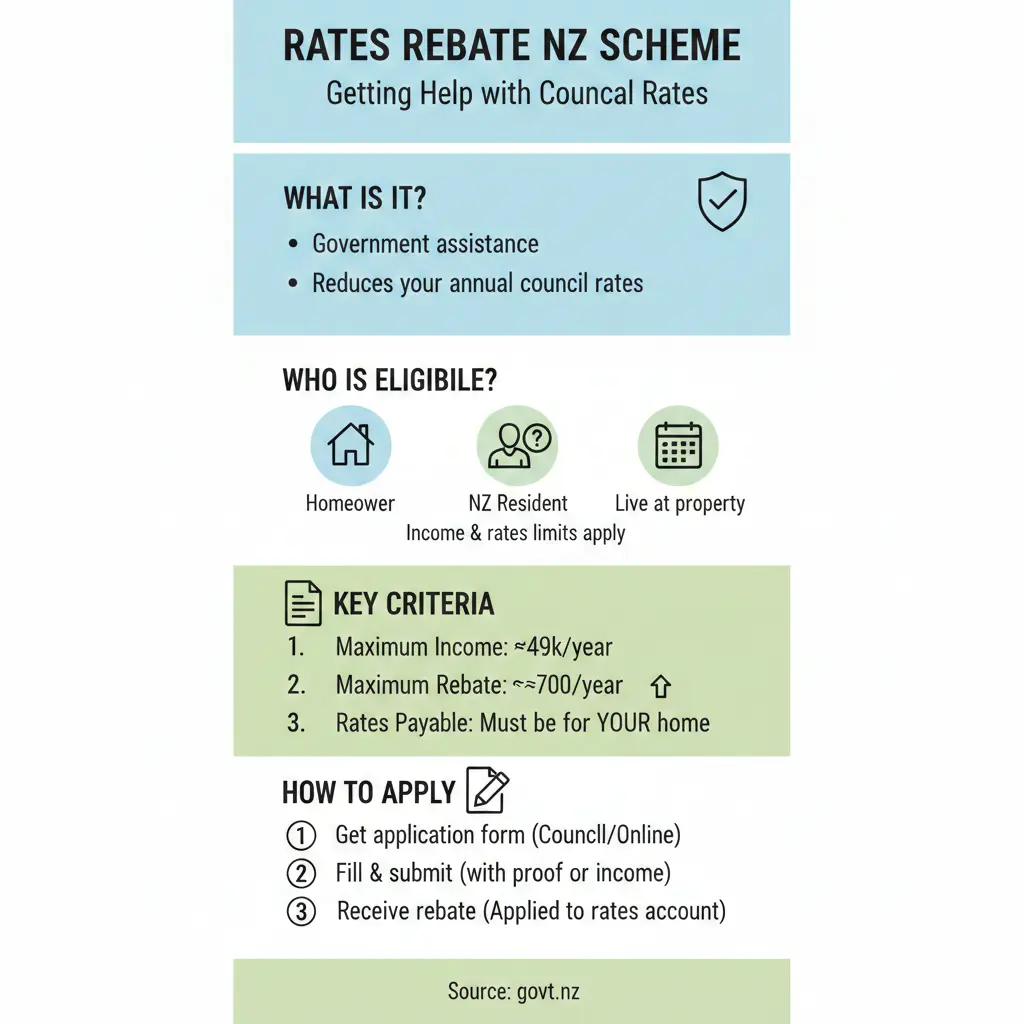
Who is Eligible for Rates Rebate NZ?
Eligibility hinges on residency, ownership, and income as of 1 July 2025. You must be the ratepayer (or qualify under specific arrangements) for your principal home and have lived there on the qualifying date.
Residency and Ownership Rules
Your property must be your usual place of residence—short absences like holidays or hospital stays are fine, but it can't be a rental, holiday home, or commercial property (e.g., farm or business premises).
- You (or your household) must be listed as the ratepayer on your council's Rating Information Database (RID).
- Retirement village residents qualify if they have a licence to occupy and supply the right declaration.
- Trust-owned properties: You must be a named trustee listed on the RID—contact your council to confirm.
- Company-share apartments: Eligible with proper occupancy rights and forms.
- No rebates for second homes, even in other council areas.
If you moved after 1 July 2025, check with your council—some flexibility applies for ongoing residency.
Income Thresholds for 2025/26
Household income is assessed before tax for the year ended 31 March 2025 (your 'gross' earnings from IRD summaries).
| Household Type | Maximum Rebate Income (Full $805) | Notes |
|---|---|---|
| Standard households | $32,210 | Income over this gets partial rebate. |
| SuperGold cardholders | $45,000 | New higher limit for 2025/26; include signed card copy. |
A couple on NZ Superannuation typically earns around $45,000, qualifying SuperGold holders for the full amount. Include all household incomes (yours + spouse/partner's if cohabiting), but exclude dependants'.
Dependants That Boost Your Rebate
Dependants lower your effective income threshold, increasing your rebate. They must live with you and be supported by your household.
- Child dependants: Under 18 on 1 July 2025, unmarried/not in relationships, living at home (shared care counts).
- Family dependants: Relatives on Work and Income benefits (not NZ Super), whom you care for.
Each dependant can add hundreds to your rebate—use the government's online calculator to estimate.
How Much Rates Rebate Can You Get?
Your rebate = minimum of $805 or (rates paid - income abatement - dependant adjustments). The government's tool provides a precise estimate based on your details.
2025/26 Examples (No Dependants):
- Income $25,000, rates $2,500: Full $805 rebate.
- Income $35,000 (standard), rates $2,000: Partial ~$500 (exact via calculator).
- SuperGold household $44,000, rates $3,000: Full $805.
Higher rates or more dependants mean bigger rebates. Councils like Auckland require proof of both income and residency.
"Eligible households can have income up to $32,210 and get the maximum rebate amount. SuperGold cardholders... up to $45,000."
What Counts as Household Income?
Total gross income (pre-tax) from 1 April 2024 to 31 March 2025 includes:
- Wages, salary, bonuses, self-employment (net profit via IR3/IR10).
- NZ Superannuation, Veteran's Pension, overseas pensions.
- Work and Income benefits, ACC compensation, rental/trust income.
- Interest, dividends, PIE income.
Excludes: Child tax credits, war pensions, funeral grants, prizes. Get IRD summaries or Work and Income letters as proof.
How to Apply for Your Rates Rebate NZ
Applications opened 1 July 2025 and close 30 June 2026—apply early to avoid instalment disruptions.
- Check eligibility: Use govt.nz calculator and confirm ratepayer status via council RID.
- Gather documents:
- Rates invoice.
- Income proof (IRD summary, WINZ letter, financial accounts).
- SuperGold card copy (if applicable).
- Dependant details and residency evidence (e.g., licence to occupy).
- Download form: From govt.nz or your council site (PDF, 333KB).
- Submit: To your local council by post, in-person, or online where available (e.g., Auckland).
Your council calculates and applies the rebate—expect notification within weeks. If paid upfront, get a cheque or direct credit.
Council-Specific Tips
- Gisborne: Bring docs to customer service; WINZ income auto-shared.
- Auckland: Strict evidence rules; check portal for status.
- Most councils: Call for help—staff guide trustees/retirement residents.
Common Mistakes to Avoid
- Missing the 30 June 2026 deadline—late apps rejected.
- Forgetting partner income or non-taxable sources like PIEs.
- Not proving residency for trusts/villages.
- Applying for investment properties—no go.
Double-check with IRD (myIR portal) or WINZ (0800 559 009) for income summaries.
Next Steps to Claim Your Rates Rebate
Don't leave money on the table—grab your rates notice, log into myIR for income proof, and download the form today. Thousands of Kiwis reclaim up to $805 annually; make 2026 yours. If unsure, ring your council or visit govt.nz for personalised checks. Remember, this isn't financial advice—consult a professional for your situation.
Apply now and breathe easier with lower rates.
Frequently Asked Questions
Sources & References
- 1
-
2
Are you eligible for a rates rebate? - Lifetime Retirement Income — www.lifetimeincome.co.nz
-
3
Rates rebate | Gisborne District Council — www.gdc.govt.nz
-
4
Get a rates rebate | New Zealand Government — www.govt.nz
-
5
Apply for a property rates rebate - Auckland Council — www.aucklandcouncil.govt.nz
-
6
New Zealand Rates Rebate Deadline Closes June 30, 2026 — www.artbeat.org.nz
Related Articles

Working Multiple Jobs NZ: Tax and Legal Considerations
Juggling multiple jobs can boost your income, but it's crucial to understand the tax implications and legal requirements that come with working more than one role in Aotearoa. Whether you're a contrac...

Name Changes NZ: Legal Process and Costs
Considering a fresh start with a new name? Whether it's after marriage, divorce, or simply embracing a personal transformation, changing your name in New Zealand is straightforward but requires follow...

Holiday Home Tax Rules NZ: Private Use and Rental
Own a bach in Coromandel or a holiday home in Queenstown? You're not alone—many Kiwis cherish these escapes, but renting them out while enjoying personal use can trip you up on tax rules. Getting the...

Industry Bodies and Professional Associations NZ
Whether you're launching a business, advancing your career, or navigating financial regulations, industry bodies and professional associations in New Zealand offer invaluable support. These organisati...