Water Tanks and Rainwater Collection NZ

Imagine a summer where water restrictions don't cramp your style—your garden thrives, toilets flush without worry, and your water bill stays low. For Kiwis facing drier spells and rising mains pressur...
Sarah covers personal finance, tax, and KiwiSaver topics for Lifetimes NZ. She focuses on making money management straightforward and practical for everyday Kiwis.
Imagine a summer where water restrictions don't cramp your style—your garden thrives, toilets flush without worry, and your water bill stays low. For Kiwis facing drier spells and rising mains pressure, water tanks and rainwater collection NZ offer a smart, sustainable fix that's fully legal and increasingly encouraged by councils.
With urban growth straining supplies in places like Auckland and climate shifts bringing more extremes, harvesting rainwater from your roof isn't just practical—it's a financial win. A typical household can save hundreds annually on water bills while cutting stormwater runoff and boosting resilience. This guide breaks down everything you need to know, from setup costs to council rules, tailored for New Zealand homes in 2026.
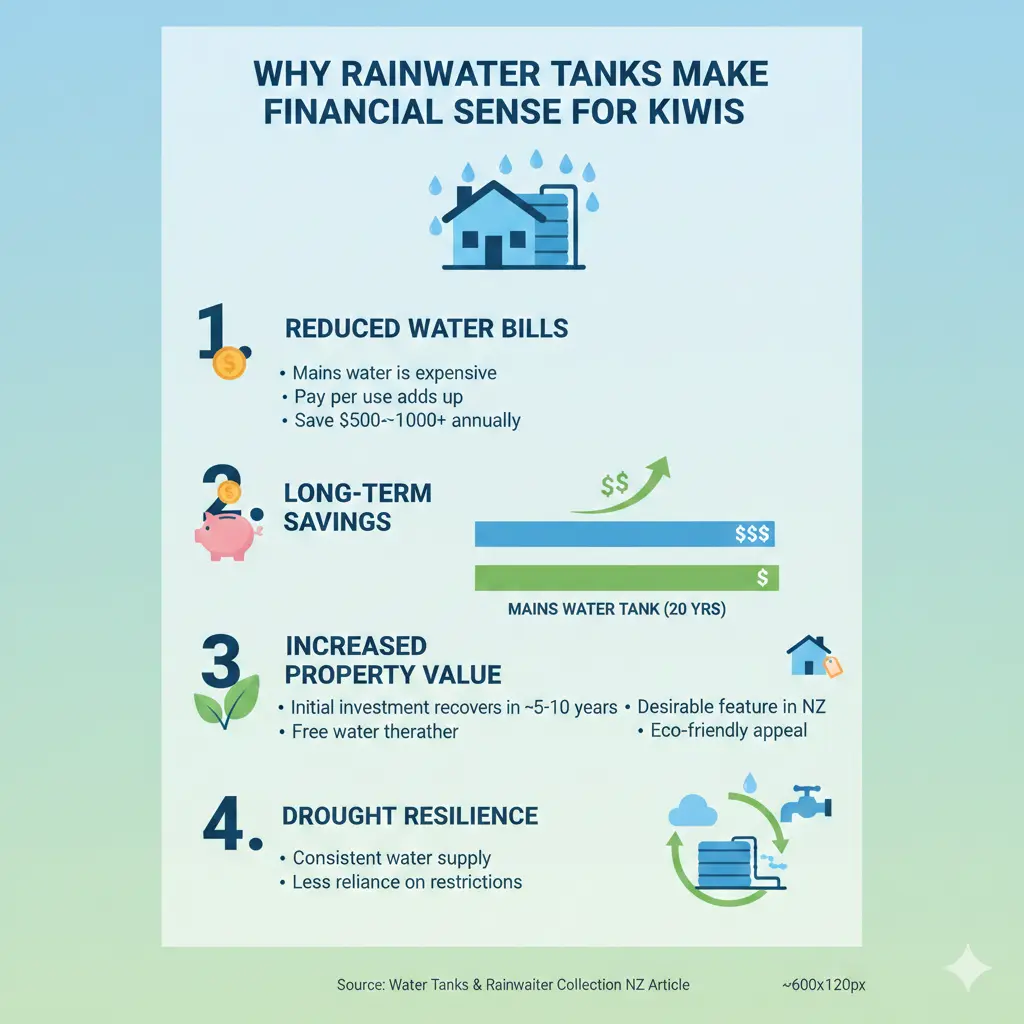
Why rainwater tanks make financial sense for Kiwis
Rainwater collection reduces reliance on mains water, directly impacting your wallet. In Auckland, where restrictions hit hard from 2020-2021, tanks could meet 16% of drought demand by 2050, easing bills during shortages. Nationally, a 5,000-litre tank for garden use starts at $1,000, paying for itself in 3-5 years through savings—especially with metered supplies averaging $3-4 per cubic metre.
Beyond savings, tanks mitigate flooding by slowing runoff, protecting property and infrastructure. Rural homes have long relied on them, but urban uptake is rising as councils push for integrated water management. Financial perks include council rebates: Auckland offers up to $5,000 grants for existing homes, Kapiti Coast gives $250 annual rates remission, and Far North subsidises up to $500.
Cost breakdown: Tanks, installation, and ROI
- Basic garden tank (5,000L): $1,000-$2,000, slimline or round polyethylene from trusted NZ makers like Bailey Tanks.
- Full home system (10,000L+ with pump/filtration): $3,000-$8,000, including first-flush diverters and UV treatment.
- Installation: $500-$1,500 DIY-friendly for above-ground; underground adds $2,000+ for aesthetics.
- Annual savings: $200-$600 for a family of four, more in dry regions like Canterbury.
Factor in KiwiSaver-like long-term thinking: tanks hedge against future rate hikes as water scarcity grows. Use online calculators from suppliers to estimate your payback based on roof size and local rainfall.
Is rainwater collection legal in New Zealand?
Yes—collecting rainwater from your roof is fully legal for residential properties nationwide, with no restrictions. Councils like Auckland have dropped resource consent fees for tanks, and Gore mandates 3,000L minimum for new builds. Masterton and Carterton offer tank discounts, while 21 of 66 territorial authorities actively support it.
Check your local council: most aboveground tanks for gardens need no consent, but indoor plumbing or large installs (>10,000L) may require building consent via building.govt.nz. Auckland's Unitary Plan review could make tanks mandatory for new homes soon.
Council incentives and requirements by region
| Region/Council | Incentives/Requirements |
|---|---|
| Auckland Council | No resource consent fees; up to $5,000 grants; potential mandate for new builds |
| Gore District | 3,000L minimum for new homes |
| Kapiti Coast | $250/year rates remission |
| Far North | Up to $500 subsidies |
| Horowhenua | Emergency 200L tanks available at council desk |
Always verify with your council's district plan—urban areas prioritise tanks to cut mains strain and flooding.
How to choose the right water tank for your NZ home
Size matters: calculate based on roof area, rainfall, and usage. Auckland's year-round rain suits 500L+ for gardens; drier spots like Marlborough need 10,000L+ for reliability. Tools on building.govt.nz help: multiply roof sqm by annual rainfall (e.g., 1,200mm in Auckland) by 0.8 (collection efficiency) for harvest volume.
Tank types and features
- Slimline/above-ground: Space-savers for sections, $500-$3,000 (1,000-5,000L).
- Underground: Aesthetic, flood-proof; pricier at $4,000+.
- Bladder/pillow: Compact for indoors, 500-2,000L.
- Smart tanks: App-monitored levels, pressure, and run-out predictions—track savings easily.
Opt for UV-stabilised polyethylene (NZ-made like Bailey or Raintanks) lasting 20+ years. Add child-proof lids and overflow to stormwater.
Setting up your rainwater harvesting system
Start with roof suitability: metal or Coloursteel is ideal; avoid asbestos or lichen-heavy areas. Install gutter guards to cut debris. Core components:
- First-flush diverter: Dumps initial dirty runoff (e.g., Maelstrom or Marley systems).
- Leaf filters/screens: Gutter meshes prevent clogs.
- Tank inlet filter: Coarse screen at entry.
- Pump (for home use): Pressure system mimicking mains.
- Treatment: Sediment filters, carbon, UV for potable water.
DIY for basics, but hire plumbers for indoor ties (needs backflow prevention). Total setup: 1-2 days.
Safety for drinking rainwater
NZ rainwater is safe to drink with proper treatment—low contaminants compared to global norms. Use a 'treatment train': first-flush, inline filters, UV steriliser. Test annually via councils or labs; add chlorine dosing for storage. Not for infant formula without boiling.
Maintenance tips to keep costs low
Annual checks save thousands in repairs. Schedule:
- Clean filters/diverters quarterly.
- Inspect tank interior yearly (diverter access).
- Flush sediment biannually.
- Test water quality yearly ($100-200).
Smart monitors alert via app, preventing dry runs. Lifespan: 20-50 years with care.
Financial planning: Budgeting for your tank
Treat it like KiwiSaver: upfront $2,000-10,000 yields ongoing returns. Finance via home loans (low rates 2026) or 0% supplier deals. Track savings with apps showing bill reductions—pair with low-flow fixtures for max ROI.
Claim GST if registered; rural farmers deduct via IRD as farm assets. No nationwide rebates yet, but lobby your council. Disclaimer: This isn't personalised financial advice—consult IRD or a advisor for your situation.
Next steps to secure your water future
Measure your roof, check local rainfall on NIWA, and get 2-3 quotes from Bailey, Raintanks, or Aqua Works. Apply for council grants today—Auckland's $5,000 could cover most costs. Start small with a garden tank, scale to home use. You'll save money, stress less in droughts, and do your bit for NZ's water cycle. Ready to harvest? Your drier, cheaper tomorrow starts now.
Frequently Asked Questions
Sources & References
-
1
Can you collect rainwater in NZ? — smartwateronline.com — smartwateronline.com
-
2
Collecting and using rainwater — building.govt.nz — www.building.govt.nz
-
3
Rainwater tanks: Opportunities, implementation, challenges — waternz.org.nz — www.waternz.org.nz
-
4
Perfect Rainwater Harvesting System - Aqua Works — aquaworks.co.nz — www.aquaworks.co.nz
-
5
Everything You Need to Know About Rainwater Tanks — rainreserve.co.nz — www.rainreserve.co.nz
- 6
-
7
Water Tanks | Bailey Tanks® — tanks.co.nz — tanks.co.nz
- 8
-
9
Rainwater Harvesting NZ Products - Marley — marley.co.nz — marley.co.nz
-
10
Emergency Rainwater Tanks — horowhenua.govt.nz — www.horowhenua.govt.nz
Related Articles

Industry Bodies and Professional Associations NZ
Whether you're launching a business, advancing your career, or navigating financial regulations, industry bodies and professional associations in New Zealand offer invaluable support. These organisati...

Emergency Benefit NZ: When You Have No Other Options
When you're struggling financially and don't qualify for other benefits, the Emergency Benefit might be your lifeline. It's a discretionary payment designed for Kiwis in genuine hardship who've exhaus...

Unpaid Internships NZ: Are They Legal?
Unpaid internships are a common pathway for students and graduates to gain work experience in New Zealand, but there's often confusion about whether they're actually legal. The short answer is: unpaid...

Estate Administration NZ: Managing Someone's Affairs After Death
Losing a loved one is one of life's toughest challenges, and stepping in to manage their estate can feel overwhelming. In New Zealand, estate administration—the process of handling someone's affairs a...