House Prices NZ 2025: What to Expect by Region

New Zealand's property market ended 2025 on a softer note, but there are genuine signs of recovery emerging as we head into 2026. After years of volatility following the pandemic boom, the market is n...
The Lifetimes NZ editorial team curates, fact-checks, and updates guides on personal finance, property, health, immigration, legal, business, and lifestyle topics relevant to Lifetimes NZ readers. Articles are produced with AI assistance and reviewed by the editorial team before publication.
New Zealand's property market ended 2025 on a softer note, but there are genuine signs of recovery emerging as we head into 2026. After years of volatility following the pandemic boom, the market is now showing stabilisation with regional variations that could significantly impact your buying, selling, or investment decisions. Understanding where prices are headed in your region is crucial whether you're a first-home buyer, existing homeowner, or property investor.
The National Picture: Where We Stand Now
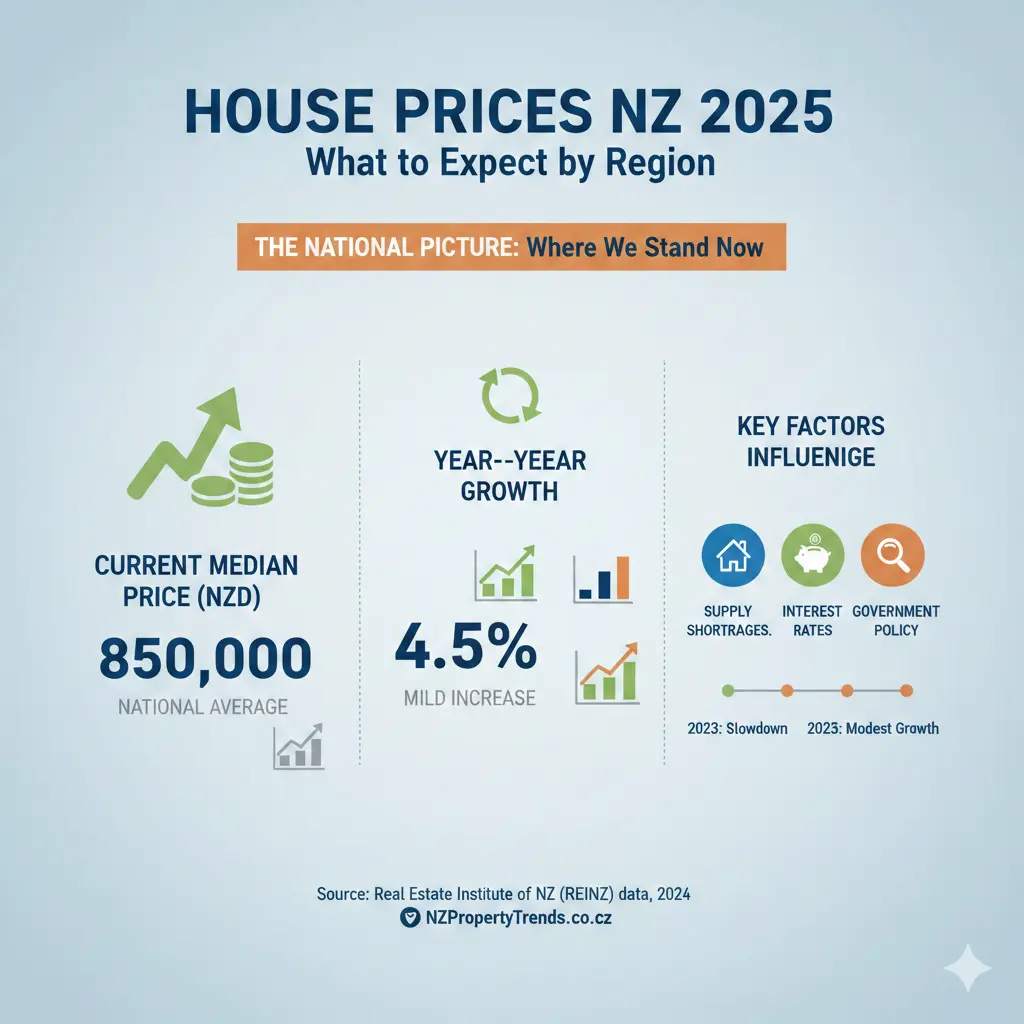
The New Zealand property market experienced a challenging 2025, with national property values declining by 1.0% over the calendar year. The median national house price now sits at $808,430, down 17.6% from the early 2022 peak when the market was at its absolute height. This represents a significant correction from the COVID-era boom, but it's important to note that prices remain substantially higher than they were five years ago.
According to the Reserve Bank of New Zealand (RBNZ), the House Price Index showed a 1.82% year-on-year drop as of Q1 2025, though the pace of decline has moderated compared to previous downturns. This slowdown in the rate of decline is actually a positive indicator, suggesting the market may be finding its floor.
Real Estate Institute of New Zealand (REINZ) data from mid-2025 revealed that the median national house price stood at NZD 770,000, with the national market remaining relatively flat in year-on-year terms. However, this national figure masks significant regional variations that tell a much more interesting story.
Regional Variations: Where Prices Are Rising and Falling
The most important takeaway for Kiwis is that your region matters enormously right now. While the national average appears stable, ten of the sixteen regions reported annual increases in median house prices, while others struggled.
Strong Performers: Where to Watch Growth
Southland has emerged as the standout performer. The region reached a new record median house price of $502,500 in mid-2025—the first regional record high since January—and continued this strength through to the end of the year. By December 2025, each of Southland's three districts saw median values reach new peaks: Southland District up 0.5% to $597,000, Gore up 0.6% to $448,432, and Waihōpai Invercargill up 0.5% to $520,464.
West Coast experienced the most pronounced growth nationally, with prices surging 35.5% year-on-year from $310,000 to $420,000. This dramatic increase reflects the regional dynamics playing out across provincial New Zealand.
Christchurch and parts of Canterbury also performed well, with Christchurch's median property value up 2.6% in 2025, and various Canterbury areas edging to new records by December. New Plymouth (Ngāmotu) also saw increases of 0.5% in December, suggesting strength in provincial centres with stronger local economies.
Other provincial areas showing resilience include Tauranga, Gisborne, Marlborough, and Bay of Plenty, which all recorded strong growth in property sales during 2025.
Struggling Markets: Auckland and Wellington
If you're in Auckland or Wellington, the market has been tougher. Auckland's median price fell 3.4% year-on-year to NZD 990,000 in mid-2025, and the decline accelerated through the latter part of the year. By the end of 2025, Auckland City saw values fall by 3.5%, with Manukau down 3.2% and North Shore down 1.3%.
Wellington has fared even worse. All of Wellington's sub-markets experienced value declines in 2025, with drops from the peak sitting at 23% or more across the board. This represents a significant correction from the pandemic highs, though it's worth noting that first-home buyers remain very active in the Wellington area, taking advantage of lower entry prices.
The weakness in these major centres reflects several factors: elevated stock levels of existing listings, the supply shift from new townhouse developments, net migration easing (particularly noticeable in Auckland where new arrivals typically settle), rising vacancy rates, and softening rental growth.
The Rest of the Country
Excluding Auckland, the median price rose by 1.7% to $691,500, indicating that provincial New Zealand is outperforming the major urban centres. Northland saw modest growth of 0.8%, while Hawke's Bay showed some lingering weakness, with Napier down 0.3% and Hastings down 0.9% in December 2025.
What's Driving These Regional Differences?
Several factors are creating this patchwork of regional performance:
- Economic fundamentals: Regions with stronger local economies—particularly those benefiting from agriculture—are outperforming areas dependent on services sector activity, which remains subdued.
- Migration patterns: Net migration gains continue to ease, with particular impacts in Auckland where new arrivals typically settle first.
- Housing supply: New dwelling consents show regional variation, with Otago (+37.25%), Taranaki (+27.51%), and Tasman (+15.73%) recording the strongest growth, while Marlborough (-34.80%), Northland (-27.19%), and Gisborne (-21.58%) experienced declines.
- Rental market dynamics: Rising vacancy rates and softening rental growth in major centres are affecting investor sentiment and property values.
What Does 2026 Hold? The Outlook
The good news is that forecasters are cautiously optimistic about 2026. Here's what experts are predicting:
ANZ forecasts a 5.0% increase in house prices over 2026, following a more modest 2.5% rise in 2025. This projected increase is supported by anticipated further OCR (Official Cash Rate) reductions and a strengthening economic recovery.
A Reuters poll of 14 property analysts indicates expected increases of 6.0% in 2026 and 5.1% in 2027, with anticipated monetary policy easing expected to bolster market confidence.
However, it's important to note that 2026 will be an election year, which historically tends to induce housing uncertainty, particularly in Wellington. This could moderate some gains, especially in politically sensitive markets.
The consensus view is that lower mortgage rates will be the key driver of recovery. As the RBNZ continues to ease monetary policy, borrowing costs should fall, improving affordability and encouraging buyers back into the market. This should support prices across most regions, though the recovery may be uneven.
What This Means for Different Groups
First-Home Buyers
If you're saving for your first home, 2026 could be a better time to enter the market than 2025. Lower mortgage rates will improve your borrowing capacity, and in many regions, prices have already corrected significantly from pandemic peaks. Major centres like Auckland and Wellington offer better value now than they did two years ago. Consider whether you want to buy in a growth region or a more established market—both strategies have merit depending on your circumstances and KiwiSaver balance.
Current Homeowners
If you already own your home, the stabilisation and projected recovery in 2026 should ease concerns about further significant declines. Your property's value is likely to hold steady or increase modestly over the next 12 months, particularly if you're outside the major centres. Focus on managing your mortgage strategically as rates fall.
Property Investors
Investors should pay close attention to regional dynamics. The strong performance in provincial centres like Southland, West Coast, and Christchurch suggests these areas offer better growth prospects than Auckland or Wellington in the near term. However, rental market softening in major centres means yields may be compressed—a factor that requires careful analysis before investing.
Practical Steps to Take Now
- Get your finances in order: With lower mortgage rates coming, now's the time to improve your credit score and get pre-approval sorted if you're planning to buy.
- Research your region: Understand the local economic drivers in your area. Is employment growing? Are people moving in or out? These fundamentals matter more than national headlines.
- Monitor KiwiSaver: If you're a first-home buyer with KiwiSaver, check your balance and contribution strategy. You may be able to withdraw funds once you've been in the scheme for three years.
- Get professional advice: Talk to a mortgage broker or property advisor who understands your local market. Regional variations are too significant to rely on national data alone.
- Don't rush: The market is stabilising, not booming. You have time to make a considered decision rather than being forced by FOMO (fear of missing out).
Moving Forward in 2026
New Zealand's property market has stabilised after a challenging correction, and the outlook for 2026 is cautiously optimistic. However, the national picture masks significant regional variations that will shape your personal experience of the market. Whether you're buying, selling, or investing, understanding your local market dynamics is more important than ever.
The key takeaway: provincial New Zealand is outperforming major centres right now, mortgage rates are falling, and forecasters expect modest but meaningful price growth through 2026. This creates opportunities for informed buyers and investors willing to look beyond headline national figures and understand the fundamentals driving their local market.
Before making any major property decisions, take time to research your region, get pre-approval sorted if you're buying, and seek professional advice tailored to your circumstances. The market is moving in your favour—make sure you're positioned to take advantage of it.
Frequently Asked Questions
Sources & References
-
1
New Zealand Residential Property Market Analysis 2026 — www.globalpropertyguide.com
-
2
NZ Property Market Update 2025: Regional house prices and rents — www.youtube.com
-
3
NZ property values end 2025 in the red - Cotality — www.cotality.com
-
4
Property Focus: For homeowners and investors — www.anz.co.nz
-
5
2025 House Prices in New Zealand - Trends & Market Data — tremains.co.nz
-
6
NZ House Prices 2025: Where values fell – and what's coming next — www.mpamag.com
Related Articles

First Home Grant NZ: How to Get Up to $10000
Buying your first home is one of the biggest financial decisions you'll make, and the New Zealand government wants to help. The First Home Grant puts up to $10,000 directly towards your deposit, makin...

Why 2026 is the Hardest Year to Buy a Home (and How to Beat the Odds)
Imagine standing at the edge of the property ladder in 2026, eyeing your dream home while prices hover stubbornly high, listings pile up, and buyer confidence wavers. For Kiwis, this year feels toughe...

Buying Your First Home in 2026: A Step-by-Step NZ Checklist
Imagine standing in your own Kiwi bach or cosy family home, keys in hand, after years of renting. In 2026, with interest rates stabilising and first-home schemes still strong, buying your first home i...

Selling Your Home? 10 Low-Cost Renovations That Add $50k in Value
If you're planning to sell your home in New Zealand, you don't need to break the bank with a complete renovation to attract buyers and boost your sale price. The good news? Some of the most effective...