First 30 Days in New Zealand: Essential Setup Guide
Arriving in New Zealand is thrilling—those first glimpses of green hills and ocean views make the long flight worthwhile. But with the excitement comes the practical side: sorting your essentials quic...
Priya writes about immigration pathways, job searching, and building a career in New Zealand. She covers visa options, CV writing, interview preparation, and workplace culture for newcomers and locals alike.
Arriving in New Zealand is thrilling—those first glimpses of green hills and ocean views make the long flight worthwhile. But with the excitement comes the practical side: sorting your essentials quickly so you can focus on enjoying life here. This guide walks you through the must-dos in your first 30 days, from getting an IRD number to setting up a bank account, phone, accommodation, and key registrations. We've tailored it for newcomers in 2026, with Kiwi-specific tips to make settling in smooth and stress-free.
Days 1-3: Arrival and Immediate Essentials
Your first few days are about basics—clearing customs, finding temporary digs, and getting connected. New Zealand's border processes are efficient, but preparation pays off.
Clearing Immigration and Customs
Upon landing, expect questions on your visa, biosecurity (declare all food and gear), and customs. Most visitors or visa holders need a visa or NZeTA beforehand—check this pre-flight to avoid issues. Have digital copies of your passport, visa approval, job offer (if applicable), and proof of funds ready on your phone. Biosecurity is strict—no fresh fruit, soil, or untreated wood—to protect our unique environment.
- Tip: Download the NZ Customs app for declarations to speed things up.
- Pay the International Visitor Conservation and Tourism Levy (IVL) of NZD$100 if required—it's included in many airfares now.
Temporary Accommodation
Book an Airbnb, hotel, or motel for the first week via Trade Me Property or Bookabach. Expect NZD$150-300/night in Auckland or Wellington. If you're on a work visa, your employer might cover initial stays—confirm this early. Aim to secure something central to transport links for easy access to services.
Pro tip: Use sites like Trade Me for short-term rentals, popular among Kiwis.
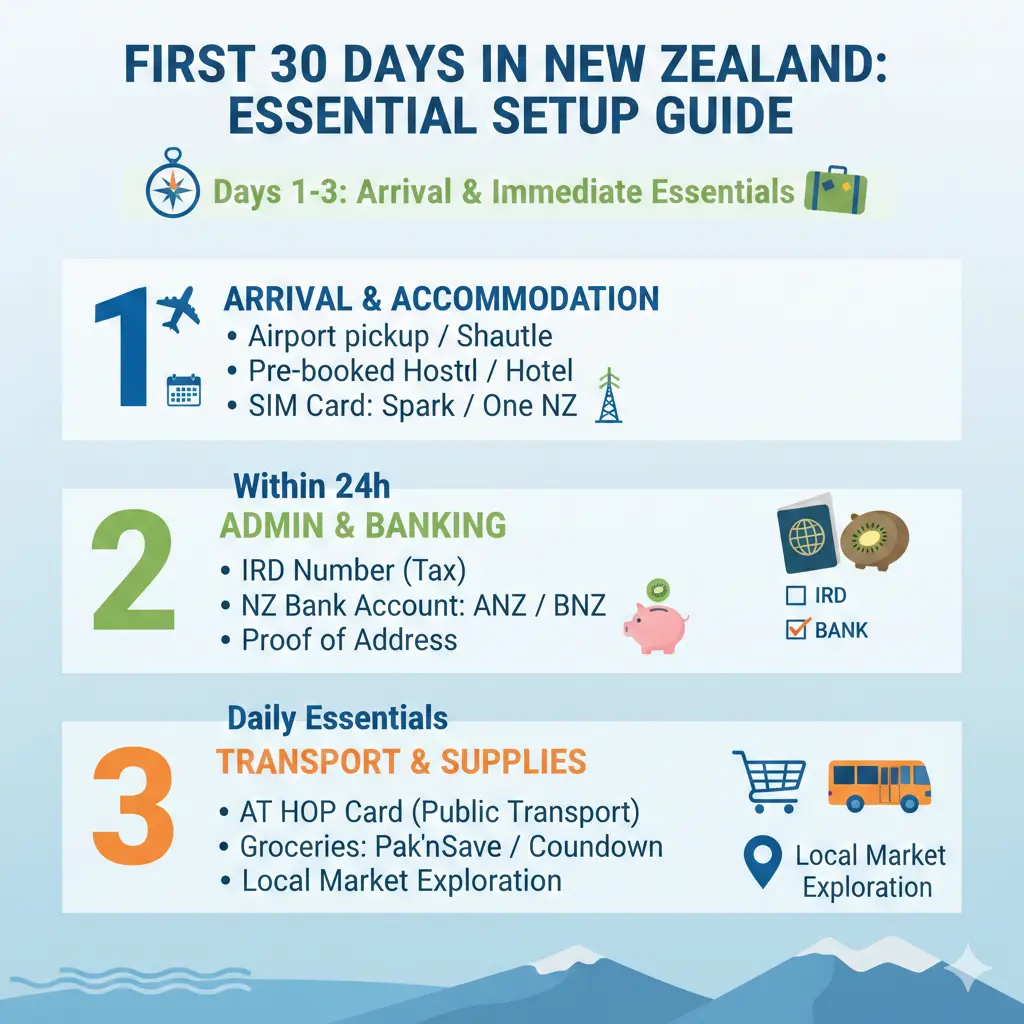
Days 4-7: Get Your IRD Number and Bank Account
These are non-negotiables for working, paying tax, or even getting paid. Do them early to avoid delays.
Applying for an IRD Number
The IRD (Inland Revenue Department) number is your tax ID—essential for employment, KiwiSaver, and benefits. New arrivals can apply online via myIR (create an account with RealMe login) or in person at an IRD office. You'll need your passport, visa, and arrival details. Processing takes 8-10 working days, but you can start work with proof of application.
- Go to ird.govt.nz and select 'New to New Zealand'.
- Upload docs—digital is fastest.
- Once approved, link it to myIR for tax returns and refunds.
In 2026, with Going for Growth updates, having an IRD speeds up pathways for skilled migrants aiming for residence.
Opening a Bank Account
Kiwis bank with ANZ, ASB, BNZ, or Kiwibank—choose based on branches near you. Visit a branch with your passport, visa, and IRD application proof (full IRD not always needed initially). Most offer instant debit cards and apps. Everyday accounts have low/no fees if you deposit salary regularly.
- Auckland newcomers: ASB or ANZ for widespread ATMs.
- Compare fees: Use Sorted.org.nz tool.
- Pro tip: Set up internet banking day one—EFTPOS is king here.
Once banked, transfer funds via Wise or OFX for best rates—avoid airport exchanges.
Days 8-14: Phone, SIM, and Connectivity
Stay connected for job hunting, rentals, and navigation. NZ has excellent coverage from Spark, One NZ, or 2degrees.
Getting a Local SIM Card
Buy a prepaid SIM at the airport (NZD$30-50 for 10-20GB) or supermarkets like Countdown. Plans start at NZD$25/month for unlimited calls/texts and 40GB data. eSIMs work for compatible phones—scan and activate instantly.
| Provider | Starter Plan (2026) | Best For |
|---|---|---|
| Spark | NZD$29/mth, 50GB + unlimited | Rural coverage |
| One NZ | NZD$25/mth, 40GB | Urban value |
| 2degrees | NZD$30/mth, 100GB | Data-heavy users |
Download apps like NZ Transport or AA Roadwatch for real-time updates. WiFi is free at cafes, libraries, and malls.
Internet and Utilities Setup
For rentals, providers like Spark or Vodafone offer 4G/5G routers (NZD$70/month). Once in permanent accommodation, contact your landlord for power/gas (Contact Energy or Genesis) and internet setup—expect NZD$100-150/month combined.
Days 15-21: Secure Accommodation and Transport
Finding Long-Term Housing
Shift from temp stays to renting via Trade Me, Facebook Marketplace, or agents. Average rents in 2026: Auckland 2-bed NZD$650/week, Wellington NZD$550, Christchurch NZD$500. Need 100 points ID check (passport + bank statement). Bonds are 4 weeks' rent—save up.
- Viewing tips: Check for insulation (Healthy Homes standards mandatory).
- Beware scams—never pay deposits unseen.
- Pet-friendly? List pets upfront.
Getting Around
Buy an AT HOP card (Auckland) or Snapper (Wellington) for public transport—fares NZD$2-5/trip. Uber/Bolt are affordable; buy a cheap used car via Trade Me (NZD$5,000-10,000) after your licence conversion. Visitor DL valid 12 months; convert at AA with test if needed.
Days 22-30: Health, Registrations, and Family Setup
Enrol with a GP and Access Health
Register at a medical centre via Healthpoint.co.nz—free for kids under 14, subsidised for others. ACC covers accidents automatically. Pharmacies like Unichem stock essentials. If on work visa, private insurance bridges gaps.
Essential Registrations
KiwiSaver: Auto-enrolled if working; opt in for retirement savings (employer matches 3%).
Voter Roll: Register at vote.nz if eligible.
RealMe: Verified account for govt services—link IRD/bank.
For families: Enrol kids at schools via education.govt.nz; zones apply. StudyLink for tertiary if studying.
If eyeing residence, note 2026 Skilled Migrant updates: easier points for NZ quals and work experience.
Practical Budget for Your First Month
Plan NZD$4,000-6,000/person: rent bond $2,000, weekly rent $600, food $400, transport/phone $200, misc $500. Track via PocketSmith app.
Next Steps to Thrive in Aotearoa
Tick off these in order, and you'll be sorted by day 30. Join expat groups on Facebook (e.g., 'Newcomers to NZ') for tips, explore local markets, and embrace the Kiwi way—laid-back but efficient. If work leads to residence, track Immigration NZ updates. You've got this—welcome home!
Frequently Asked Questions
Sources & References
-
1
Skilled Migrant Category Points Updates 2026 — www.newzealandshores.com
-
2
Immigration and Visas - New Zealand Government — www.govt.nz
-
3
Visa and Entry Requirements to New Zealand — www.newzealand.com
-
4
Legal Guide Immigration for New Zealand 2026 — ieltsfever.org
-
5
Planned Upgrades for 2026 - Immigration New Zealand — www.immigration.govt.nz
-
6
Operational Manual - Immigration New Zealand — www.immigration.govt.nz
-
7
Setting Up Your Life in New Zealand — www.immigration.govt.nz
-
8
What You Need to Visit New Zealand — www.immigration.govt.nz
-
9
Visas - Immigration New Zealand — www.immigration.govt.nz
-
10
Tenancy Services - Healthy Homes Standards — www.tenancy.govt.nz
Related Articles
Best Cities to Live in NZ: A Honest Comparison for Newcomers
Choosing where to settle in New Zealand can feel overwhelming, especially if you're a newcomer eyeing the best cities to live in NZ. Whether you're moving for work, study, or a fresh start, this hones...

Shipping Your Life to NZ: Cost Comparisons of Major Moving Companies
Moving your entire life to New Zealand doesn't have to break the bank or your spirit. Whether you're a Kiwi returning home from overseas or someone chasing that fresh start in Aotearoa, comparing cost...

The Ultimate Checklist for Moving to New Zealand
Moving to New Zealand is an exciting step towards a fresh start in one of the world's most beautiful countries. Whether you're chasing job opportunities, a laid-back lifestyle, or our stunning landsca...

Setting Up Your NZ Life: Bank Accounts; IRD Numbers; and Utilities
Moving to a new place in New Zealand can feel overwhelming, but getting your bank account, IRD number, and utilities sorted early makes settling in smooth and stress-free. Whether you're a new migrant...