Index Funds NZ: The Simple Way to Invest

Ever wondered how to grow your hard-earned KiwiSaver or savings without spending hours picking stocks or paying sky-high fees? Index funds offer a straightforward path to building wealth, tracking mar...
Sarah covers personal finance, tax, and KiwiSaver topics for Lifetimes NZ. She focuses on making money management straightforward and practical for everyday Kiwis.
Ever wondered how to grow your hard-earned KiwiSaver or savings without spending hours picking stocks or paying sky-high fees? Index funds offer a straightforward path to building wealth, tracking market indexes like the S&P/NZX 50 for steady, long-term growth.Index Funds NZ are perfect for busy Kiwis who want simple, low-cost investing.
Whether you're dipping your toes into shares for the first time or diversifying your portfolio, index funds deliver broad market exposure with minimal fuss. In New Zealand, they're popular through KiwiSaver providers like Simplicity and platforms like Sharesies or Kernel Wealth. Let's dive into why they're the smart choice for 2026 and how you can get started today.
What Are Index Funds?
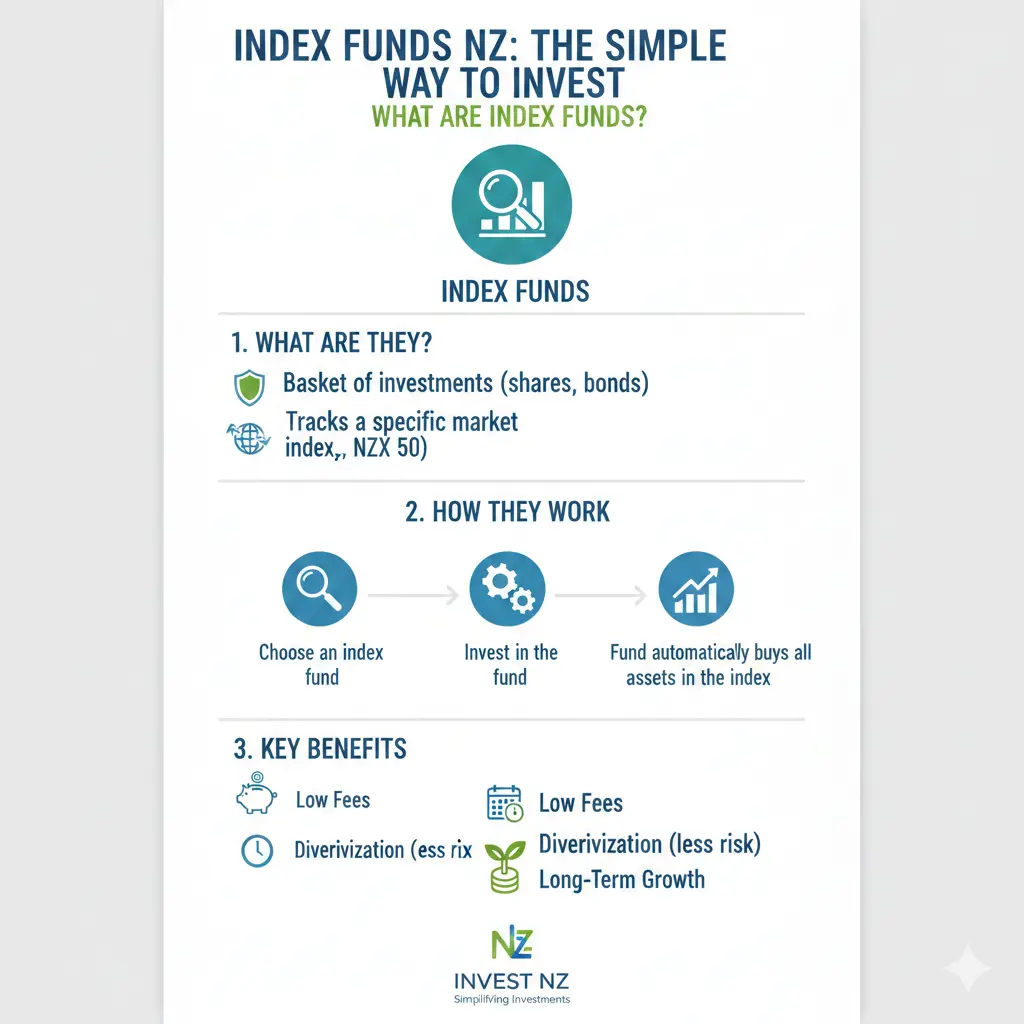
Index funds are investment vehicles that mirror the performance of a specific market index, such as the S&P/NZX 50, which tracks New Zealand's top 50 companies listed on the NZX.Instead of a manager picking individual stocks, the fund simply buys all (or a representative sample) of the shares in that index, matching its ups and downs.
This passive approach keeps costs low—often just 0.03% to 0.60% per year in management fees—compared to actively managed funds charging up to 2% p.a. Over time, these savings compound, boosting your returns. Research shows index funds often outperform active funds after fees, making them a staple in KiwiSaver schemes like Simplicity.
How Index Funds Differ from Active Funds
- Passive vs Active: Index funds track an index; active funds aim to beat it through stock-picking.
- Fees: Index: 0.03%-0.60% p.a.; Active: up to 2% p.a.—that's 66 times higher in some cases.
- Performance: Index funds provide market-average returns with diversification; active funds may shine short-term but lag long-term.
For most Kiwis, index funds are the simple way to invest without needing a finance degree.
Why Choose Index Funds in New Zealand?
New Zealand's market is small—less than 0.2% of global markets—so pure NZ index funds limit diversification.Most experts recommend 20-40% in NZ funds and 60-80% global for balanced risk. Yet, local options shine for home bias, dividends, or property exposure.
Benefits include:
- Low Fees: Keep more of your returns.
- Diversification: Spread risk across dozens of companies.
- Tax Efficiency: As PIE funds, taxed at your PIR (up to 28%), not income tax (up to 39%). Overseas holdings over $50k trigger FIF rules unless via NZ PIE.
- Ease: Set-and-forget for long-term growth, ideal alongside KiwiSaver.
In 2026, with NZX volatility from economic shifts, index funds offer stability through broad exposure.
Top Index Funds Available in New Zealand
From NZX trackers to global giants like the S&P 500, here's a rundown of popular options. Many are accessible via platforms like InvestNow, Sharesies, Hatch, or Kernel Wealth.
NZ Shares Index Funds
Track Kiwi blue-chips for local exposure:
- Smartshares S&P/NZX 50 ETF (NZG): Top 50 NZ companies. Real-time trading.
- Kernel NZ 20 Fund (0.25% p.a.): 20 largest, like Fisher & Paykel Healthcare, Auckland Airport. Higher growth potential, more volatility.
- Smartshares NZ Top 10 ETF (TNZ, 0.60% p.a.): Ultra-focused on biggest names (60% of NZX market cap).
- Smartshares NZ Mid Cap ETF (MDZ): 11th-50th largest, excluding big banks.
- Smartshares NZ Dividend ETF (DIV): 25 high-dividend NZX 50 stocks for income.
NZ Property and Bonds
- Smartshares NZ Property ETF (NPF): 8 major REITs.
- Smartshares S&P/NZX NZ Govt Bond ETF (NGB): Government bonds for stability.
- Simplicity NZ Bond Fund: Mostly govt/local bonds.
Global and Diversified Funds
Go international for true diversification:
- S&P 500 Funds: Via Hatch, Sharesies, or NZ platforms like Kernel's Global 100.
- SuperLife Growth Fund: 19% NZ/Aus shares, 51% international (65% hedged).
- Simplicity Balanced Fund: 21% NZ/Aus, 35% international shares (65% hedged), 42% bonds.
Platforms: InvestNow (broad selection), Kernel (NZ-focused), Hatch/Stake (US ETFs).
How to Build a Portfolio with Index Funds NZ
Start simple: Use a core-satellite approach—80-90% in broad index funds (core), 10-20% in themed ones (satellite).
Example Portfolios for Kiwis
- Beginner Balanced (Low Risk): 30% Kernel NZ 20, 50% S&P 500, 20% NZ Bonds. Add cash for buffer.
- Growth-Focused: 20% Smartshares NZG, 60% Global 100, 10% Clean Energy satellite, 10% REITs.
- Core-Satellite: Core: S&P 500 + NZ 20 (90%); Satellite: Global Clean Energy (10%).
Asset Allocation Tip: Adjust by age/risk—younger Kiwis: more shares; nearing retirement: bonds/cash.
Steps to Invest
- Choose Platform: Sharesies (easy app), InvestNow (no min for some), Hatch (US access).
- Set PIR: Confirm with IRD to avoid tax issues.
- Pick Funds: Match your goals—check min investment, fees.
- Invest Regularly: Dollar-cost averaging beats timing the market.
- Monitor: Rebalance yearly; use KiwiSaver for auto-growth.
Minimums vary—some from $1 on Sharesies.
Tax and Regulations for Kiwi Investors
Most NZ index funds are PIEs, taxing returns at your Prescribed Investor Rate (10.5%, 17.5%, or 28%).Declare correctly via IRD myIR. For overseas direct holdings over $50k, FIF rules apply (deemed rate or market value tax)—stick to NZ PIEs to simplify.
No capital gains tax yet, but watch for changes. Dividends and interest are taxed as income.
Risks and How to Manage Them
Markets fluctuate—NZX 50 can drop 20% in downturns. Mitigate with:
- Diversification: Global + NZ mix.
- Long Horizon: 5-10+ years.
- Hedging: Some funds hedge currency risk (e.g., 65% on international shares).
- Emergency Fund: 3-6 months expenses in high-interest savings first.
Property funds add income but sector risk; bonds lower volatility.
Platforms to Buy Index Funds in NZ
| Platform | Strengths | Fees | Best For |
|---|---|---|---|
| Sharesies | NZ/Global ETFs, easy app | 0.5% brokerage (drops with volume) | Beginners |
| InvestNow | Broad fund selection, no min | 0.3% admin (some zero) | Diversified portfolios |
| Kernel Wealth | NZ-focused indexes | 0.25%-0.5% p.a. | Local exposure |
| Hatch | US indexes like S&P 500 | US$3 trade, 0.5% FX | Global growth |
Compare via MoneyHub or FMA register.
Ready to Start? Your Next Steps
Index funds NZ make investing accessible—sign up on Sharesies or InvestNow today, pick a balanced mix, and automate contributions. Track via the FMA site, consult a adviser for personalised advice, and watch your wealth grow steadily. With low fees and global reach, it's the simple way to secure your financial future.
Frequently Asked Questions
Sources & References
-
1
The Ultimate Guide to Index Funds in New Zealand — moneykingnz.com
-
2
How to Build an Investment Portfolio Using Index Funds in NZ — kernelwealth.co.nz
-
3
Low Fee NZ Index Funds — www.moneyhub.co.nz
-
4
S&P 500 Guide - What, Why and How to Invest in NZ — www.amp.co.nz
-
5
How an Index Fund Works—Sharesies New Zealand — www.sharesies.nz
-
6
My Investing Plan For 2026 (How I'm Investing In 2026) - YouTube — www.youtube.com
-
7
How to Invest in the S&P 500 from New Zealand — www.moneyhub.co.nz
Related Articles

Ethical Investing in NZ: Top 5 Sustainable Funds for Kiwis
Ever wondered if you can grow your KiwiSaver or investments while doing good for the planet and people? Ethical investing in New Zealand is booming, with Kiwis pouring billions into funds that priorit...

Beginner's Guide to Investing in New Zealand
Getting started with investing in New Zealand doesn't have to be complicated. Whether you're looking to grow your wealth, save for retirement, or build financial security, there are plenty of accessib...

How to Buy Shares in New Zealand: Step-by-Step Guide
Ever wondered how to dip your toes into share investing without getting overwhelmed? Whether you're saving for a house deposit, retirement, or just want to grow your hard-earned cash, buying shares in...

ETFs vs Managed Funds: Which is Better for Kiwi Investors?
When you're ready to invest your money, you'll likely come across two main options: exchange-traded funds (ETFs) and managed funds. Both offer diversification and professional management, but they wor...