Buying a Do-Up: Renovation Costs and Finance Options

Ever dreamed of snapping up a fixer-upper in Kiwi suburbs like Ponsonby or Karori, rolling up your sleeves, and turning it into your perfect family pad? Buying a do-up – that's Kiwi slang for a proper...
The Lifetimes NZ editorial team curates, fact-checks, and updates guides on personal finance, property, health, immigration, legal, business, and lifestyle topics relevant to Lifetimes NZ readers. Articles are produced with AI assistance and reviewed by the editorial team before publication.
Ever dreamed of snapping up a fixer-upper in Kiwi suburbs like Ponsonby or Karori, rolling up your sleeves, and turning it into your perfect family pad? Buying a do-up – that's Kiwi slang for a property ripe for renovation – can be a smart way to get into the housing market without paying top dollar for a pristine home. But with construction costs ticking up 0.9% in Q4 2025 and steady rises into 2026, getting your numbers right is crucial to avoid budget blowouts.
In this guide, we'll break down realistic renovation costs across New Zealand, from villa reclads to kitchen overhauls, and explore finance options tailored for Kiwis, including top-up loans and KiwiSaver withdrawals. Whether you're eyeing a character home in Auckland or a weatherboard in Christchurch, you'll walk away with actionable steps to make your do-up dream a reality.
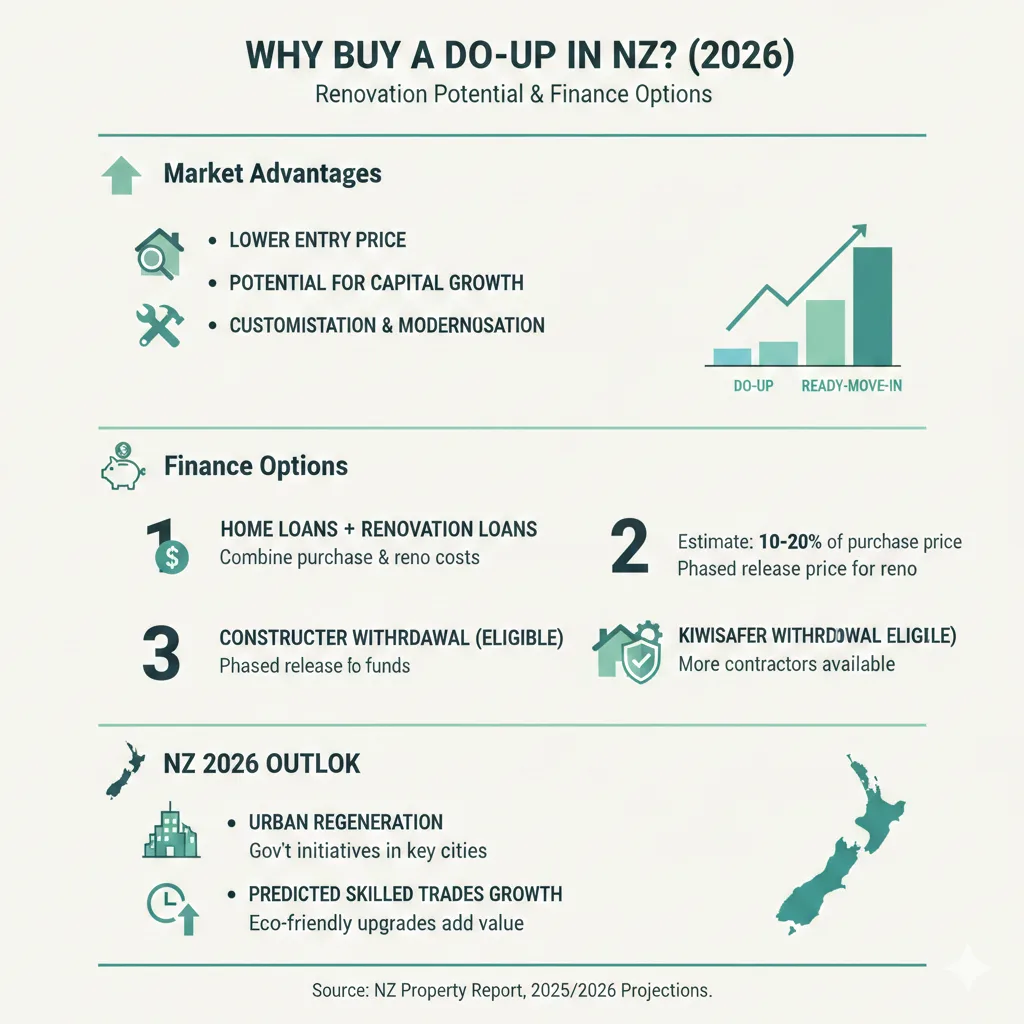
Why Buy a Do-Up in 2026 New Zealand?
Do-ups offer entry into hot markets at a discount. A rundown villa might list 20-30% below comparable renovated properties, but adding value through smart renos can boost equity fast. With dwelling consents rebounding to 35,500 in late 2025, driven by lower mortgage rates and new-build lending exemptions, the market's recovering – making now a good time to buy and build.
Key perks include:
- Equity growth: Renovate wisely, and your home's value could jump 10-20% or more.
- Personalisation: Tailor the space to your whānau needs, like open-plan living or home offices.
- Affordability: Cheaper entry point amid steady construction costs (up just 0.4-0.9% quarterly).
However, pitfalls loom: unexpected structural issues, consent delays, and cost overruns. Always get a builder's report and council LIM before bidding.
Understanding Renovation Costs in New Zealand
Renovation costs vary by location, home type, and spec level. In 2026, expect $2,800-$4,000 per square metre for new builds, but do-ups often cost less if you're smart – though labour shortages in Auckland push prices higher. Factor in 10-15% contingency for surprises like rotten weatherboards.
Average Costs for Common Renovation Projects
Here's a breakdown based on 2026 estimates for mid-range work on a typical Kiwi villa or 3-bedroom home:
| Project | Estimated Cost (NZD) | Notes |
|---|---|---|
| Roof replacement (corrugated iron, average size) | $12,000-$14,000 | Higher for long-run iron or complex pitches. |
| Dormer window replacement | $8,000-$9,000 | Includes frame and installation. |
| Recladding and insulation (villa) | $30,000-$35,000 | Add $10,000 for exterior paint. |
| Double-glazing retrofit | $10,000 | Doubles if replacing all joinery. |
| Bathroom renovation (medium, mid-range) | $20,000-$35,000 | Basic: $15,000-$20,000; save by keeping plumbing points. |
| Kitchen renovation (full, mid-range) | $30,000-$60,000 | Cabinets: $14k-$20k; labour: $5k-$15k. |
Full-house renos for a 150sqm home might total $150,000-$300,000, excluding GST. Costs have stabilised post-2022 peaks, with annual growth at 2.3%, but regional differences apply – Auckland 10-20% pricier than regional centres.
Hidden Costs to Watch
Don't overlook these budget busters:
- Consents and compliance: $2,000-$5,000; check building.govt.nz for Healthy Homes rules.
- Site prep and waste: 20-30% uplift on builds.
- Moving out vs staying: Rent at $700/week + $600 storage vs $3,000+ in builder delays if staying.
- Labour: 15-25% of kitchen budgets; rising in cities.
Tips to Control Renovation Costs
- Get 3 fixed-price quotes from licensed builders via licensedbuildingpractitioners.govt.nz.
- Prioritise: Kitchen and bathroom first for max value-add.
- Buy ex-demo appliances or recycled materials from Trade Me or salvage yards.
- Hire an interior designer ($500-$5,000) to avoid code breaches.
- Track inflation: Costs up 1% annually in 2025.
Finance Options for Buying and Renovating a Do-Up
Funding a do-up splits into purchase and reno phases. Banks like ASB or BNZ offer specialist products, but you'll need 20% deposit for investment do-ups (less for owner-occupiers). Use the Reserve Bank’s loan-to-value exemptions for new builds, though renos qualify indirectly.
Mortgage Options for Do-Ups
- Top-up mortgage: Add reno costs to your home loan; interest deductible if flipping. Rates ~5.5-6.5% in 2026 (check interest.co.nz).
- Construction loan: Staged drawdowns for progressive work; converts to standard mortgage post-completion.
- Bridging finance: Short-term for quick flips; high rates (8-12%).
Government and Kiwi-Specific Schemes
Leverage these for affordability:
- KiwiSaver withdrawal: First home buyers can pull $X (your balance) tax-free for deposit or renos; must live in 6 months. Check kiwisaver.govt.nz.
- Progressive Home Ownership: Kāinga Ora scheme for low-income Kiwis; shared equity up to 40%.
- First Home Grant: Up to $10,000 for existing homes under $950k (2026 caps); pair with reno budget.
- Best Start: Extra grant if expecting.
For investors, IRD allows deducting reno interest from 2024, but track bright-line test (10 years for non-residential land).
Comparing Finance Costs
| Option | Pros | Cons | Best For |
|---|---|---|---|
| Top-up Mortgage | Low rates, one repayment | Secured on home | Owner-occupiers |
| Personal Loan | Quick approval | High interest (10-15%) | Small renos |
| KiwiSaver | Tax-free, no repayment | Locked till 65 otherwise | First-timers |
Chat to a mortgage adviser via mortgageresearcher.co.nz for personalised rates.
Step-by-Step Guide to Buying and Renovating
- Budget set: Purchase + 20% reno buffer. Use sorted.org.nz calculator.
- Due diligence: Builder report ($800-$1,500), pest inspection, council consents check.
- Finance pre-approval: Shop banks for do-up-friendly lenders.
- Project plan: Timeline 3-6 months; fixed-price contract essential.
- Hire pros: LBP builder, engineer for structurals.
- Monitor progress: Weekly site meets; app like Buildertrend.
Real Kiwi Case Study: Villa Revival in Wellington
Take Sarah from Karori: Bought a 1920s villa for $850k (20% under market). Reno budget $120k: $35k kitchen, $25k bathroom, $20k insulation. Top-up loan at 6%, KiwiSaver for deposit. Post-renovation value: $1.2m. Timeline: 4 months, moved out to save $3k in delays.
FAQ
How much should I budget for a full do-up reno in 2026?
Expect $150k-$300k for a 150sqm home, or $2,000-$3,000/sqm mid-range.
Is it cheaper to move out during renos?
Often a tie: $700/week rent vs $3k+ delays staying put.
Can I use KiwiSaver for renovations?
Yes, for first homes; withdraw for purchase or immediate renos. Confirm with provider.
What are current construction cost trends?
Steady at 1-2.3% annual growth into 2026; no big spikes expected.
Do I need consents for renos?
Yes for structural, plumbing, insulation; check building.govt.nz.
Best finance for investors?
Top-up mortgage with interest deductibility; mind bright-line rules.
Next Steps for Your Do-Up Journey
Ready to dive in? Start with a property search on realestate.co.nz filtering for 'as is where is'. Get pre-approval, line up a builder, and run numbers with sorted.org.nz tools. Remember, this isn't financial advice – consult an adviser or accountant for your situation. With planning, your do-up could be the savvy move that builds lasting wealth in Aotearoa.
Related Articles

Industry Bodies and Professional Associations NZ
Whether you're launching a business, advancing your career, or navigating financial regulations, industry bodies and professional associations in New Zealand offer invaluable support. These organisati...

Emergency Benefit NZ: When You Have No Other Options
When you're struggling financially and don't qualify for other benefits, the Emergency Benefit might be your lifeline. It's a discretionary payment designed for Kiwis in genuine hardship who've exhaus...

Unpaid Internships NZ: Are They Legal?
Unpaid internships are a common pathway for students and graduates to gain work experience in New Zealand, but there's often confusion about whether they're actually legal. The short answer is: unpaid...

Estate Administration NZ: Managing Someone's Affairs After Death
Losing a loved one is one of life's toughest challenges, and stepping in to manage their estate can feel overwhelming. In New Zealand, estate administration—the process of handling someone's affairs a...