Financial Abuse: Recognising Signs and Getting Help
Imagine discovering that your hard-earned KiwiSaver savings have been secretly drained, or that debts you never agreed to are piling up in your name—all orchestrated by someone you trusted. Financial...
Sarah covers personal finance, tax, and KiwiSaver topics for Lifetimes NZ. She focuses on making money management straightforward and practical for everyday Kiwis.
Imagine discovering that your hard-earned KiwiSaver savings have been secretly drained, or that debts you never agreed to are piling up in your name—all orchestrated by someone you trusted. Financial abuse is a hidden form of family violence affecting thousands of Kiwis, leaving victims trapped in cycles of debt and dependency. In New Zealand, **15% of women** who have been in a relationship have experienced economic abuse, with Māori women facing the highest rates at 22.1%. This article equips you with the knowledge to recognise the signs and access the help you need.
What is Financial Abuse?
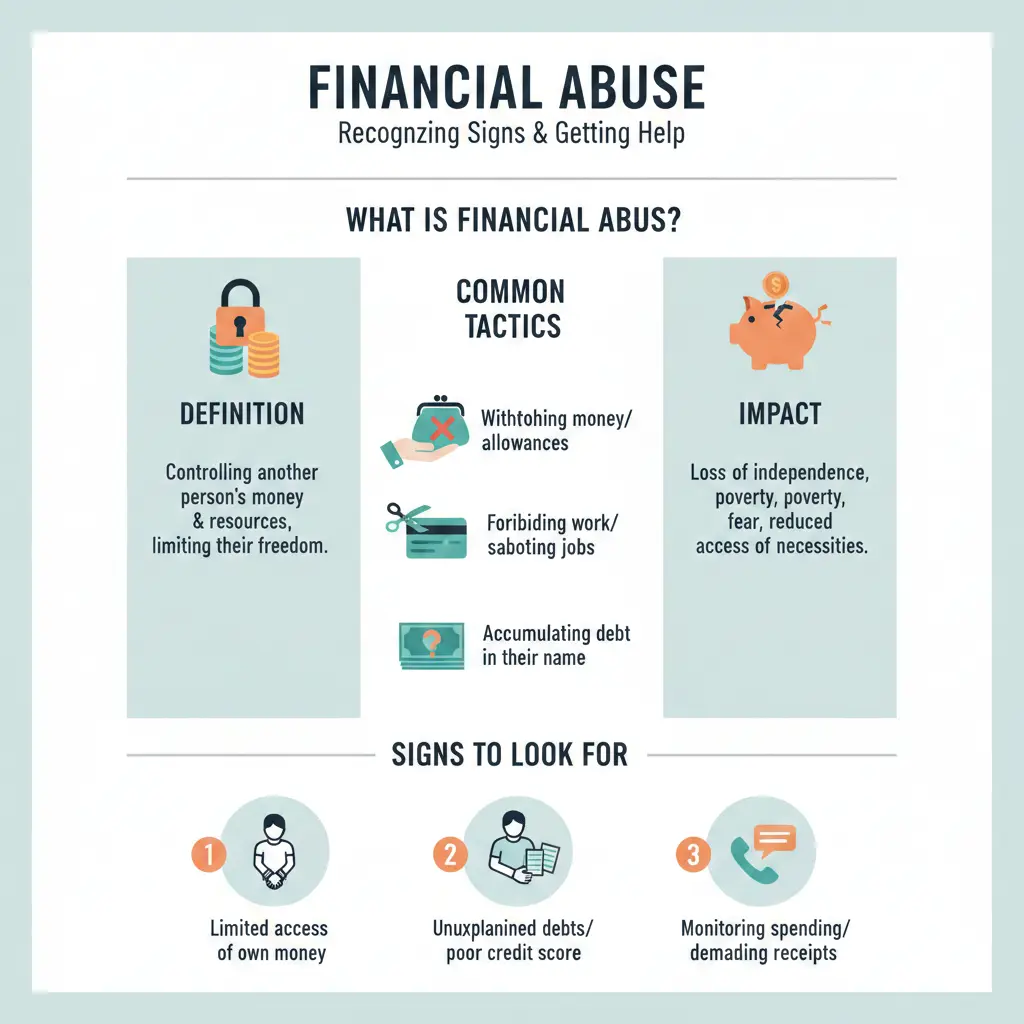
Financial abuse, also known as economic abuse, involves one person controlling or exploiting another's finances to exert power and control. It's recognised under New Zealand's Family Violence Act 2018 as a form of family violence, encompassing behaviours that limit a victim's financial independence. Unlike physical abuse, it often goes unnoticed until debts mount or credit is ruined, making escape even harder.
For Kiwis, this might mean a partner restricting access to joint bank accounts at ANZ or BNZ, or racking up payday loans in your name through high-interest lenders. It can happen in intimate relationships, among whānau, or even with adult children exploiting elderly parents—BNZ identified over 130 cases of elder financial abuse in 2024 alone, a 20% rise from the previous year.
Why It's a Growing Concern in Aotearoa
Recent data shows economic abuse doubling from 4.5% to 8.9% between 2003 and 2019, with the New Zealand Family Violence Survey indicating one-third of women have faced psychological abuse, often intertwined with financial control. In 2023/24, 60% of Women's Refuge clients—2,629 women—reported at least one form of economic harm. Family violence overall hit highest levels since 2018, per Salvation Army reports.
The long-term impacts are devastating: average debts from abuse reached $21,773 across 87 clients in one service, with many facing multiple creditors like banks (21%), finance companies (37%), and government agencies (16%). Victims often struggle with ruined credit, barriers to renting or buying a home, and even WINZ benefit complications.
Recognising the Signs of Financial Abuse
Spotting financial abuse early can be lifesaving. Abusers isolate victims financially, making them reliant and fearful. Here are key red flags tailored to New Zealand contexts:
- Restricted access to money: Your partner controls all household spending, excludes you from decisions on shared money (72% of Refuge clients), or stops you from having your own bank account.
- Forced debt: Pressured to take out loans, credit cards, or buy-now-pay-later schemes you're uncomfortable with (46% of cases), or debts appear in your name without consent.
- Sabotage of employment or education: Undermining your job at a local firm, preventing study via StudyLink, or monitoring your phone/internet to track earnings (3.2% prevalence).
- Exploitation of benefits or assets: Lying to IRD about income to dodge child support, misusing KiwiSaver withdrawals, or coercing you to sign over property.
- Hidden finances: Concealing bank statements, gambling away joint funds, or destroying financial documents.
- Elder-specific signs: Adult children pressuring power of attorney misuse or unexplained withdrawals from older Kiwis' accounts.
Real Kiwi Stories
Consider "Sarah" (name changed), whose ex-partner built $50,000 in debt via finance companies, then vanished, leaving her facing debt collectors and a damaged credit score. Or elderly victims at Age Concern, where family members siphoned thousands, spiking 20% in 2024. These aren't rare—abuse often escalates post-separation, manipulating IRD child support obligations.
The Impact of Financial Abuse on Victims
Beyond immediate debt, financial abuse erodes mental health, housing stability, and future prospects. Victims face credit blacklisting, blocking rentals or mortgages; WINZ overpayments from manipulated incomes; and ACC claims complicated by shared finances. Long-term, it traps people in low-wage jobs or benefits dependency.
Children suffer too—abusers may restrict healthcare or school costs, exacerbating intergenerational harm. Economically, New Zealand loses billions annually to family violence, with sexual violence alone costing $6.9 billion in 2020 (adjusted higher by 2026).
New Zealand Laws Protecting Against Financial Abuse
The Family Violence Act 2018 explicitly lists economic abuse, enabling Police safety orders that can address financial control. Under the Domestic Violence Act remnants and Property (Relationships) Act, courts can divide assets equitably post-separation, considering abuse.
IRD has powers to review child support manipulations, though victims bear the proof burden—advocates call for reforms like ATO-style specialist teams. Banks must report suspected elder abuse under anti-money laundering rules, and the Financial Markets Authority (FMA) oversees predatory lending.
In 2026, expect expanded creditor guidelines for debt waivers in proven abuse cases, mirroring Australian pushes.
How to Get Help in New Zealand
If you suspect financial abuse, act swiftly—help is accessible and confidential.
Immediate Support Services
- Shine or Women's Refuge: 24/7 helpline 0800 733 843 for safety planning and economic harm assessments—60% of clients in 2023/24 got tailored aid.
- Police: 111 for emergencies; non-urgent family violence reports via 105. Request a Police Safety Order.
- Good Shepherd Economic Harm Service: Free phone support for debt negotiation, creditor pauses, and write-offs—helped reduce $1.89 million in debts.
- Age Concern: Elder abuse hotline 0800 22 47 21, partnering with BNZ for interventions.
Financial Recovery Steps
- Contact your bank: Freeze joint accounts, request transaction histories—BNZ and others have abuse protocols.
- Seek free advice: Citizens Advice Bureau or Community Law Centres for IRD/WINZ disputes.
- Debt management: Insolvency and Trustee Service for no-asset procedures if overwhelmed; negotiate hardship plans with creditors.
- Legal aid: Via Community Law or Legal Aid Services for protection orders and asset division.
- Counselling: Free via Lifeline (0800 543 354) or Shakti for migrant women.
Practical tip: Document everything—bank statements, texts, debts—to build your case for IRD reviews or court.
Role of Professionals
Accountants spot signs like unexplained lodgements; GPs via ACC can refer; employers offer paid family violence leave (10 days minimum wage, 2026 rates).
Preventing Financial Abuse
Empower yourself: Maintain separate KiwiSaver and bank accounts; review credit reports yearly via Centrix or Equifax; discuss finances openly in relationships. Teach tamariki financial literacy to break cycles. Workplaces, adopt family violence policies per Employment NZ guidelines.
Next Steps: Take Control Today
Financial abuse thrives in silence—reach out now. Start with a confidential call to Shine (0800 733 843) or your bank. Rebuild via free credit counselling and legal aid. Remember, support networks across Aotearoa are here to help you reclaim your financial future. If in doubt, consult a financial adviser or lawyer—seek professional advice tailored to your situation. You're not alone.
Frequently Asked Questions
Sources & References
-
1
Financial abuse (and what accountants can do to help) | INTHEBLACK — intheblack.cpaaustralia.com.au
-
2
BNZ and Age Concern warn of rising elder financial abuse — www.bnz.co.nz
-
3
Data and research - Ministry for Women — www.women.govt.nz
-
4
Long-term impact of family violence economic abuse (PDF) — goodshepherd.org.nz
- 5
Related Articles

Industry Bodies and Professional Associations NZ
Whether you're launching a business, advancing your career, or navigating financial regulations, industry bodies and professional associations in New Zealand offer invaluable support. These organisati...

Emergency Benefit NZ: When You Have No Other Options
When you're struggling financially and don't qualify for other benefits, the Emergency Benefit might be your lifeline. It's a discretionary payment designed for Kiwis in genuine hardship who've exhaus...

Unpaid Internships NZ: Are They Legal?
Unpaid internships are a common pathway for students and graduates to gain work experience in New Zealand, but there's often confusion about whether they're actually legal. The short answer is: unpaid...

Estate Administration NZ: Managing Someone's Affairs After Death
Losing a loved one is one of life's toughest challenges, and stepping in to manage their estate can feel overwhelming. In New Zealand, estate administration—the process of handling someone's affairs a...