Gap Year Options for Kiwis: Productive Time Off

A gap year doesn't have to mean endless partying or drifting aimlessly—it's your chance to build skills, earn money, and set yourself up for a stronger future. For Kiwis eyeing **productive time off**...
Sarah covers personal finance, tax, and KiwiSaver topics for Lifetimes NZ. She focuses on making money management straightforward and practical for everyday Kiwis.
A gap year doesn't have to mean endless partying or drifting aimlessly—it's your chance to build skills, earn money, and set yourself up for a stronger future. For Kiwis eyeing **productive time off**, New Zealand's stunning landscapes, robust visa options, and diverse opportunities make it the perfect playground to turn a break into a launchpad.
Why Take a Productive Gap Year as a Kiwi?
Skipping straight from school or uni into the workforce can feel like jumping without a parachute. A well-planned gap year lets you recharge, gain real-world experience, and clarify your next move—all while padding your CV. In 2026, with youth unemployment hovering around 12% according to Stats NZ, standing out matters more than ever. Productive gap years focus on growth: think paid work, skill-building adventures, or volunteering that aligns with Kiwi values like sustainability and community.
Locally, many Kiwis use this time to travel overseas or dive deeper into Aotearoa's opportunities. You'll return with independence, global perspectives, and potentially savings in your KiwiSaver or a fatter bank account. Best of all, it's tax-smart—earnings from casual work count towards your IRD records, and you can claim back overpaid tax at year's end.
Financial Benefits: Making Your Gap Year Pay Off
A productive gap year can actually boost your finances. Working holiday gigs in hospitality or farms often pay $23–$30 per hour, above the 2026 minimum wage of $23.50. Save aggressively, and you could bank $10,000–$20,000 in 12 months, minus living costs. Use apps like Sharesies or Hatch for low-risk investing during downtime, growing your nest egg while adventuring.
- Budget tip: Aim for $15,000–$25,000 total costs for a year abroad or locally, including visas ($500–$1,000) and flights ($1,500 return to Australia).
- KiwiSaver pause: You can contribute voluntarily from gap year earnings to keep momentum.
- Tax hack: Track expenses like travel for potential deductions if self-employed.
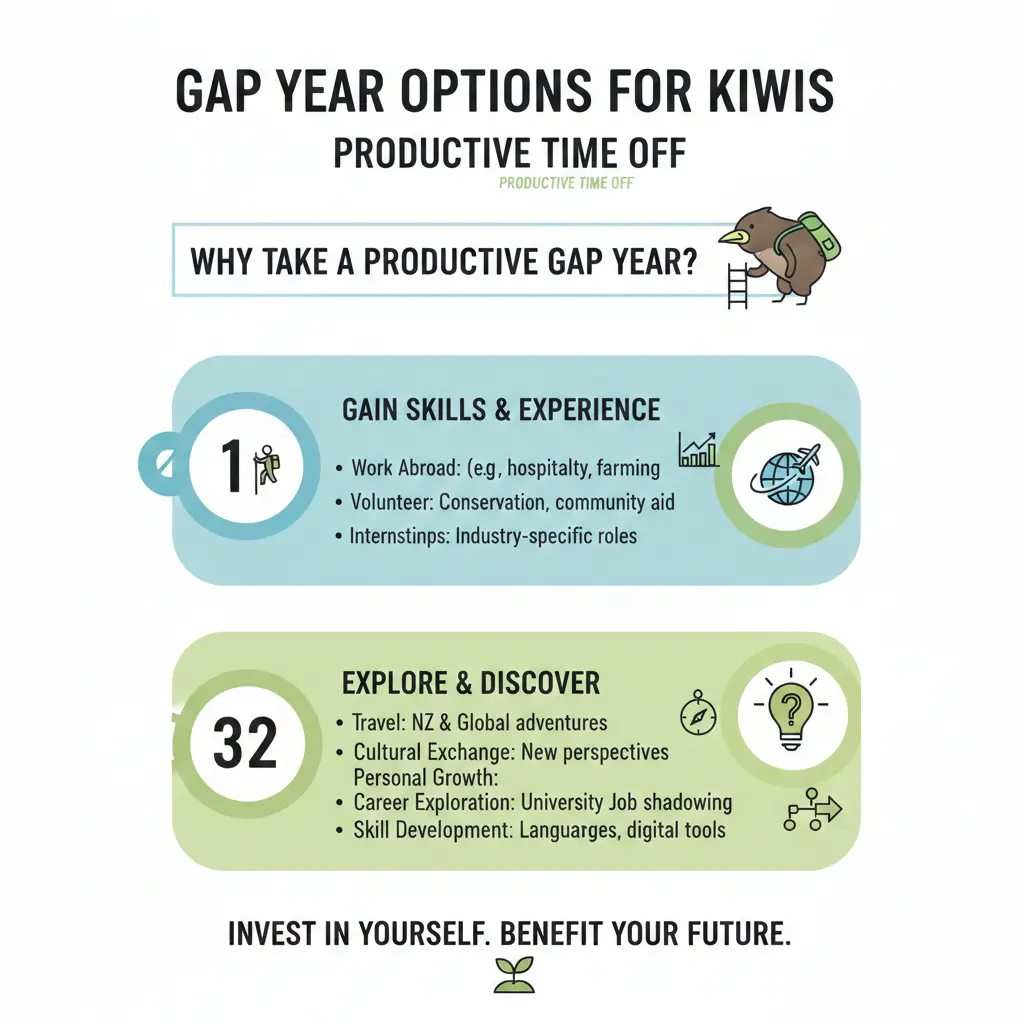
Top Gap Year Options Tailored for Kiwis
New Zealand's Working Holiday Scheme (WHS) opens doors worldwide, but staying home or heading nearby offers low-risk productivity. Here's how to make it count.
Option 1: Working Holidays Overseas
Grab a WHS visa for countries like Australia, the UK, or Canada—perfect for Kiwis aged 18–30 (up to 35 for some spots in 2026). In Australia, programs like Green River College's 10-month gap year blend study, travel, and career discovery across the ditch and back home. Earn while exploring: Queenstown-style adventures in Oz pay well in tourism.
Auckland to Oz tip: Providers like Global Work & Travel set you up with jobs, bank accounts, and housing upon arrival—ideal for seamless transitions.
Option 2: Paid Work & Travel in New Zealand
Stay put and thrive. Letz Live places 18–25-year-olds in paid school roles (classroom aides, sports coaches) with accommodation included—think $500–$700 weekly pay while living like a local. Or join Ultimate Travel's arrival packages for job assistance, IRD setup, and adventures like Rangitoto hikes.
In 2026, hospitality booms in Queenstown and Auckland, with roles via Seek or Trade Me paying top dollar. Farms offer $27/hour plus free board via WWOOFing (willing workers on organic farms).
Option 3: Adventure & Skill-Building Programs
Combine thrills with growth. Rooted Life Adventures' South Island program (6–10 weeks, $16,500–$25,000) includes hiking, farming internships, Maori culture, and 24/7 coaching—ending with a certificate and job search support for extended stays. Pacific Discovery's NZ-Australia semester mixes service learning and cultural immersion.
Queenstown's Adventure Guide Program (12 weeks) teaches rock climbing, rafting, and backcountry skills—prime for outdoor careers.
Option 4: Volunteering & Internships
Build your resume ethically. Volunteer on permaculture farms, as tutors, or au pairs via GoAbroad—often with stipends. JENZA in Auckland offers internships, volunteering, and life skills with therapeutic support. Post-program, transition to WHS for paid work.
| Option | Cost (NZD) | Duration | Key Perk |
|---|---|---|---|
| Working Holiday (Overseas) | $5,000–$15,000 | 6–12 months | High earnings potential |
| Paid NZ School Job | Low (accomm included) | 6–12 months | Professional experience |
| Adventure Program | $16,500–$25,000 | 6–10 weeks | Certificates & coaching |
| Volunteering | $2,000–$5,000 | Flexible | Networking & skills |
Visas, Money, and Legal Essentials for 2026
Navigating Visas as a Kiwi
For overseas jaunts, apply via immigration.govt.nz—most WHS are online, needing proof of funds ($4,200+), health insurance, and a return ticket. In NZ, international gappers need visitor, student, or WHS visas (18–30, up to 12 months work). Providers handle paperwork.
Managing Finances on Your Gap Year
Track every dollar with PocketSmith (NZ-made app). Open an offshore bank account pre-departure—ASB or BNZ for easy transfers. Budget: $50–$100/day living costs in NZ. WINZ won't fund gap years, but check StudyLink if pivoting to study later.
Pro tip: Use ACC coverage abroad via your policy, and get travel insurance covering adventure sports ($200–$500/year).
Taxes and IRD for Gap Year Earnings
Report all income to IRD.govt.nz—gap year jobs trigger PAYE, but claim refunds via myIR if under thresholds (2026: $24,000 tax-free bracket). Overseas earnings may qualify for foreign income exemptions; file by 7 July 2027.
Practical Tips for a Successful Productive Gap Year
- Plan early: Apply for visas 3–6 months ahead; book programs by November for 2026 starts.
- Build skills: Learn basic Maori phrases or first aid (St John courses, $200).
- Stay safe: Download the What3Words app for remote areas; heed MetService forecasts.
- Network: Join Kiwi gap year Facebook groups for flatmates and gigs.
- Sustainability: Choose eco-programs—NZ leads in conservation volunteering.
Next Steps: Launch Your Productive Gap Year Today
Dust off your passport, crunch the numbers, and pick one option that fires you up. Chat with a careers advisor at your local iwi centre or via Careers.govt.nz, then apply. Track progress in a journal—by year's end, you'll have stories, skills, and savings that no lecture hall can match. Remember, this is your time—make it count.
Disclaimer: This isn't personalised financial advice. Consult IRD, a tax advisor, or financial planner for your situation.
Frequently Asked Questions
Sources & References
-
1
Gap Year - Australia / New Zealand - Green River College — www.greenriver.edu
-
2
Gap Year Programs in New Zealand - GoAbroad.com — www.goabroad.com
-
3
Gap Year Jobs in New Zealand | Paid Work & Travel Adventures — letzlive.org
-
4
Supported New Zealand Gap Year Program for Young Adults — rootedlifeadventures.com
-
5
Gap Year Programs in New Zealand | Go Overseas — www.gooverseas.com
-
6
Full Guide to Gap Years in New Zealand for 2026! — www.thebrokebackpacker.com
-
7
Work & Travel in New Zealand — greenhearttravel.org
-
8
New Zealand Gap Years, Trips & Tours 2026/27 — www.gap360.com
-
9
New Zealand Gap Year | Work in New Zealand - Ultimate Travel — www.ultimate.travel
-
10
New Zealand & Australia Gap Semester | Pacific Discovery — www.pacificdiscovery.org
-
11
Stats NZ Labour Market Statistics 2026 — www.stats.govt.nz
-
12
IRD: Gap Year and Casual Work Income — www.ird.govt.nz
-
13
Minimum Wage Rates 2026 — www.employment.govt.nz
-
14
Sharesies Investment Platform — sharesies.co.nz
-
15
Personal Budgeting Guide 2026 — www.budget.govt.nz
-
16
KiwiSaver Official Site — www.kiwisaver.govt.nz
-
17
Working Holiday Scheme Visas — www.immigration.govt.nz
-
18
StudyLink Support — www.studylink.govt.nz
-
19
ACC Coverage Overseas — www.acc.co.nz
Related Articles

Industry Bodies and Professional Associations NZ
Whether you're launching a business, advancing your career, or navigating financial regulations, industry bodies and professional associations in New Zealand offer invaluable support. These organisati...

Emergency Benefit NZ: When You Have No Other Options
When you're struggling financially and don't qualify for other benefits, the Emergency Benefit might be your lifeline. It's a discretionary payment designed for Kiwis in genuine hardship who've exhaus...

Unpaid Internships NZ: Are They Legal?
Unpaid internships are a common pathway for students and graduates to gain work experience in New Zealand, but there's often confusion about whether they're actually legal. The short answer is: unpaid...

Estate Administration NZ: Managing Someone's Affairs After Death
Losing a loved one is one of life's toughest challenges, and stepping in to manage their estate can feel overwhelming. In New Zealand, estate administration—the process of handling someone's affairs a...