Provisional Tax NZ: How It Works for Business

If you're running a business in New Zealand, understanding provisional tax NZ is crucial for keeping your cash flow steady and staying on the right side of Inland Revenue (IRD). It's the system that s...
Sarah covers personal finance, tax, and KiwiSaver topics for Lifetimes NZ. She focuses on making money management straightforward and practical for everyday Kiwis.
If you're running a business in New Zealand, understanding provisional tax NZ is crucial for keeping your cash flow steady and staying on the right side of Inland Revenue (IRD). It's the system that spreads your income tax payments across the year, preventing a nasty surprise at tax time—especially if your residual income tax hits over $5,000.
Whether you're a sole trader in Auckland juggling seasonal sales or a growing SME in Christchurch, provisional tax helps you pay as you earn, aligning with Kiwi business rhythms. In this guide, we'll break down exactly how provisional tax NZ works for business, from calculations and due dates to smart strategies for 2026. You'll walk away with practical steps to avoid penalties, manage interest, and even optimise your payments.
What is Provisional Tax and Who Needs to Pay It?
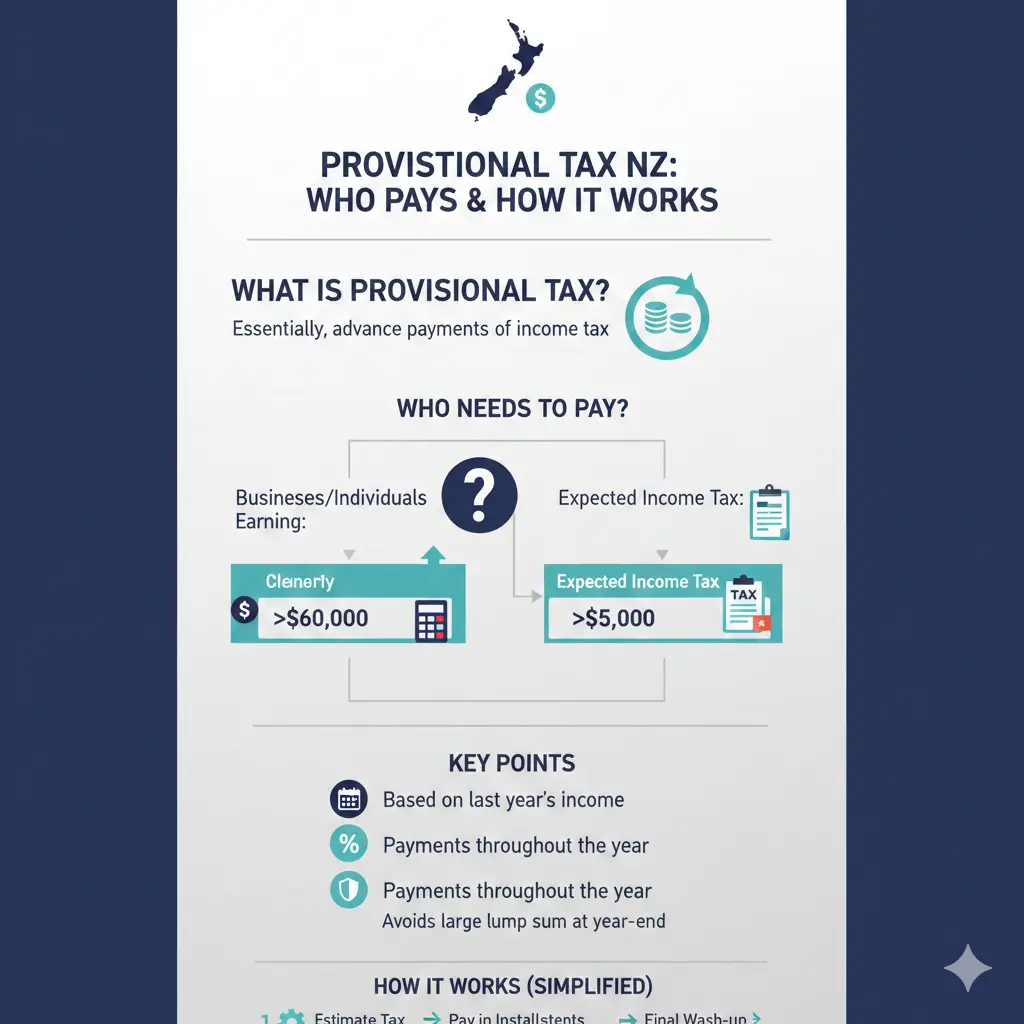
Provisional tax is essentially pre-paid income tax, paid in instalments throughout the financial year rather than as a single lump sum at the end. It's designed to smooth out tax obligations for businesses and high-income individuals, ensuring IRD gets steady revenue while helping you manage cash flow.
You'll need to pay provisional tax if your residual income tax—that's your total income tax minus credits like PAYE and RWT—exceeds $5,000 in a year. For most Kiwi businesses, this kicks in from your second year of trading, when IRD notifies you via myIR or letter. New businesses with over $60,000 residual tax in their first year must also pay in one to three equal instalments.
Key Thresholds for 2026
- $5,000+ residual tax: Provisional tax required, typically in three instalments.
- $60,000+ for new businesses: Mandatory provisional payments from year one.
- Under $5,000: Pay as terminal tax in a lump sum after year-end.
Pro tip: Check your status in myIR anytime. If IRD hasn't flagged you but you expect to hit the threshold, get ahead by electing provisional tax early to avoid use-of-money interest.
How Provisional Tax is Calculated: Your Options Explained
IRD offers three main methods to calculate provisional tax, letting you pick what fits your business model. The right choice can save you from overpaying or facing shortages.
1. Standard Option (Default for Most Businesses)
This is the go-to for established firms. IRD takes your previous year's residual income tax, adds a 5% uplift for growth, then divides by three for equal instalments. For a 31 March balance date business with $20,000 prior residual tax, that's $21,000 total provisional ($7,000 x 3).
At year-end, if actual tax is higher, you pay the difference as terminal tax. Overpay? Get a refund with interest.
2. Estimation Option (For Accurate Forecasters)
Estimate your residual tax via myIR or by calling IRD, then split into three payments. Ideal if you expect big changes—like a tourism operator post-summer boom. But underestimate? Penalties and interest apply, so chat with your accountant first.
3. GST Ratio Option (Perfect for Fluctuating Income)
Best for seasonal or variable businesses, this bases payments on your GST-taxable supplies (revenue including GST). Pay a percentage every two months, matching cash in with tax out. Great for retailers with holiday spikes or farmers with harvest cycles—no more paying from empty pockets in quiet months.
4. Accounting Income Method (AIM)
AIM uses your accounting profits, filed every two months alongside GST returns. Suits smaller operators not on GST or filing bi-monthly. It's straightforward but requires regular statements of activity.
| Method | Best For | Calculation Basis | Instalments |
|---|---|---|---|
| Standard | Stable growth businesses | Prior year +5% uplift | 3 equal payments |
| Estimation | Those with forecasts | Your estimate | 3 equal payments |
| GST Ratio | Seasonal/fluctuating | % of GST supplies | Every 2 months |
| AIM | Small, regular filers | Accounting income | Every 2 months |
Switch methods anytime via myIR, but notify IRD to avoid shortfalls.
Provisional Tax Payment Dates for 2026 (31 March Balance Date)
Most Kiwi businesses use a 31 March year-end, so here's your 2026 calendar. Dates shift for other balance dates: generally, 28th of the 7th month before, 3rd month before, and month after balance date.
Three-Instalment Schedule (Standard/Estimation)
- 28 August 2025: First payment for 2026 FY.
- 15 January 2026: Second payment—watch the summer cash crunch!
- 7 May 2026: Third and final instalment.
Bi-Monthly for GST Ratio or AIM
Aligns with GST periods: every two months, based on recent supplies.
Miss a date? Late payment penalties start at 5% plus use-of-money interest (around 9% via tax pooling alternatives). Mark these in your calendar now.
Cash Flow Tips: Managing Provisional Tax Without the Stress
January's 15th hits hard for many—think retail post-Christmas or hospitality in winter lull. Here's how to stay liquid:
Use Tax Pooling Services
Providers like Tax Management NZ (TMNZ) let you defer payments up to 17 months, paying low interest (under 9%) instead of IRD penalties. Spread over six months if under $60,000 liability—free up capital for growth.
"TMNZ’s flexible tax payment solution... lets you defer or spread payments, avoid penalties, save on interest and keep your business moving."
Staged Payments Strategy
- Pay August if cash allows, reassess January with fresh data.
- Opt for GST Ratio if sales fluctuate.
- Estimate conservatively but accurately—overestimate for refunds.
First-Year Businesses: Special Rules
Year one tax is due 7 February (or 7 April with an agent), no provisional unless over $60,000 residual. Use this grace to build buffers.
Always factor KiwiSaver, ACC levies, and GST—provisional covers income tax only. Track via Xero or MYOB integrations with myIR.
Common Pitfalls and How to Avoid Penalties
Underestimating triggers shortfalls: 5% penalty on amounts over $500, plus interest. Overpaying ties up cash unnecessarily.
- Audit your prior return: Confirm residual tax accurately.
- Monitor monthly: Adjust estimates if trading changes (e.g., export boom).
- Get help: Accountants can file elections and optimise methods.
Shortfall penalties kick in if payments are less than 85% of actual liability. Pro tip: Use IRD's provisional tax calculator in myIR for scenarios.
Next Steps: Take Control of Your Provisional Tax Today
Don't let provisional tax catch you out—log into myIR now to check your status, run calculations, and elect the best method. Review your August 2025 payment against actuals, consider GST Ratio for 2026 fluctuations, and explore tax pooling for January relief. Chat with your accountant or a tax expert for personalised advice; this isn't financial advice—seek professional guidance tailored to your business.
Mastering provisional tax NZ: how it works for business means more cash for reinvestment, less stress at tax time. Stay compliant, stay strategic, and watch your Kiwi business thrive.
Frequently Asked Questions
Sources & References
-
1
New Zealand - Corporate - Tax administration — taxsummaries.pwc.com
-
2
Your Guide to Business Provisional Tax NZ: Dates, Deadlines, and Everything You Need to Know — www.bringonmonday.com
-
3
Provisional tax for individuals 2025 (PDF) — assets.kpmg.com
-
4
Flexible January 2026 Provisional Tax Payments — www.tmnz.co.nz
-
5
Provisional Tax 2026FY: Don't Pay Blindly — businesslike.co.nz
-
6
Provisional Tax Due 28 August – Are You Prepared? — nz.andersen.com
-
7
Income tax and provisional tax — www.business.govt.nz
-
8
Paying tax in your first year in business — www.ird.govt.nz
-
9
Provisional tax — www.ird.govt.nz
Related Articles

Industry Bodies and Professional Associations NZ
Whether you're launching a business, advancing your career, or navigating financial regulations, industry bodies and professional associations in New Zealand offer invaluable support. These organisati...

Emergency Benefit NZ: When You Have No Other Options
When you're struggling financially and don't qualify for other benefits, the Emergency Benefit might be your lifeline. It's a discretionary payment designed for Kiwis in genuine hardship who've exhaus...

Unpaid Internships NZ: Are They Legal?
Unpaid internships are a common pathway for students and graduates to gain work experience in New Zealand, but there's often confusion about whether they're actually legal. The short answer is: unpaid...

Estate Administration NZ: Managing Someone's Affairs After Death
Losing a loved one is one of life's toughest challenges, and stepping in to manage their estate can feel overwhelming. In New Zealand, estate administration—the process of handling someone's affairs a...