Business Structures Explained: Sole Trader vs Company vs Partnership

Starting a business in New Zealand is an exciting step, but picking the right structure can make or break your success. Whether you're a solo entrepreneur testing a café idea in Auckland or teaming up...
The Lifetimes NZ editorial team curates, fact-checks, and updates guides on personal finance, property, health, immigration, legal, business, and lifestyle topics relevant to Lifetimes NZ readers. Articles are produced with AI assistance and reviewed by the editorial team before publication.
Starting a business in New Zealand is an exciting step, but picking the right structure can make or break your success. Whether you're a solo entrepreneur testing a café idea in Auckland or teaming up with mates for a tech startup in Wellington, understanding **sole trader vs company vs partnership** helps you manage risks, taxes, and growth smartly.
We'll break down these common business structures under New Zealand law, comparing liability, tax rules, setup costs, and more. With insights from official sources like business.govt.nz, you'll get practical advice tailored for Kiwis in 2026.
What Are the Main Business Structures in New Zealand?
New Zealand keeps things straightforward for startups—no minimum capital for most structures, and online setup often takes less than a day. The big three for most Kiwis are **sole trader**, **partnership**, and **company**. Others like limited partnerships or look-through companies (LTCs) suit specific needs, but we'll focus on the essentials.
Your choice affects everything from IRD tax filings to personal asset protection. Let's dive in.
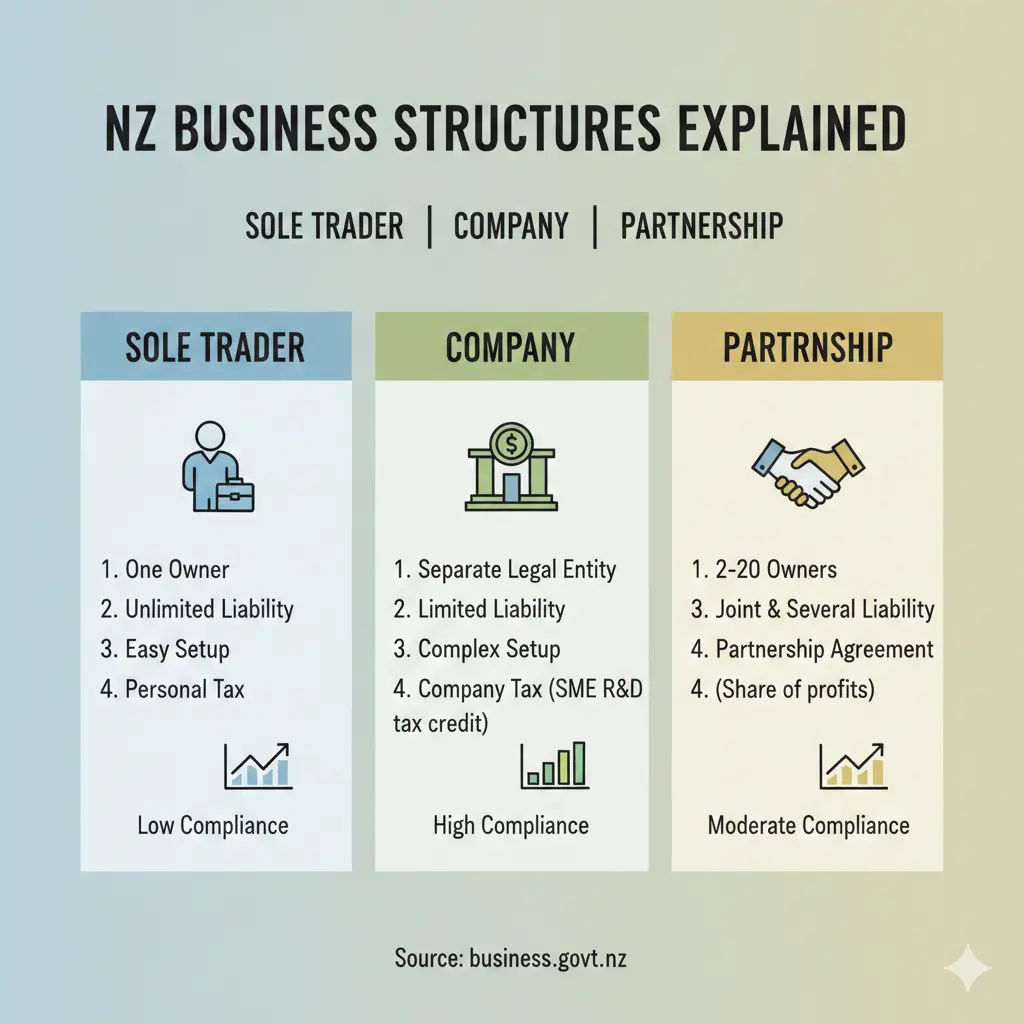
Sole Trader: The Simplest Option for Solo Kiwis
A **sole trader** is you running the business as an individual—no separate legal entity. It's the most popular structure in New Zealand, ideal for freelancers, tradies, or market stall owners.
Key Features and Setup
- Setup: No formal registration needed beyond a GST number if turnover hits $60,000. Just get an IRD number and start trading.
- Costs: Minimal—under $100 for basics like a business name via the Companies Office if you want one.
- Management: Full control, no partners or directors.
Liability
Here's the catch: unlimited personal liability. Your home, car, or savings are at risk if the business owes money. ACC covers work injuries, but debts are on you personally.
Tax Implications
Income is taxed as personal income via your IRD return—rates from 10.5% to 39% in 2026. No separate company tax; claim expenses directly. Provisional tax applies if income exceeds $5,000.
Pros and Cons
| Pros | Cons |
|---|---|
| Easy and cheap to start | Unlimited liability |
| Full control and profits | Harder to raise capital |
| Simple accounting | Business dies with you |
Best for: Low-risk solo ventures like consulting or a home-based bakery.
Partnership: Teaming Up Without the Hassle
A **partnership** lets two or more people share the load, governed by the Partnership Act 1908. Think mates opening a plumbing business in Christchurch—no separate legal entity from the partners.
Key Features and Setup
- Setup: Draft a partnership agreement (recommended) and register for GST/IRD if needed. No Companies Office filing.
- Costs: Low—$200–$500 for legal advice on the agreement.
- Management: Partners decide jointly, sharing profits/losses per agreement.
Liability
Joint and several liability means one partner's mistake can sink everyone's personal assets. A solid agreement limits some risks.
Tax Implications
No partnership tax—each partner reports their share on personal returns. Same progressive rates as sole traders. Partnerships file an IR3 return for info only.
Pros and Cons
| Pros | Cons |
|---|---|
| Shared resources and skills | Unlimited liability for all |
| Easy to form and flexible | Disputes can end it |
| Pass-through taxation | Hard to exit or sell |
Best for: Small teams with trust, like a graphic design duo.
Company: Limited Liability for Growing Businesses
A **company** is a separate legal entity under the Companies Act 1993, perfect for scaling up. Shareholders own it; directors run it. Common for e-commerce or tech firms.
Key Features and Setup
- Setup: Register online via Companies Office—done in hours. Need at least one director (NZ resident) and shareholder.
- Costs: $150 incorporation fee, plus $100–$300 annual return. No minimum capital.
- Management: Directors handle ops; annual shareholder meetings required.
Liability
Limited to your shares—personal assets safe unless you guarantee debts. Directors have duties under the Act.
Tax Implications
Company tax at 28% on profits. Dividends to shareholders taxed at their rates (with credits). Imputation system avoids double tax. File IR4 return.
Pros and Cons
| Pros | Cons |
|---|---|
| Liability protection | Higher setup/compliance costs |
| Easier to attract investors | More paperwork (annual returns) |
| Perpetual existence | 28% flat tax rate |
Best for: Higher-risk or growth-focused businesses like software devs seeking VC.
Sole Trader vs Company vs Partnership: Side-by-Side Comparison
Here's a quick table for Kiwi business owners comparing the structures on key factors in 2026.
| Factor | Sole Trader | Partnership | Company |
|---|---|---|---|
| Liability | Unlimited personal | Joint/several unlimited | Limited to investment |
| Tax Rate | Personal (10.5–39%) | Personal shares | 28% company + dividends |
| Setup Cost | <$100 | $200–$500 | $150 + ongoing |
| Compliance | Low | Low | Medium (returns, records) |
| Raising Capital | Hard | Moderate | Easy (shares) |
| Suitability | Solo, low-risk | Small teams | Growth, high-risk |
Tax Implications Deep Dive for New Zealand Businesses
Taxes vary hugely. Sole traders and partnerships enjoy pass-through—no entity-level tax—but face top personal rates (39% over $180,000). Companies pay 28%, but dividends add personal tax (often lower effective rate via imputation).
Watch provisional tax, GST ($60k threshold), and KiwiSaver obligations. Use IRD's myIR portal for filings. For 2026, no major changes announced, but check ird.govt.nz for updates.
Costs and Compliance: What to Budget For
Sole traders spend least on admin. Partnerships add agreement costs. Companies need annual returns ($50 online), basic records, and audits only if large.
Practical tip: Use free tools from business.govt.nz for checklists. Factor ACC levies (1–2% of payroll) and lawyer fees for advice (~$500–$2,000 initially).
Which Structure Suits Your Business Type?
- Freelance/consulting: Sole trader—keep it simple.
- Family tradies: Partnership—share the workload.
- Tech/e-com scaling: Company—protect and grow.
- High-risk like construction: Company or LTC for liability shield.
Assess risk appetite, team size, and growth plans. A café might start sole trader, then incorporate.
Other Structures to Consider
Beyond the basics: Limited partnerships suit investors (limited liability for some). LTCs blend company protection with partnership tax. Trusts add asset protection but more complex. Check business.govt.nz for all options.
Practical Tips for Kiwis Starting Out
- Chat with an accountant or lawyer early—many offer free initial consults via NZQBA or similar.
- Use Companies Office online tools for companies.
- Register for GST proactively if scaling.
- Draft agreements for partnerships to avoid disputes.
- Plan for KiwiSaver and ACC from day one.
Next Steps: Get Your Business Structured Right
Grab a coffee, review your business plan, and use business.govt.nz's structure chooser tool. Consult IRD for tax, a lawyer for liability, and an accountant for the full picture. The right structure sets you up for success—whether trading solo in Dunedin or building an empire in Auckland. Start small, protect smart, and grow Kiwi-strong.
Frequently Asked Questions
Sources & References
-
1
Most Common Business Structures in NZ - LegalVision New Zealand — legalvision.co.nz
-
2
New Zealand vs Switzerland: Best Business Structure for Startups — enterslice.com
-
3
Choosing the Right Business Structure in NZ — www.aba.org.nz
-
4
Choosing the right business structure - Business.govt.nz — www.business.govt.nz
-
5
Investing In... 2026 - New Zealand - Chambers Global Practice Guides — practiceguides.chambers.com
-
6
Choosing the Right Business Structure - NZQBA — www.nzqba.co.nz
-
7
Types of Business Structures: How To Choose in 2026 - Shopify — www.shopify.com
Related Articles

Why Every Kiwi Should Have a "Side Hustle" in 2026
Imagine topping up your KiwiSaver, covering those rising power bills, or even saving for a deposit on your first home—all while keeping your day job. In 2026, with New Zealand's cost of living still b...

AI Tools for Small Business: How Kiwis are Automating Their Work
Imagine wrapping up your day in Auckland or Christchurch, knowing your small business emails are drafted, social posts scheduled, and customer queries handled—all without lifting a finger. That's the...

Working for Yourself: How to Register as a Sole Trader in NZ
Ever dreamed of ditching the 9-to-5 and calling the shots on your own terms? For many Kiwis, becoming a sole trader is the perfect way to turn that dream into reality—it's simple, low-cost, and lets y...

Side Hustles That Actually Work in NZ: From E-commerce to Local Services
Ever feel like your paycheck just isn't stretching far enough in today's New Zealand? With living costs climbing and Kiwis hunting for smarter ways to boost income, side hustles are more popular than...