FIF Tax Rules Explained: Investing in Overseas Shares

If you're a Kiwi investor with money in overseas shares, you've probably heard the term "FIF tax" and wondered what it actually means for your portfolio. The Foreign Investment Fund (FIF) tax rules ca...
Sarah covers personal finance, tax, and KiwiSaver topics for Lifetimes NZ. She focuses on making money management straightforward and practical for everyday Kiwis.
If you're a Kiwi investor with money in overseas shares, you've probably heard the term "FIF tax" and wondered what it actually means for your portfolio. The Foreign Investment Fund (FIF) tax rules can feel complicated, but understanding them is essential if you want to make smart investment decisions and avoid unexpected tax bills. Whether you're investing in US tech stocks, UK dividend-paying shares, or international ETFs, the FIF regime will likely affect how much tax you owe each year—and it might be more than you expect.
What Is FIF Tax and Why Does It Matter?
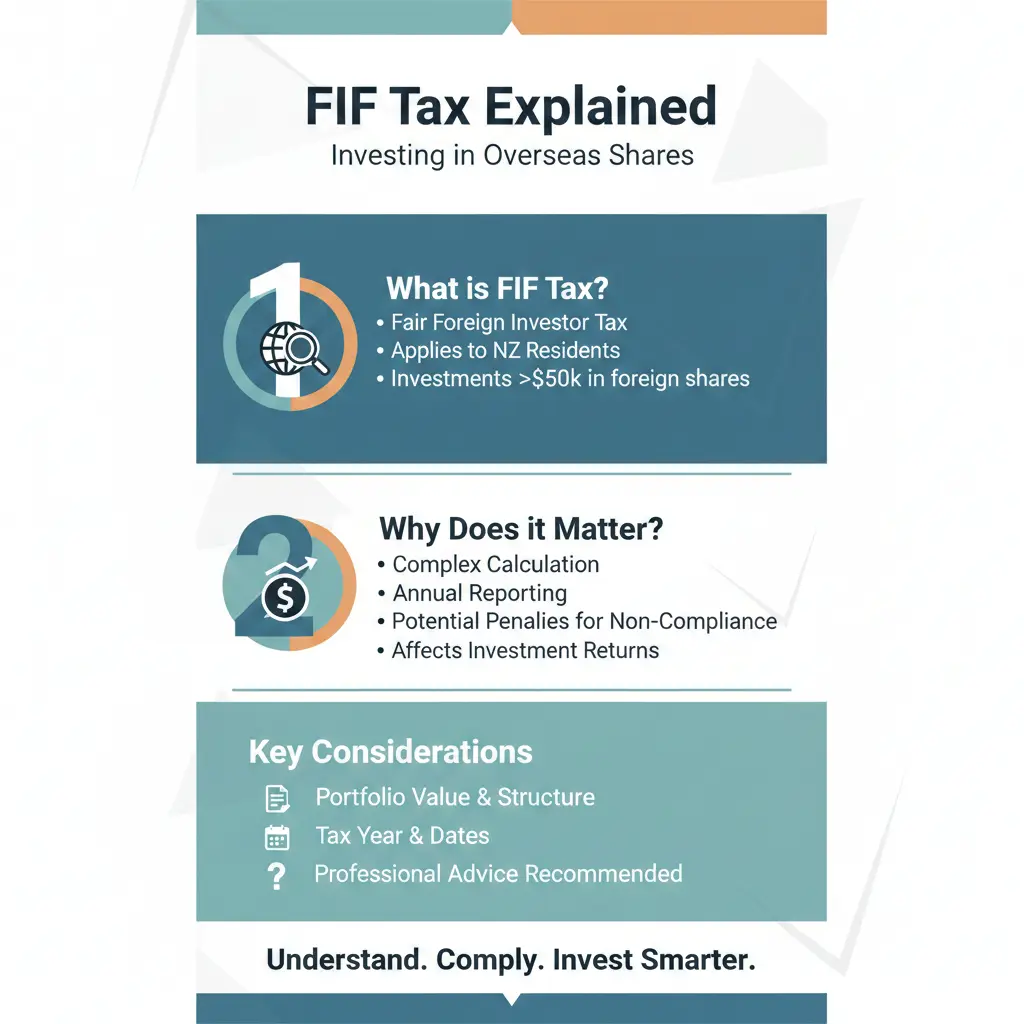
The Foreign Investment Fund (FIF) tax regime is New Zealand's way of taxing residents on their overseas investments. FIF tax applies to New Zealand residents who hold less than 10% interests in foreign companies, and it treats overseas investments very differently from how we tax domestic ones.
Here's the key difference: when you invest in New Zealand shares, you only pay tax on the dividends you receive—not on any capital gains when you sell. But with overseas shares worth over NZ$50,000, the IRD doesn't wait for you to make a profit or receive dividends. Instead, they deem you to have earned income from your foreign investments each year, whether or not you actually received any money.
This is why FIF tax often comes as an unwelcome surprise for migrants and Kiwis with international portfolios. You can owe tax on investments that haven't paid out anything and may even have lost value.
How Does FIF Tax Actually Work?
The Fair Dividend Rate (FDR) Method
The most common way to calculate FIF tax is the Fair Dividend Rate (FDR) method. Under this approach, the IRD assumes your foreign investments earn a flat 5% return each year, regardless of what actually happened.
Here's how it works in practice:
- Take the market value of your foreign shares on 1 April (the start of the New Zealand tax year)
- Multiply that value by 5%
- That figure becomes your taxable FIF income for the year
- Add it to your other income and pay tax at your marginal tax rate (up to 39%)
Example: Let's say you own US shares worth NZ$100,000 on 1 April 2026. Under the FDR method, you'd have $5,000 of deemed taxable income. If you're in the top tax bracket (39%), you'd owe $1,950 in tax on those shares—even if they paid no dividends and didn't increase in value.
Other FIF Calculation Methods
The FDR method isn't your only option. The IRD provides other methods, and you can choose whichever produces the lowest tax bill for your situation. These include:
- Comparative Value (CV) method: Calculates tax based on actual gains or losses compared to the opening value
- Actual Return method: Based on real dividends and capital gains (only available in certain situations)
- Revenue Account Method (RAM): A new option for qualifying migrants, explained below
Because these methods can be complex, the IRD suggests getting expert advice if you own significant overseas investments.
Who Actually Pays FIF Tax?
Not everyone pays FIF tax, and knowing whether you're affected could save you money.
The NZ$50,000 Threshold
If your total foreign investment portfolio is worth NZ$50,000 or less on 1 April, you're not affected by FIF tax. This is an important threshold for many Kiwi investors.
However, if your foreign investments exceed this amount, the FIF rules apply to the entire portfolio, not just the amount over $50,000.
Exceptions: Investments That Aren't Subject to FIF Tax
Not all overseas investments trigger FIF tax. You don't pay FIF tax on:
- New Zealand shares
- Most Australian shares listed on the ASX (though there are some exceptions, like stapled securities)
- Overseas shares held through a managed fund or KiwiSaver provider (the fund manager handles the FIF tax)
- Overseas shares held through a PIE fund registered with the IRD
This is why many financial advisers recommend Kiwis invest in overseas shares through managed funds or KiwiSaver rather than holding them directly—it simplifies the tax situation and often results in better tax efficiency.
FIF Tax and Different Investment Types
Direct Foreign Shares
If you buy US, UK, or other overseas shares directly, you'll need to calculate and pay FIF tax yourself on any holdings over NZ$50,000. The calculation can be complicated, especially if you're choosing between different methods.
International ETFs
Dividends from international ETFs are taxable, typically at 28% (the standard RWT rate). If you hold them directly and they're worth over NZ$50,000, FIF tax also applies.
Managed Funds and KiwiSaver
If you invest in overseas shares through a managed fund or KiwiSaver provider, the fund manager calculates and pays any FIF taxes for you. Your tax liability is simplified—you'll pay tax at the PIE rate (10.50%, 17.50%, or 28% depending on your income) on any income the fund generates, but not on capital gains.
This is often more tax-efficient than holding overseas shares directly, especially if you're in a higher tax bracket.
New FIF Rules for Migrants (2026)
If you've recently moved to New Zealand or are considering it, there's some good news. The government has introduced new FIF tax rules designed to make New Zealand more attractive to migrants.
The Revenue Account Method (RAM)
From 1 April 2025, qualifying new migrants can use the Revenue Account Method for certain foreign investments. Under this method, you're taxed on dividends received plus 70% of any realised capital gains—a much more favourable treatment than the traditional FDR method.
The RAM is available to people who became fully tax resident in New Zealand on or after 1 April 2024, but it only applies to illiquid FIF interests acquired before they moved to New Zealand.
Transitional Residency Benefits
If you arrive on a transitional residency visa (usually lasting 4 years), you'll be exempt from FIF tax on foreign investment income and dividends during your transitional period. Once that period ends, you'll be taxed on dividends received and on realised gains (with a 30% discount applied before your marginal tax rate).
This is a significant advantage for migrants with overseas portfolios, effectively giving you a 4-year tax-free period on foreign investments before more standard rules apply.
Practical Tips for Managing FIF Tax
Keep Your Portfolio Under NZ$50,000
If you're below the threshold, you avoid FIF tax entirely. This might mean keeping overseas investments modest or spreading them across different investment types.
Use Managed Funds for Overseas Exposure
Rather than buying overseas shares directly, consider investing through a managed fund or KiwiSaver provider. The tax treatment is simpler, and the fund manager handles all the FIF calculations for you.
Choose a PIE Fund
If you invest in international index funds, look for ones registered with the IRD as a PIE (Portfolio Investment Entity). PIE funds have a maximum tax rate of 28%, whereas your personal marginal tax rate could be up to 39%. This can be significantly more tax-efficient if you're a high earner.
Get Professional Advice
FIF tax calculations can be complicated, especially if you're choosing between different methods or have a large overseas portfolio. It's worth consulting a tax adviser or accountant who understands the FIF regime—the cost could easily be offset by tax savings.
Track Your Investment Values
To calculate FIF tax correctly, you'll need the market value of your overseas investments on 1 April each year. Keep detailed records and consider using a portfolio tracking tool to make this easier.
Common Questions About FIF Tax
Do I have to pay FIF tax if my overseas shares haven't made any money?
Yes. Under the FDR method, you pay tax on deemed 5% income regardless of actual performance. This is one of the most frustrating aspects of FIF tax for many Kiwis. However, if you use the Comparative Value method and your shares have actually lost value, you might have a lower or even negative FIF income for the year.
What if I sell my overseas shares at a loss?
If you sell at a loss and use the Comparative Value method, you may be able to offset that loss against other FIF income. However, the rules are complex, and you should get professional advice.
Are overseas shares held through KiwiSaver subject to FIF tax?
No. The fund provider handles all FIF tax calculations, and you don't need to worry about it. You simply pay tax at the PIE rate on any income generated.
If I move overseas, do I still pay FIF tax?
Once you cease being a New Zealand tax resident, you're no longer subject to FIF tax. However, there can be an "exit tax" if you don't sell your FIF interests within three years of leaving. Under the new migrant rules, you can avoid this exit tax in certain circumstances.
Can I choose which FIF calculation method to use?
Yes. You can choose whichever method produces the lowest tax bill for your situation. However, you need to be able to calculate the result under each method, which is why many investors work with a tax adviser.
Is there a difference between FIF tax and capital gains tax?
Yes. FIF tax is a form of deemed income tax on overseas investments. New Zealand doesn't have a traditional capital gains tax (except for property under the bright-line rules), but FIF tax serves a similar purpose for foreign investments.
Next Steps: Getting Your FIF House in Order
If you have overseas investments, here's what you should do:
- Calculate your total foreign portfolio value as of 1 April 2026. If it's over NZ$50,000, you'll need to manage FIF tax.
- Check whether you can use the new Revenue Account Method if you're a recent migrant (arrived after 1 April 2024).
- Consider consolidating overseas investments into a managed fund or KiwiSaver if you want to simplify tax compliance.
- Talk to a tax adviser about which FIF calculation method is best for your situation.
- Keep detailed records of your investment values, dividends, and any gains or losses for tax purposes.
FIF tax might seem daunting, but with the right information and advice, you can manage it effectively. The key is understanding how it works, knowing your options, and making deliberate choices about how you structure your overseas investments. Whether you're a long-term Kiwi investor or a recent migrant, there are strategies to help you navigate the FIF regime and build wealth through international investing.
Sources & References
-
1
Tax on Investments and Savings in a Nutshell 2026 — MoneyHub NZ — www.moneyhub.co.nz
-
2
Proposed Foreign Investment Fund Changes – Fact Sheet — Inland Revenue — www.taxpolicy.ird.govt.nz
-
3
Changes to Foreign Investment Fund Rules — New Zealand Budget 2025 — www.budget.govt.nz
-
4
New Zealand Active Investor Plus (AIP) Visa: What to Look Forward to — Minter Ellison — www.minterellison.co.nz
-
5
The Foreign Investment Fund (FIF) Tax Regime — Creative Planning — creativeplanning.com
-
6
Foreign Investment Fund Regime 2025 — KPMG — assets.kpmg.com
Related Articles

Ethical Investing in NZ: Top 5 Sustainable Funds for Kiwis
Ever wondered if you can grow your KiwiSaver or investments while doing good for the planet and people? Ethical investing in New Zealand is booming, with Kiwis pouring billions into funds that priorit...

Beginner's Guide to Investing in New Zealand
Getting started with investing in New Zealand doesn't have to be complicated. Whether you're looking to grow your wealth, save for retirement, or build financial security, there are plenty of accessib...

How to Buy Shares in New Zealand: Step-by-Step Guide
Ever wondered how to dip your toes into share investing without getting overwhelmed? Whether you're saving for a house deposit, retirement, or just want to grow your hard-earned cash, buying shares in...

ETFs vs Managed Funds: Which is Better for Kiwi Investors?
When you're ready to invest your money, you'll likely come across two main options: exchange-traded funds (ETFs) and managed funds. Both offer diversification and professional management, but they wor...