Company Tax NZ: Rates Payments and Compliance

Running a company in New Zealand means navigating the ins and outs of company tax NZ, from flat rates to timely payments and strict compliance rules. Whether you're a startup founder in Auckland or sc...
The Lifetimes NZ editorial team curates, fact-checks, and updates guides on personal finance, property, health, immigration, legal, business, and lifestyle topics relevant to Lifetimes NZ readers. Articles are produced with AI assistance and reviewed by the editorial team before publication.
Running a company in New Zealand means navigating the ins and outs of company tax NZ, from flat rates to timely payments and strict compliance rules. Whether you're a startup founder in Auckland or scaling up in Christchurch, understanding these obligations ensures your business thrives without nasty surprises from the IRD.
With the corporate tax rate holding steady at 28% into 2026, Kiwi businesses need clear guidance on calculations, deadlines, and deductions to stay compliant and optimise cash flow. This guide breaks it all down with practical tips tailored for New Zealand companies.
Understanding Company Tax Rates in New Zealand
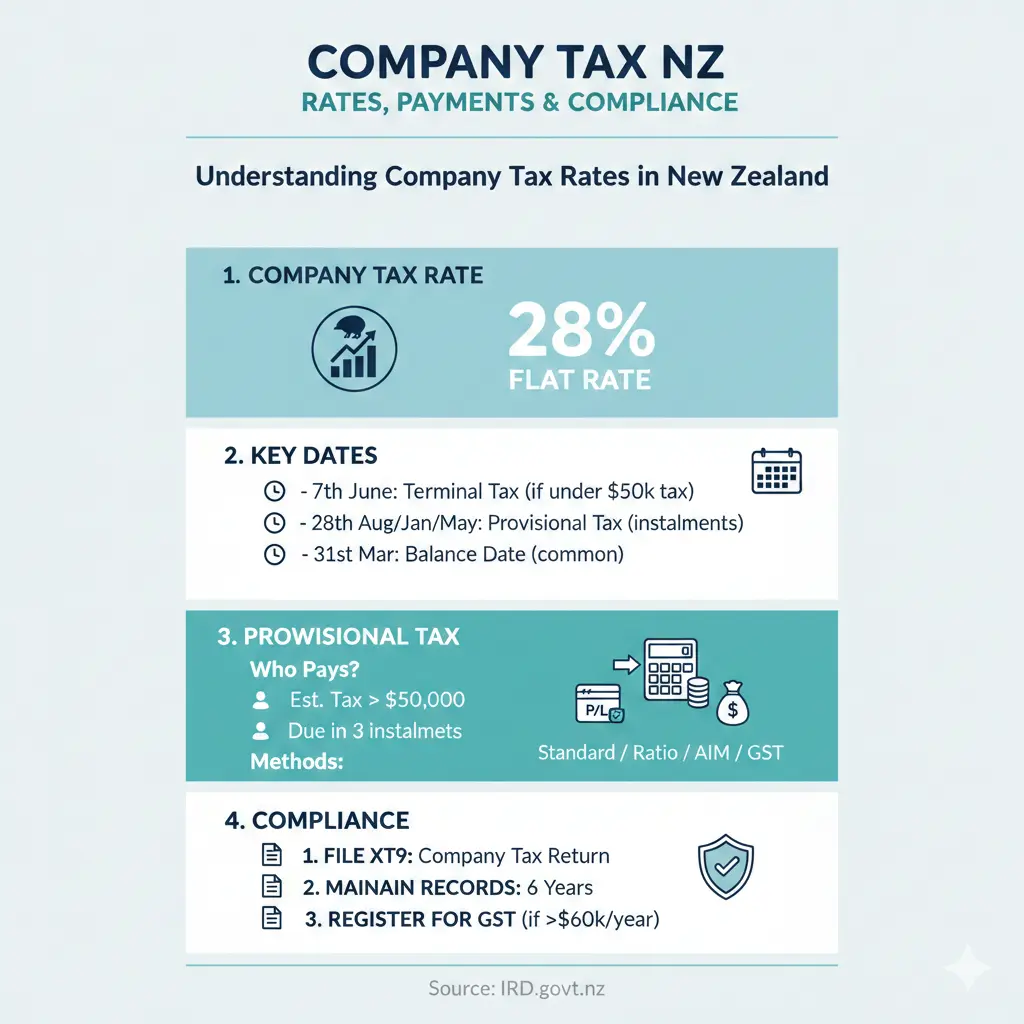
The cornerstone of company tax NZ is the flat corporate income tax rate of 28%, applied to most companies' taxable profits. This rate has been stable since 2011, averaging 33.02% historically but dropping to a low of 28%—and it's projected to remain at 28% through 2026 and into 2027.
Who Pays the 28% Rate?
- Resident companies: Taxed on worldwide income at 28%.
- Non-resident companies (including branches): Taxed only on New Zealand-sourced income at 28%, subject to double tax agreements (DTAs).
- Māori authorities: Pay a reduced rate of 17.5% on income from managing communal assets.
- Sole traders and partnerships: Taxed at individual progressive rates (10.5%–39%), not the company rate.
There's no general capital gains tax in NZ, but gains from certain asset sales—like revenue-generating property or business turnover—can be taxed as income. For example, if your Wellington tech firm sells depreciated equipment at a profit, that counts towards your taxable income.
Provisional Tax for Growing Businesses
New companies with residual income tax (RIT) over $5,000 must pay provisional tax—essentially advance payments on your annual liability. Options include:
- Standard option: Three equal instalments based on prior year tax or estimated current tax.
- Ratio option: Payments based on GST ratios, ideal for businesses with variable profits.
- Estimation option: Custom estimates, updated if your profits change significantly.
Choose wisely: the estimation option suits seasonal businesses like tourism operators in Queenstown, avoiding overpayments.
Company Tax Payments: Deadlines and Methods
Getting payments right keeps your IRD account in good standing. Companies file an annual return by 7 July (two months after the standard 31 March balance date, or seven months for custom dates). Tax is due in full with the return unless you use provisional tax.
Key Payment Deadlines for 2026
| Instalment | Due Date (31 March Balance Date) | Amount |
|---|---|---|
| First provisional | 28 August 2025 | 1/3 of liability |
| Second provisional | 15 November 2025 | 1/3 of liability |
| Third provisional / Terminal | 7 May 2026 | 1/3 of liability + final adjustment |
| Annual return & final tax | 7 July 2026 | Balance due |
Note: Adjust for your balance date—e.g., a 30 June year-end shifts deadlines forward. Use myIR portal for electronic payments via bank transfer or direct debit to avoid penalties.
PAYE and Other Employer Levies
Companies also handle PAYE for employees, withheld at progressive rates for the 2025-2026 tax year:
| Taxable Income (NZD) | Rate | Tax Owed |
|---|---|---|
| 0 – 15,600 | 10.5% | 10.5% of income |
| 15,601 – 53,500 | 17.5% | $1,638 + 17.5% over $15,600 |
| 53,501 – 78,100 | 30% | $8,271 + 30% over $53,501 |
| 78,101 – 180,000 | 33% | $15,651 + 33% over $78,100 |
| 180,000+ | 39% | $49,277 + 39% over $180,000 |
Plus ACC levies: Employers pay 1.67% earners' levy (capped at $152,790 earnings) and industry-specific work levies. File PAYE monthly or bi-monthly via myIR.
GST: The Companion to Company Tax
While not company income tax, GST intertwines with compliance. Register if turnover exceeds $60,000 NZD annually; charge 15% on most goods/services. Exports are zero-rated (0% but reportable), financial services exempt.
GST Filing Cycles
- Monthly: Turnover over $500,000.
- Bi-monthly: $500,000–$24 million.
- Six-monthly: Under $500,000 (with approval).
Tip: Use GST ratios for provisional tax to align payments with actual GST-filed turnover, saving cash for reinvestment.
Compliance Essentials: Avoid IRD Penalties
Non-compliance hits hard—late filings incur 5% initial penalty + 1% per month, up to 100% of tax short-paid. Key steps for Kiwi companies:
Record-Keeping Must-Dos
- Maintain invoices, receipts, and bank statements for 7 years.
- Track depreciation on assets (dimishing value or straight-line methods).
- Separate business/personal expenses—IRD audits love muddy accounts.
Common Deductions to Maximise
- Salary/wages, including KiwiSaver contributions.
- Travel, marketing, and home office costs (if proportionate).
- ACC levies and R&D expenditure.
Pro tip: For a Dunedin manufacturing firm, claim immediate deductions on low-value assets under $1,000 to lower taxable income fast.
Withholding Taxes
Resident withholding tax (RWT) on interest is 28% for companies (45% without IRD number). Dividend withholding tax (DWWT) at 33%, with imputation credits offsetting corporate tax paid.
Global Minimum Tax and 2026 Updates
From 2025, New Zealand implements GloBE Rules for multinational enterprises (MNEs) with €750 million+ global revenue, ensuring a 15% effective tax rate. Domestic top-up tax applies if foreign taxes fall short. Smaller Kiwi firms are unaffected, but monitor if expanding overseas.
Practical Tips for Company Tax Success
- Automate with Xero or MYOB: Link to myIR for seamless GST/PAYE filing.
- Forecast cash flow: Use IRD's tax calculator to predict provisional payments.
- Seek imputation credits: Attach to dividends to refund shareholders' tax.
- Review annually: Adjust balance date if it better matches operations (e.g., retail to 31 January).
- Get professional help: Accountants handle audits; IRD-approved tax agents offer concessions.
These steps keep compliant businesses like Hamilton exporters penalty-free and eligible for refunds.
Next Steps for Your Business
Log into myIR today to check your compliance status and run a tax forecast. If profits are climbing, consult an IRD-registered tax agent for deductions and planning. Remember, this isn't personalised advice—always seek professional financial guidance tailored to your company.
Frequently Asked Questions
Sources & References
-
1
New Zealand Corporate Tax Rate - Trading Economics — tradingeconomics.com
-
2
Business tax rate NZ: Here's what to know - Stripe — stripe.com
-
3
New Zealand PAYE Tax Rates 2025 & 2026 - MoneyHub NZ — www.moneyhub.co.nz
-
4
NZ Tax Brackets 2025/2026 - ABA Chartered Accountants — www.aba.org.nz
-
5
New Zealand - Corporate - Taxes on corporate income - PwC — taxsummaries.pwc.com
-
6
Payroll Taxes in New Zealand [2026 Guide] - Horizons — joinhorizons.com
-
7
Tax rates for businesses - Inland Revenue — www.ird.govt.nz
Related Articles

Working Multiple Jobs NZ: Tax and Legal Considerations
Juggling multiple jobs can boost your income, but it's crucial to understand the tax implications and legal requirements that come with working more than one role in Aotearoa. Whether you're a contrac...

Name Changes NZ: Legal Process and Costs
Considering a fresh start with a new name? Whether it's after marriage, divorce, or simply embracing a personal transformation, changing your name in New Zealand is straightforward but requires follow...

Holiday Home Tax Rules NZ: Private Use and Rental
Own a bach in Coromandel or a holiday home in Queenstown? You're not alone—many Kiwis cherish these escapes, but renting them out while enjoying personal use can trip you up on tax rules. Getting the...

Industry Bodies and Professional Associations NZ
Whether you're launching a business, advancing your career, or navigating financial regulations, industry bodies and professional associations in New Zealand offer invaluable support. These organisati...