Dividend Investing NZ: Building Passive Income

Imagine kicking back with a flat white in hand, watching regular payments hit your bank account without lifting a finger—that's the allure of dividend investing NZ. For Kiwis chasing passive income, d...
Sarah covers personal finance, tax, and KiwiSaver topics for Lifetimes NZ. She focuses on making money management straightforward and practical for everyday Kiwis.
Imagine kicking back with a flat white in hand, watching regular payments hit your bank account without lifting a finger—that's the allure of dividend investing NZ. For Kiwis chasing passive income, dividends from solid NZX-listed companies offer a reliable way to build wealth over time, especially with our unique imputation credits smoothing out the tax hit.
In 2026, with economic shifts and tax tweaks like the new Domestic Income Inclusion Rule (DIIR), dividend investing remains a cornerstone for many portfolios. Whether you're topping up KiwiSaver or aiming for retirement freedom, this guide breaks it down with practical steps tailored for New Zealanders.
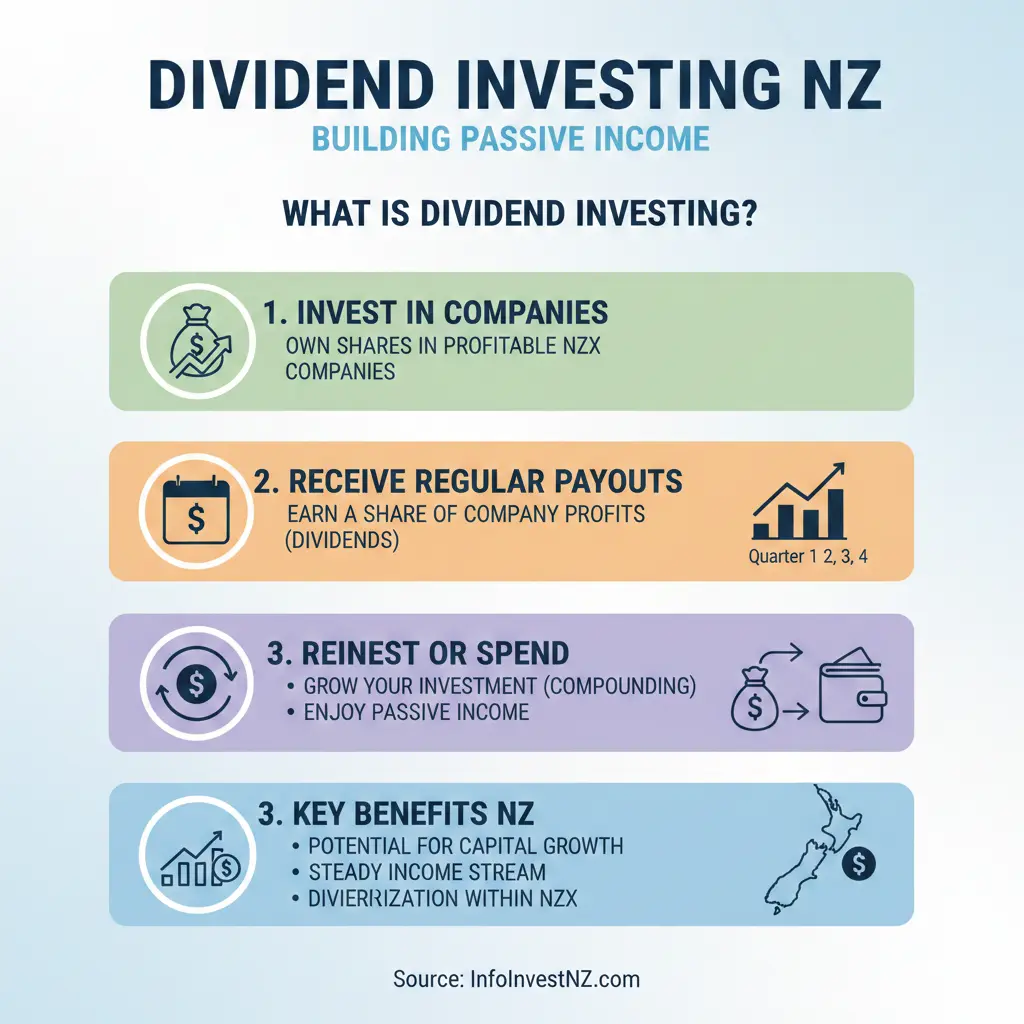
What is Dividend Investing?
Dividend investing means buying shares in companies that regularly share their profits with shareholders through dividends—cash payments straight to your account. Unlike growth stocks that reinvest earnings for share price gains, dividend payers prioritise returning cash to owners, making them ideal for passive income.
In New Zealand, this strategy shines thanks to our imputation system. Companies pay 28% corporate tax, then attach imputation credits to dividends, which you can use to offset your personal tax—often making your net tax zero if you're on the lowest rates. It's like getting paid tax-free in many cases, a perk not every country offers.
How Dividends Work in Practice
Companies declare dividends per share, say 12 cents, so if you own 1,000 shares, that's $120 before tax. Key dates matter: the ex-dividend date means you must own shares before it to qualify, with settlement typically taking one day on the NZX. Set up a dividend mandate with your broker (like Sharesies or Hatch) to direct payments to your bank—no mandate, no auto-deposit.
- Declaration date: Company announces the dividend.
- Ex-dividend date: Buy before this to get paid.
- Record date: Official shareholder list.
- Payment date: Cash hits your account, often quarterly.
Why Dividend Investing Suits Kiwis in 2026
New Zealand's tax setup makes dividends punch above their weight. While capital gains are often tax-free (no general CGT yet), dividends are taxable—but imputation credits claw back the corporate tax paid. For NZ companies, they withhold tax at source and add credits to your IR3 return; check it's correct come tax time.
With yields averaging 4-8% on NZX stocks, that's competitive against term deposits, especially post-tax. In 2026, expect inbound M&A to boost activity, potentially lifting dividends from revitalised firms. Plus, the DIIR from January ensures big multinationals pay fair whack on domestic income, stabilising the landscape.
Pros and Cons of Dividend Shares
| Pros | Cons |
|---|---|
| Steady passive income stream | Dividends aren't guaranteed—companies can cut them |
| Tax advantages via imputation credits | Taxed as income (unlike untaxed capital gains) |
| Reinvestment compounds wealth long-term | Opportunity cost vs high-growth stocks |
| Lower volatility than pure growth plays | Brokerage fees on reinvestment add up |
Reinvesting dividends supercharges returns: from 2003-2024, NZ indices with reinvestment grew far beyond price-only gains.
Top Dividend Stocks and ETFs on the NZX
Focus on established NZX names with payout histories. Good yields sit 4-8%; over 10% screams risk, under 3% skimps on income. Check NZX for gross yields—compare to your tax rate for net return.
Standouts include:
- Spark New Zealand (SPK): Telecom giant, reliable quarterly dividends, yield around 6-7%.
- Contact Energy (CEN): Power play with green focus, consistent payer.
- Meridian Energy (MEL): Renewable leader, strong balance sheet for dividends.
- Auckland International Airport (AIA): Tourism rebound boosting yields.
For diversification, grab NZX-listed ETFs like Smart NZ Dividend ETF or similar—low fees, instant spread across top payers. Avoid single-stock bets; blend with KiwiSaver for employer matches up to 3%.
Foreign Dividends: A Kiwi Twist
US or Aussie shares via ETFs (e.g., S&P 500 funds) offer global exposure, but no imputation—full tax applies, plus withholding abroad (often 15%). Self-report on IR1261, claim foreign tax credits, and convert to NZD. Stick mostly local for tax perks.
Taxes on Dividends: Kiwi Essentials
IRD rules are straightforward but watch the details. NZ dividends: company withholds PIR (10.5-39%), attaches credits at 28:72 ratio for fully imputed. Non-residents face 0-30% NRWT, often 0% for imputed to foreigners.
Foreign dividends: fully taxable, no credits unless via treaty. Deduct interest on loans for dividend shares (not trading), prove it. General anti-avoidance nixes dodgy schemes like dividend stripping.
Tax Table for 2026 Rates
| Your Income Band | PIR Rate | Imputed Dividend Net Tax |
|---|---|---|
| $0-$14,000 | 10.5% | Often $0 after credits |
| $14,001-$48,000 | 17.5% | Minimal |
| $48,001-$70,000 | 30% | Partly offset |
| $70,001+ | 39% | Top-up tax due |
Update your PIR with brokers to avoid under/over-withholding.
Getting Started: Step-by-Step for Kiwis
- Assess your position: Check debts, emergency fund (3-6 months), KiwiSaver balance.
- Set goals: £500/month passive income? Use dividend calculators on dividends.co.nz.
- Choose platform: Sharesies, Hatch, ASB Securities—low fees, easy mandates.
- Research: NZX site, dividends.co.nz for yields, sustainability.
- Diversify: 10-20 stocks or ETFs, reinvest via DRP if available.
- Monitor: Annual review, track via Portfolio Tracker apps.
Start small: $5,000 in a dividend ETF yields ~$250/year gross. Scale with auto-invest.
Costs and Tips to Minimise Them
Brokerage $10-30/trade—batch buys. No ongoing fees on basic platforms. Reinvest manually or via ETF auto-plans to dodge extras. Claim loan interest if borrowing smartly.
Strategies for Building Passive Income
Aim for Dividend Growth Investing: pick firms hiking payouts yearly, like utilities. Reinvest everything early—compounding turns $10k at 6% yield into $30k+ in 10 years.
Balance with growth: 60% dividends, 40% growth shares. For retirement, dividends beat bonds; pair with KiwiSaver for govvie top-ups ($521/year max).
"NZ’s dividend strategy may provide investors with robust income... reinvesting dividends [is key] to total long-term equity returns."
Next Steps to Launch Your Dividend Portfolio
Grab your IRD number, sign up on Sharesies today, and paper-trade a £10k portfolio on NZX. Track yields weekly, reinvest ruthlessly, and review tax with an adviser yearly. In 2026, dividend investing NZ could be your ticket to true passive income—start small, stay consistent, and watch it grow. Consult ird.govt.nz for personalised tax advice.
Frequently Asked Questions
Sources & References
-
1
Investing In... 2026 - New Zealand - Chambers Global Practice Guides — practiceguides.chambers.com
-
2
Share investments - Inland Revenue — www.ird.govt.nz
-
3
My Dividend Investing Guide for 2026 - YouTube — www.youtube.com
-
4
Investing in Dividend Shares - MoneyHub NZ — www.moneyhub.co.nz
-
5
Is Investing for Dividends Bad for Long Term Wealth? Part 2 — kernelwealth.co.nz
-
6
Top 8 Best Investments in New Zealand (2026) | Opes Partners — www.opespartners.co.nz
-
7
NZ Stocks & Dividends 2026 | NZX Share Prices, Analysis & Yields — dividends.co.nz
-
8
All things dividends—Sharesies New Zealand — www.sharesies.nz
-
9
S&P 500 Guide - What, Why and How to Invest in NZ - AMP — www.amp.co.nz
Related Articles

Ethical Investing in NZ: Top 5 Sustainable Funds for Kiwis
Ever wondered if you can grow your KiwiSaver or investments while doing good for the planet and people? Ethical investing in New Zealand is booming, with Kiwis pouring billions into funds that priorit...

Beginner's Guide to Investing in New Zealand
Getting started with investing in New Zealand doesn't have to be complicated. Whether you're looking to grow your wealth, save for retirement, or build financial security, there are plenty of accessib...

How to Buy Shares in New Zealand: Step-by-Step Guide
Ever wondered how to dip your toes into share investing without getting overwhelmed? Whether you're saving for a house deposit, retirement, or just want to grow your hard-earned cash, buying shares in...

ETFs vs Managed Funds: Which is Better for Kiwi Investors?
When you're ready to invest your money, you'll likely come across two main options: exchange-traded funds (ETFs) and managed funds. Both offer diversification and professional management, but they wor...