Flexible Working Requests NZ: Your Rights to Ask

Imagine wrapping up your workday early to pick up the kids from school, or logging in from home a few days a week to care for an elderly parent—all without risking your job. For Kiwis juggling family,...
The Lifetimes NZ editorial team curates, fact-checks, and updates guides on personal finance, property, health, immigration, legal, business, and lifestyle topics relevant to Lifetimes NZ readers. Articles are produced with AI assistance and reviewed by the editorial team before publication.
Imagine wrapping up your workday early to pick up the kids from school, or logging in from home a few days a week to care for an elderly parent—all without risking your job. For Kiwis juggling family, health, or personal commitments, flexible working requests NZ make this a reality under the law. Since 2016, you've had the statutory right to ask your employer for changes to your hours, days, or location, and with 2026 reforms on the horizon, understanding your rights has never been more crucial.
This guide breaks down everything you need to know about flexible working requests NZ: your rights to ask, from eligibility and the process to what happens if your request is declined. We'll cover practical tips, real Kiwi examples, and updates for 2026, so you can confidently approach your boss and balance work with life.
What Are Flexible Working Requests in New Zealand?
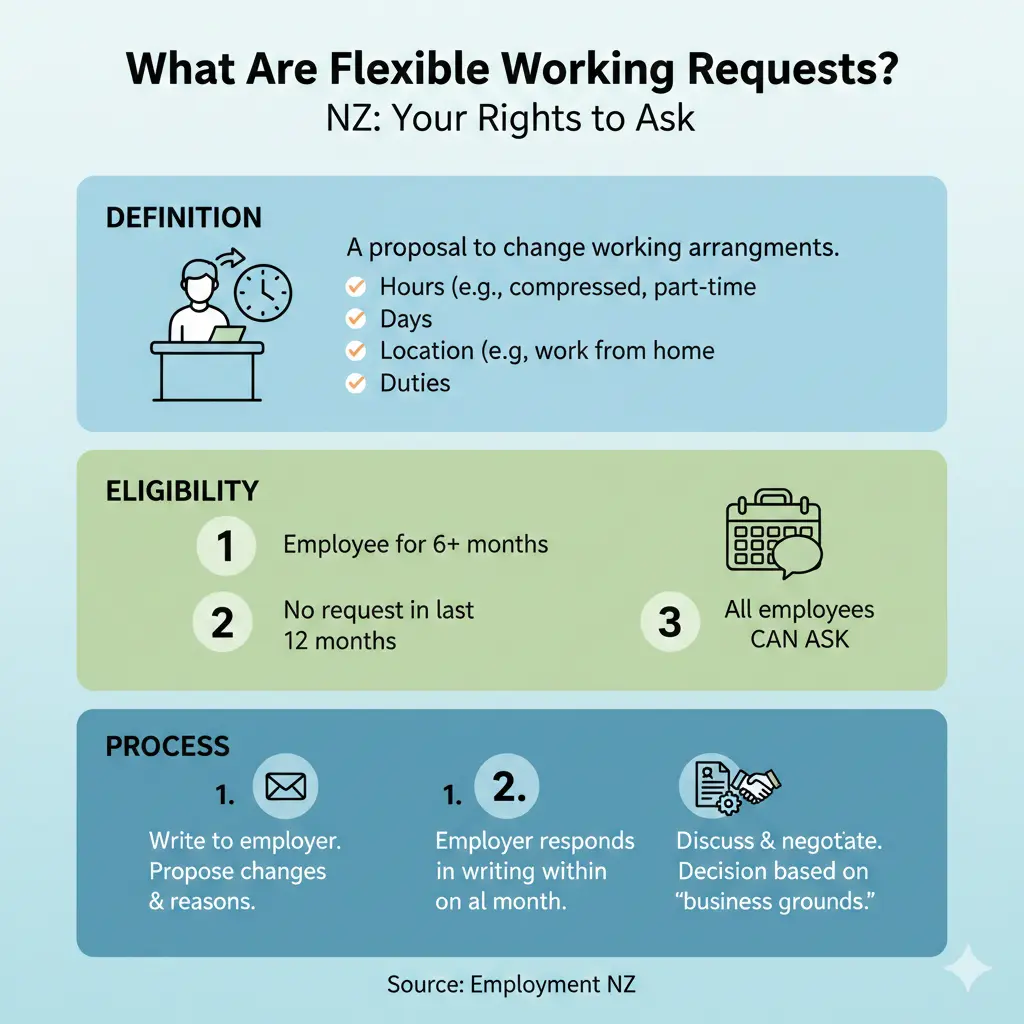
Flexible working arrangements let employees tweak their work setup to better suit their needs. This could mean part-time hours, compressed weeks, job-sharing, or working remotely. Under New Zealand law, you have the right to request these changes once you've worked for your employer for at least six months (or three months for new parents returning from parental leave).
The Employment Relations Act 2000 underpins this right, ensuring employers must engage in good faith. It's not a guarantee of approval—your boss can say no for business reasons—but they can't dismiss or disadvantage you for asking.
Types of Flexible Work Available
- Flexible hours: Starting later or finishing earlier, like a 10am-6pm shift to avoid school run traffic.
- Compressed weeks: Working full-time hours over four days instead of five.
- Part-time or job-sharing: Reducing hours or splitting a role with a colleague.
- Remote or hybrid working: Working from home some days, especially relevant post-COVID.
- Shift swapping: Adjusting rosters in retail or hospitality.
For example, a nurse in Auckland might request fewer night shifts to manage childcare, while a Wellington office worker asks for two remote days to cut commuting costs amid rising fuel prices.
Who Can Make a Flexible Working Request?
Most employees qualify after the qualifying period: six months for standard employees, or three months if returning from parental leave. This applies across sectors, from small businesses to large corporates.
Casual workers generally can't make statutory requests, but many negotiate informally. Independent contractors might explore similar arrangements under contract terms. Parents, carers, those with disabilities, or anyone facing life changes—like menopause or mental health challenges—often benefit most.
In 2026, with Holidays Act reforms introducing hours-based leave accrual from day one, flexible requests could tie in seamlessly with new leave entitlements, making part-time work even more viable.
Special Cases: Parents and Carers
New parents have enhanced rights. If you've taken parental leave, you can request flexibility upon return after just three months. This supports breastfeeding, bonding, or shared parenting—vital for Kiwi families where both parents often work.
Caregivers for tamariki (children), kaumatua (elderly), or those with disabilities also qualify, aligning with our inclusive values.
How to Make a Flexible Working Request: Step-by-Step Guide
Making a request is straightforward, but preparation is key. Follow these steps to maximise success.
Step 1: Check Your Eligibility and Prepare
Confirm you've hit the six-month mark (or three for parental leave returnees). Think about what you need—be specific, e.g., "Reduce to four days a week at 0.8 FTE" rather than "work less."
Gather evidence of benefits: studies show flexible work boosts productivity by 20-30% and cuts turnover.
Step 2: Put It in Writing
Submit a written request detailing:
- Your proposed changes (hours, days, location).
- Start date and duration (e.g., trial period).
- Impact on your role and how you'll manage it.
- Any supporting reasons (optional but helpful).
Step 3: Discuss in Good Faith
Your employer must respond within one month, discussing options openly. They can't just say no without reason.
Tip: Propose alternatives, like a three-month trial, to show flexibility.
Step 4: Get a Written Response
Employers must reply in writing, approving or declining with reasons. If approved, update your employment agreement.
Pro Tip for Kiwis: Time your request around performance reviews or quiet periods, like post-holidays, when bosses are more receptive.
Employers' Obligations: What They Must (and Can't) Do
Employers must consider requests genuinely, without bias. They have one month to respond in writing.
Valid Reasons to Decline
Declines are allowed if the change would:
- cause undue hardship to the business.
- damage productivity or efficiency.
- be impractical due to inability to reorganise work.
- harm colleagues' opportunities.
- cost too much.
- involve confidential info risks.
If declined unfairly, you can raise a personal grievance via Mediation Services or the Employment Relations Authority. Note: 2026 proposals introduce a NZ$180,000 salary threshold for unjustified dismissal grievances, but this may not directly impact flexibility requests.
2026 Updates: What's Changing for Flexible Work?
Exciting reforms are reshaping employment. The Holidays Act replacement introduces hours-based annual and sick leave from day one, plus 12.5% leave compensation for casuals—perfect for flexible or part-time roles.
Extended 90-day trials for all businesses add caution for new hires testing flexibility early. Tax tweaks ease remote work for migrants, signaling government support for hybrid models.
Agencies must align policies with government expectations on work-from-home, boosting options in public service.
"The most successful businesses proactively offer flexibility rather than waiting for a formal request."
Practical Tips for Success in NZ Workplaces
- Document everything: Emails, meetings—build your case.
- Highlight mutual benefits: Lower absenteeism, happier staff, retention savings.
- Seek union or community support: If in a union, get advice; check Employment NZ resources.
- Trial periods work wonders: Suggest 3-6 months to prove it.
- Know your worth: Flexible roles often retain top talent amid NZ's tight labour market.
Real example: A Christchurch teacher requested hybrid teaching post-quake family stress; after a trial, it became permanent, improving her wellbeing and student outcomes.
Common Challenges and How to Overcome Them
Challenge 1: Small business pushback. Emphasise no-cost options like roster tweaks.
Challenge 2: Industry norms (e.g., hospitality). Point to successful Kiwi chains like Starbucks NZ offering flexibility.
Challenge 3: Remote work tech issues. Propose employer-funded tools or hybrid trials.
If disputes arise, contact Employment NZ's free helpline or use their online tools.
FAQ: Flexible Working Requests NZ
Q1: Can I make more than one request?
A: Yes, but only one statutory request every 12 months. Informal chats anytime.
Q2: What if my employer ignores my request?
A: They must respond in one month. Non-response is grounds for grievance.
Q3: Does flexibility affect KiwiSaver or pay?
A: Pro-rated pay and KiwiSaver contributions apply to reduced hours. Check with IRD for tax implications.
Q4: Can zero-hour contract workers request it?
A: No statutory right, but negotiate via good faith bargaining.
Q5: How does this tie into ACC or sick leave?
A: Flexible hours can accommodate ACC claims or new 2026 sick leave accrual.
Q6: What's the process if declined?
A: Raise a grievance within 90 days via mediation, then Employment Relations Authority.
Next Steps: Take Control of Your Work-Life Balance
Ready to ask? Download a template from Employment NZ, draft your request today, and schedule that chat. Flexibility isn't just a perk—it's your right, backed by law and evolving with 2026 reforms. If needed, consult a community law centre or employment advocate. Balance work with what matters—your family, health, and Kiwi lifestyle deserve it.
Disclaimer: This is general guidance. Seek personalised advice from Employment NZ, a lawyer, or advisor for your situation. Financial impacts (e.g., KiwiSaver, tax) should be checked with IRD or a professional.
Related Articles

Industry Bodies and Professional Associations NZ
Whether you're launching a business, advancing your career, or navigating financial regulations, industry bodies and professional associations in New Zealand offer invaluable support. These organisati...

Emergency Benefit NZ: When You Have No Other Options
When you're struggling financially and don't qualify for other benefits, the Emergency Benefit might be your lifeline. It's a discretionary payment designed for Kiwis in genuine hardship who've exhaus...

Unpaid Internships NZ: Are They Legal?
Unpaid internships are a common pathway for students and graduates to gain work experience in New Zealand, but there's often confusion about whether they're actually legal. The short answer is: unpaid...

Estate Administration NZ: Managing Someone's Affairs After Death
Losing a loved one is one of life's toughest challenges, and stepping in to manage their estate can feel overwhelming. In New Zealand, estate administration—the process of handling someone's affairs a...