Healthy Homes Assessment: What Landlords Must Provide
If you're a Kiwi landlord, the clock is ticking towards full Healthy Homes compliance by 1 July 2025 – and a professional Healthy Homes Assessment is your best first step to avoid hefty fines and keep...
Sarah covers personal finance, tax, and KiwiSaver topics for Lifetimes NZ. She focuses on making money management straightforward and practical for everyday Kiwis.
If you're a Kiwi landlord, the clock is ticking towards full Healthy Homes compliance by 1 July 2025 – and a professional Healthy Homes Assessment is your best first step to avoid hefty fines and keep your rental business running smoothly.
With the final deadline just months away in 2026, understanding exactly what the Healthy Homes Standards demand – and what you must provide – has never been more critical. These regulations, embedded in the Residential Tenancies Act, ensure rentals are warm, dry, and healthy, bridging the quality gap between rented homes and owner-occupied ones. Whether you're managing a cosy bach in Wellington or a family home in Auckland, this guide breaks down your obligations, the assessment process, and practical steps to get compliant without the stress.
What Are the Healthy Homes Standards?
The Healthy Homes Standards, introduced on 1 July 2019, set minimum requirements for rental properties across five key areas: heating, insulation, ventilation, moisture ingress and drainage, and draught stopping. They're designed to make Kiwi rentals safer and more comfortable, reducing health issues like colds and mould-related illnesses that hit tenants – and your maintenance bills – hard.
Landlords bear full responsibility for compliance, with no excuses for pre-2019 builds. Even new builds might not automatically meet the standards, so don't assume your property is exempt.
Key Compliance Deadlines for Landlords
- All private rentals must comply within 120 days of any new or renewed tenancy after 1 July 2021.
- Full compliance for all private rentals by 1 July 2025 – no more grace periods after this date.
- Boarding houses by 1 July 2021; Kāinga Ora and Community Housing Providers by 1 July 2023.
- Tenancies starting on or after 3 March 2025 must meet standards by the 1 July 2025 deadline.
From 1 July 2025, your property must be compliant on day one of any new or renewed tenancy. Miss this, and tenants can haul you to the Tenancy Tribunal, with fines up to $7,200 or more.
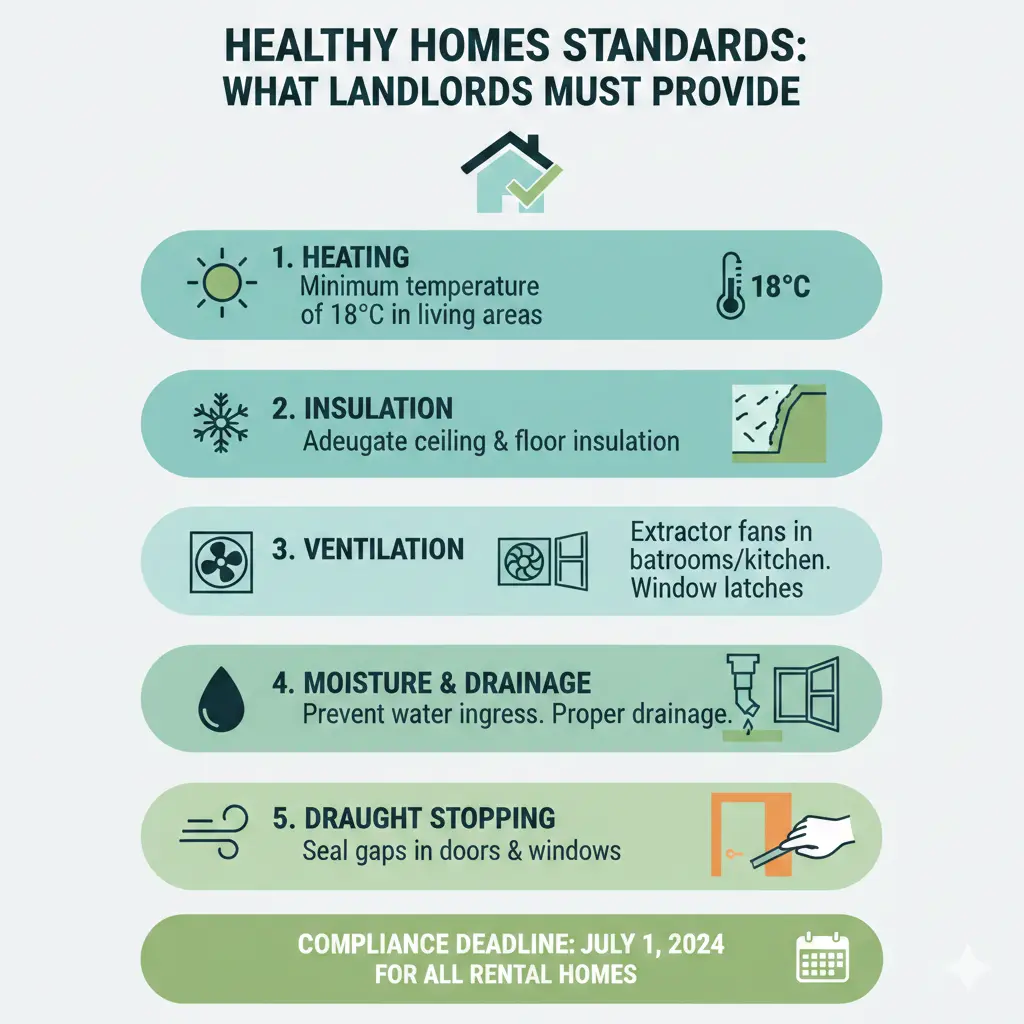
The Five Healthy Homes Standards Explained
Here's a breakdown of what each standard requires, straight from the regulations. Use this as your checklist before booking an assessment.
1. Heating
Every rental needs a fixed heater in the main living room capable of maintaining 18°C at 50% outside humidity. Portable heaters don't count. Approved options include:
- Heat pumps (ideal for most Kiwi climates, especially Auckland's damp winters).
- Wood or pellet burners.
- Flued gas heaters.
- Certain electric heaters with thermostats.
Pro tip: Heat pumps are often the most cost-effective long-term choice, slashing power bills and boosting tenant satisfaction.
2. Insulation
Ceilings must have at least R 3.2 (or R 2.8 in some older homes), and walls R 2.2 (or R 1.9). Check your property's age – pre-2000 homes often need upgrades.
3. Ventilation
Adequate airflow to prevent mould: exhaust fans in kitchens and bathrooms (rated for outdoor venting), openable windows in bedrooms and living areas (at least 5% of floor area), and trickle vents if needed.
4. Moisture Ingress and Drainage
Proper ground clearance (15cm minimum), gutters, and downpipes to keep water away from foundations. No pooling near the house.
5. Draught Stopping
Seal gaps around doors, windows, vents, and pipes to stop cold air infiltration, but maintain ventilation.
"The healthy homes standards aim to close the gap in quality between rental properties and owner-occupied homes." – Stats NZ via govt.nz
Healthy Homes Assessment: What Landlords Must Provide
A Healthy Homes Assessment isn't legally mandatory, but it's the gold standard for proving compliance – especially post-1 July 2025 when instant readiness is required. Qualified assessors inspect your property against all five standards, delivering a detailed report and a 13A Compliance Statement.
What happens during an assessment?
- Technician conducts a full internal and external audit (typically 1-2 hours).
- You receive a report listing fixes needed, plus the compliance statement for your tenancy agreement.
- Upload evidence of repairs to generate updated statements at no extra cost (with some providers).
Costs start around $219 + GST, making it a small price for peace of mind. Providers like Healthy Homes NZ have done over 30,000 assessments, bringing proven expertise.
Must-provide to tenants: Attach the signed 13A Compliance Statement to every new, renewed, or varied tenancy agreement. Skip this, and face up to $500 fines per tenancy.
MBIE guidance requires checking compliance at regular inspections and tenancy end – keep records handy.
Penalties for Non-Compliance
Ignoring Healthy Homes is a direct breach of the Residential Tenancies Act 1986. Consequences include:
- Tenancy Tribunal orders for repairs or rent reductions.
- Fines up to $7,200 per breach (escalating for repeats).
- $500 fine for missing the compliance statement in agreements.
- Enforcement action from Tenancy Services.
Tenants can issue a 14-day remedy notice; if ignored, it's Tribunal time. Proactive landlords avoid this drama entirely.
Exemptions: When Standards Don't Apply
Not every rental needs full compliance. Common exemptions include:
- Short-term holiday homes (under 90 days).
- Properties pre-1 July 2019 with fixed-term tenancies ending before 1 July 2021 (check specifics).
- Partial exemptions for insulation in very old homes or certain communal areas.
Always verify via Tenancy Services – assumptions can cost you.
Practical Steps for Landlords to Get Compliant
With 2026 underway, here's your action plan:
Step 1: Book a Healthy Homes Assessment
Search for local qualified assessors (e.g., via tenancy.govt.nz resources). Get quotes – some offer free initial checks.
Step 2: Prioritise Fixes
Tackle heating and insulation first – they're often the biggest wins. Use tradies registered with Master Heat Pump or similar for quality work.
Step 3: Gather Evidence
Keep invoices, photos, and certificates. Update your compliance statement post-repairs.
Step 4: Update Tenancy Agreements
Include the mandatory statement. Download Tenancy Services' template.
Cost-Saving Tips
- Bundle assessments for multiple properties.
- Apply for Warmer Kiwi Homes grants if eligible (check energy.govt.nz).
- Choose efficient upgrades like heat pumps to cut future power costs.
Landlords who've acted early report lower void periods and happier tenants – a win for your bottom line.
Next Steps for Kiwi Landlords
Don't wait – book your Healthy Homes Assessment today to beat the rush and sidestep penalties. Visit tenancy.govt.nz for the landlord toolkit, or contact Tenancy Services for free advice. Compliant rentals mean healthier tenants, fewer disputes, and a stronger investment portfolio. Remember, this isn't just law – it's good business for New Zealand's rental market.
Disclaimer: This guide provides general information based on 2026 regulations. Laws can change; always seek professional advice from a lawyer, accountant, or Tenancy Services for your specific situation. We're not financial advisors.
Frequently Asked Questions
Sources & References
-
1
Healthy Homes Assessment – Healthy Homes NZ — www.healthyhomesnz.co.nz
-
2
New Healthy Homes rules: What landlords must know – Opes Partners — www.opespartners.co.nz
-
3
Healthy Homes law change: what every tenant & landlord needs to know – Willis Legal — www.willislegal.co.nz
-
4
Healthy Homes Deadline: Landlords Must Comply by 1 July 2025 – Christchurch Electrical — www.christchurchelectrical.co.nz
-
5
Rental properties and healthy homes standards – govt.nz — www.govt.nz
-
6
Healthy Homes Standards Compliance – Mint Auckland — www.mintauckland.co.nz
-
7
Healthy Homes Compliance: What Every Landlord Needs to Know – GreenSide — www.greenside.co.nz
-
8
Healthy homes standards – what a landlord needs to know – Tenancy Services — www.tenancy.govt.nz
-
9
Healthy homes – Tenancy Services — www.tenancy.govt.nz
Related Articles

Industry Bodies and Professional Associations NZ
Whether you're launching a business, advancing your career, or navigating financial regulations, industry bodies and professional associations in New Zealand offer invaluable support. These organisati...

Emergency Benefit NZ: When You Have No Other Options
When you're struggling financially and don't qualify for other benefits, the Emergency Benefit might be your lifeline. It's a discretionary payment designed for Kiwis in genuine hardship who've exhaus...

Unpaid Internships NZ: Are They Legal?
Unpaid internships are a common pathway for students and graduates to gain work experience in New Zealand, but there's often confusion about whether they're actually legal. The short answer is: unpaid...

Estate Administration NZ: Managing Someone's Affairs After Death
Losing a loved one is one of life's toughest challenges, and stepping in to manage their estate can feel overwhelming. In New Zealand, estate administration—the process of handling someone's affairs a...