KiwiSaver for Over 60s: Is It Too Late to Join?

Many Kiwis in their 60s wonder if it's too late to jump into KiwiSaver, especially with retirement looming and recent changes shaking up the scheme. The good news is, it's not too late—joining KiwiSav...
Sarah covers personal finance, tax, and KiwiSaver topics for Lifetimes NZ. She focuses on making money management straightforward and practical for everyday Kiwis.
Many Kiwis in their 60s wonder if it's too late to jump into KiwiSaver, especially with retirement looming and recent changes shaking up the scheme. The good news is, it's not too late—joining KiwiSaver over 60 can still deliver real benefits, from government top-ups to employer matches, helping boost your nest egg even in the short term.
With minimum contributions rising to 3.5% from April 2026 and other tweaks in play, understanding your options is crucial.KiwiSaver for over 60s remains accessible, and we'll break down the rules, benefits, and steps to get started right here for New Zealanders eyeing a stronger retirement.
Can You Join KiwiSaver if You're Over 60?
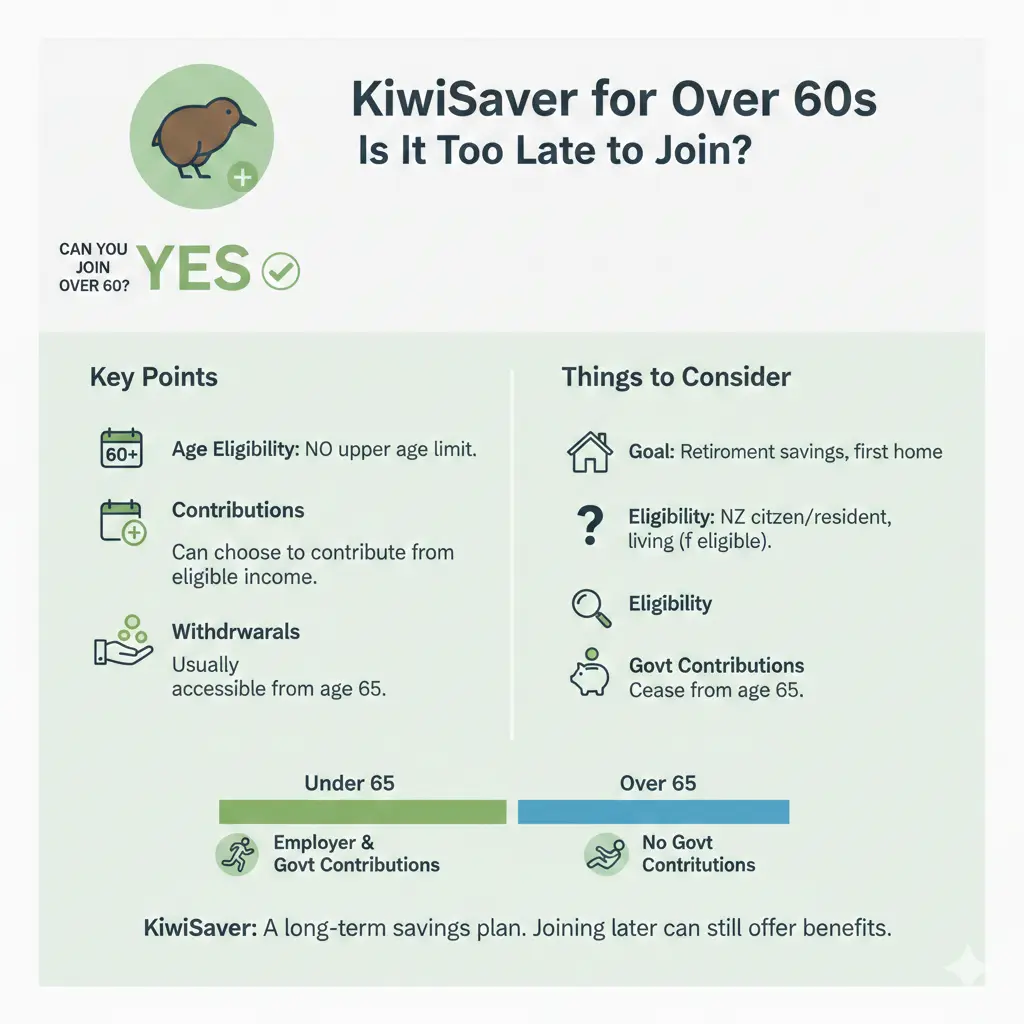
Absolutely, KiwiSaver is open to anyone up to age 65, and even beyond if you're still working.There's no upper age limit preventing you from joining or staying in, as long as you're eligible and contributing. If you're over 65, you can continue contributing voluntarily, but employer contributions aren't compulsory—though many employers still match them voluntarily.
For those aged 60-65, the scheme works much like for younger members. You're automatically eligible if employed and not already opted out (though opting out is rare post-enrolment). Self-employed Kiwis or those without an employer can join directly through a provider. Recent updates confirm eligibility stretches to 65 for government perks, making it worthwhile even if retirement is just around the corner.
Key Eligibility Rules for Over 60s
- Age range: 18-65 for automatic enrolment; voluntary contributions welcome anytime.
- Residency: You must mainly live in New Zealand (with exceptions for certain overseas workers).
- Income cap: Under $180,000 taxable income annually to qualify for government contributions.
- Employment status: Employees get employer matches; self-employed contribute directly.
Practical tip: If you're over 65 and working, chat with your employer about voluntary contributions—they often match to support loyal staff.
Benefits of Joining KiwiSaver Over 60: Free Money Awaits
Even with fewer years to compound growth, KiwiSaver for over 60s packs punch through matched contributions and tax perks. Here's why it's not too late to join.
Government Contributions: Up to $260.72 Annually
The government matches your contributions at 25 cents per dollar, up to a max of $260.72 yearly (for $1,042.86 contributed). This kicked in fully from July 2025, halved from previous rates but still valuable—especially pro-rated if you join mid-year.
For over 60s, this is pure free money. Contribute the minimum via weekly direct debit ($20/week hits the threshold easily), and pocket the top-up by July each year. You're eligible up to 65, and it applies if your income's under $180k.
"To receive the Government Contribution you must be between the ages of 16 and 65."
Employer Supercharge: Matches Up to 3.5% (Rising Soon)
Employers must contribute at least 3% now, jumping to 3.5% from April 2026 and 4% by 2028. This applies to employees up to 65; over 65, it's voluntary but common.
Example: On a $60,000 salary, a 3.5% employer match adds $2,100 yearly—on top of your contributions. Self-employed? No match, but you control everything.
Tax Advantages and Compound Growth
Your contributions are from pre-tax pay (via PAYE), and earnings grow tax-free at your PIR (10.5%, 17.5%, or 28%). For conservative investors over 60, low-risk funds preserve capital while earning steady returns.
Even short-term, compounding helps. A $5,000 balance at 4% net return grows to $5,400 in 5 years—plus contributions.
Upcoming KiwiSaver Changes in 2026: What Over 60s Need to Know
2026 brings tweaks that indirectly benefit mature members. Minimum rates rise, but you can apply for temporary reductions from February 2026 if 3.5% strains your budget.
Contribution Rate Hikes
| Period | Employee Min | Employer Min |
|---|---|---|
| Now to March 2026 | 3% | 3% |
| April 2026-2027 | 3.5% | 3.5% |
| April 2028+ | 4% | 4% |
Source: KiwiBank and Koura Wealth updates. Tip: Set up a direct debit at $20/week to qualify for government top-ups without employer reliance.
Government contribution stays at 25c/$1, max $260.72, income-capped at $180k.
How to Join KiwiSaver if You're Over 60: Step-by-Step Guide
Joining is straightforward—takes minutes online or via employer.
- Check eligibility: Confirm IRD number, NZ residency, income under $180k for gov perks.
- Choose a provider: Compare fees/performance on Sorted KiwiSaver Finder. Options like AMP, Westpac, or KiwiBank suit conservatives.
- Enrol: Employed? Ask HR. Self-employed? Apply directly (need IRD, ID). No kick-start since 2015.
- Select rate/fund: Start at 3%, pick conservative fund for over 60s.
- Monitor: Use provider app for balances; adjust annually.
Over 65? Providers like SuperLife allow voluntary joins. Pro tip: WINZ or StudyLink irrelevant here, but pair with KiwiSaver for superannuitants working part-time.
Is It Worth It? Real Examples for Kiwis Over 60
Consider John, 62, earning $70k. Joins KiwiSaver:
- His 3.5% ($2,450/year).
- Employer match: $2,450.
- Gov top-up: $260.
- Total year 1: $5,160 + growth.
Over 3 years to 65: ~$16,000 added, potentially $20k+ with 4% returns. Beats a bank term deposit.
Or Mary, 67, self-employed: $1,043 voluntary contribution nets $260 gov match (if under 65 initially), growing safely.
Stats show 53% of Kiwis in wrong funds—switch to conservative for capital protection.
Risks and Considerations for Late Joiners
Locked until 65 (or first home), but withdrawals allowed at 65 for any purpose. Conservative funds minimise volatility, but past returns don't guarantee future. Fees matter—aim under 0.5%.
Disclaimer: This isn't personalised advice. Consult a licensed adviser or call IRD on 0800 775 247. Tax rules via ird.govt.nz.
Frequently Asked Questions
Related Articles

Industry Bodies and Professional Associations NZ
Whether you're launching a business, advancing your career, or navigating financial regulations, industry bodies and professional associations in New Zealand offer invaluable support. These organisati...

Emergency Benefit NZ: When You Have No Other Options
When you're struggling financially and don't qualify for other benefits, the Emergency Benefit might be your lifeline. It's a discretionary payment designed for Kiwis in genuine hardship who've exhaus...

Unpaid Internships NZ: Are They Legal?
Unpaid internships are a common pathway for students and graduates to gain work experience in New Zealand, but there's often confusion about whether they're actually legal. The short answer is: unpaid...

Estate Administration NZ: Managing Someone's Affairs After Death
Losing a loved one is one of life's toughest challenges, and stepping in to manage their estate can feel overwhelming. In New Zealand, estate administration—the process of handling someone's affairs a...