KiwiSaver vs Term Deposits: Where to Put Short-Term Savings

Planning your short-term savings in New Zealand? With the Official Cash Rate influencing everything from mortgage repayments to investment returns, choosing between KiwiSaver and term deposits can fee...
The Lifetimes NZ editorial team curates, fact-checks, and updates guides on personal finance, property, health, immigration, legal, business, and lifestyle topics relevant to Lifetimes NZ readers. Articles are produced with AI assistance and reviewed by the editorial team before publication.
Planning your short-term savings in New Zealand? With the Official Cash Rate influencing everything from mortgage repayments to investment returns, choosing between KiwiSaver and term deposits can feel overwhelming. For Kiwis eyeing money they'll need in the next 1-5 years, understanding the trade-offs in returns, access, risk, and taxes is crucial to making a smart move.
Term deposits offer the security of fixed returns with no market ups and downs, ideal if you hate surprises.KiwiSaver, however, shines for long-term growth but locks away funds until retirement or specific withdrawals, making it less suitable for short horizons. This guide breaks it down with 2026 rates, real Kiwi examples, and actionable steps tailored to our market.
What Are Term Deposits and How Do They Work in New Zealand?
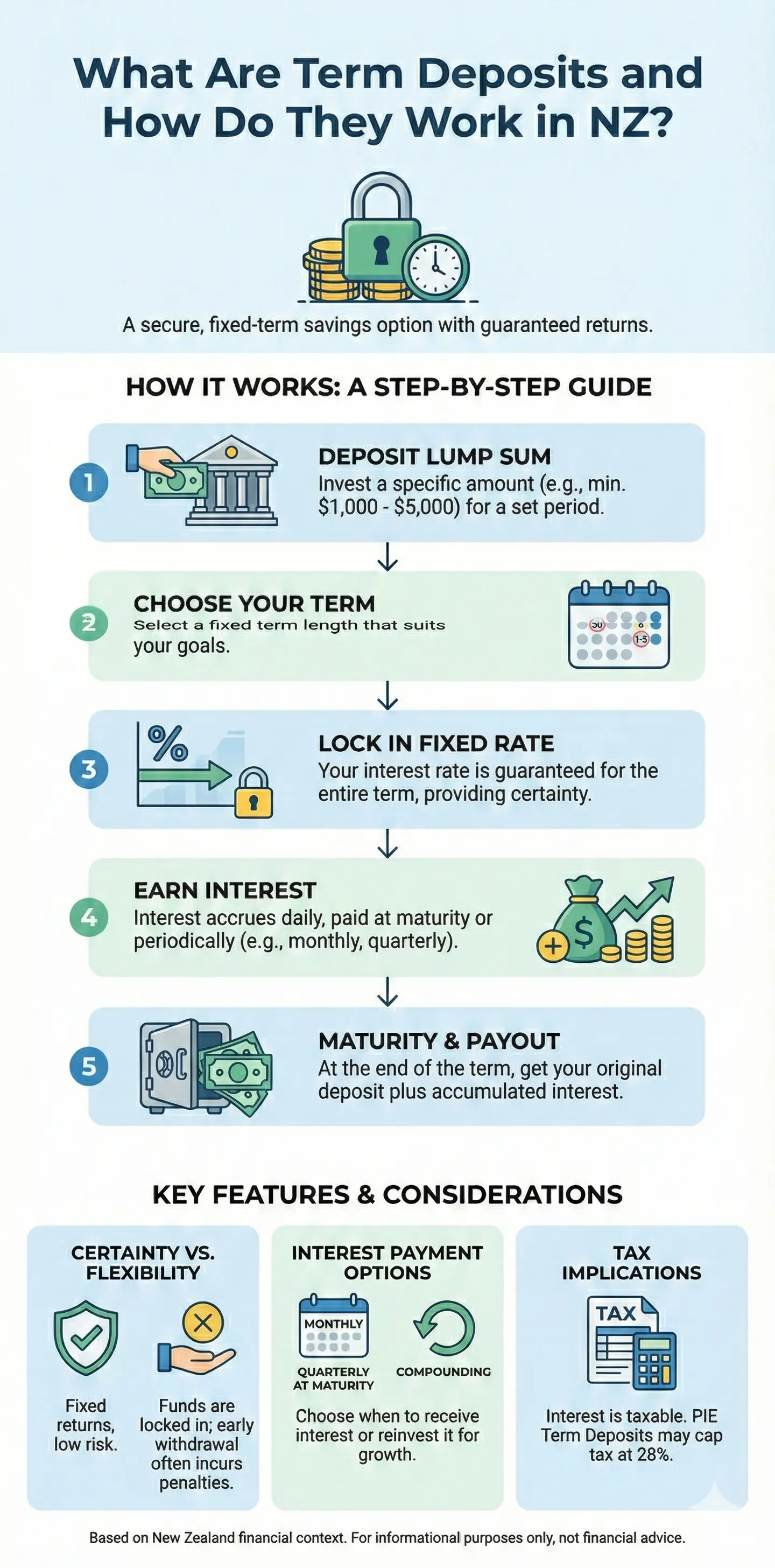
Term deposits let you park a lump sum with a bank or financial institution for a fixed period, earning a guaranteed interest rate. Terms range from one month to five years, and during this time, your money is locked in—no additions or withdrawals without penalties.
Key Features of Term Deposits
- Fixed returns: Rates are set upfront. In early 2026, top 6-month terms offer around 4% p.a. from trusted banks like those listed on comparison sites.
- Minimum investments: Often $1,000 to $5,000, depending on the provider—AMP allows $1,000 entry.
- Early access: Possible but with penalties, typically lost interest rather than direct fees.
- No diversification: Your money earns interest from the lender, backed by their stability (most banks covered by the Crown Retail Deposit Guarantee up to $100,000 per depositor).
For a Kiwi with $10,000 saved for a car deposit in 12 months, a term deposit guarantees your principal plus interest, shielding you from inflation or market dips.
2026 Term Deposit Rates and Trends
As the Reserve Bank of New Zealand (RBNZ) navigates global pressures, term deposit rates hover just under 4% p.a. for shorter terms. Longer terms (3-5 years) might edge higher, but with OCR predictions stable or slightly rising in 2026, shop around via sites like MoneyHub for the best deals.
| Term Length | Typical Rate (2026) | Example Provider |
|---|---|---|
| 6 months | ~3.8-4.0% p.a. | Major banks |
| 12 months | ~3.9-4.2% p.a. | AMP, others |
| 3 years | ~4.0-4.5% p.a. | Competitive offers |
Rates fluctuate; always check current offers and your RWT rate via IRD.govt.nz.
KiwiSaver Basics: Is It Right for Short-Term Goals?
KiwiSaver is New Zealand's government-backed retirement scheme, where you, your employer, and the government contribute to managed funds. While powerful for long-term wealth (with 14.7% annual growth reported recently), it's not designed for short-term savings due to withdrawal restrictions.
Core Rules and Contributions (2026 Updates)
- Your contribution: Minimum 3% of gross salary, rising to 3.5% from 1 April 2026.
- Employer match: At least 3% (or 3.5% post-April 2026) if you're eligible.
- Government kick-in: Up to $260.72 annually for contributors (note: post-65 changes may reduce this).
- Lock-in: Funds generally inaccessible until age 65, first home buy, or hardship/illness.
For short-term needs like emergency funds or a holiday, KiwiSaver's volatility and rules make it a poor fit. Conservative funds suggest 3-year minimums, balanced 5 years, growth 7 years.
Fees, Taxes, and Risk in KiwiSaver
Expect 0.79% annual fees plus a $1.95 monthly fixed fee on many schemes. Returns are taxed via PIE rates (up to 28%), better than personal rates up to 39% on term deposits. But balances fluctuate—great for 10+ years, risky short-term.
KiwiSaver vs Term Deposits: Head-to-Head Comparison
Here's how they stack up for short-term savings (1-5 years), focusing on Kiwi priorities like liquidity and low risk.
| Feature | Term Deposits | KiwiSaver |
|---|---|---|
| Returns | Fixed ~4% p.a. (2026) | Variable; conservative ~3-5% avg., but volatile |
| Access | Locked for term; penalties for early break | Locked until 65/first home |
| Risk | Very low (guaranteed principal) | Medium-high depending on fund |
| Minimum Investment | $1,000-$5,000 | $1/week via payroll |
| Fees | Usually none (early withdrawal aside) | 0.79% + $1.95/mth |
| Taxes | RWT 10.5-39% | PIE max 28% |
| Contributions | Lump sum only | Employer/govt boosts |
Term deposits win for predictability; KiwiSaver for boosted growth if you can wait.
Pros and Cons for Short-Term Savings
Term Deposits: Safe but Limited
Pros:
- Guaranteed returns—no losing sleep over markets.
- Short terms available for needs like 6-12 months.
- FDIC-like protection via government guarantee.
Cons:
- Lower long-term growth vs funds.
- Inflation could erode real returns if rates stay low.
- Can't add money mid-term.
KiwiSaver: Growth Potential with Strings Attached
Pros:
- Free money from employer/government.
- Diversified funds for potential outperformance.
- First home withdrawal option.
Cons:
- High volatility unsuitable for short-term (e.g., negative returns possible).
- No access without penalties or eligibility.
- Ongoing fees eat into small balances.
"Term deposits are by their nature not a diversified investment... you get a guaranteed rate of interest."
Tax Implications: RWT vs PIE in 2026
Term deposits use Resident Withholding Tax (RWT) at your marginal rate: 10.5%, 17.5%, 30%, 33%, or 39%—check IRD.govt.nz for yours. PIE term funds cap at 28%, a win for higher earners.
KiwiSaver's PIE structure taxes returns at your chosen rate (10.5-28%), often lower. No employer/govt contributions in term deposits, so KiwiSaver edges tax-wise long-term, but irrelevant for short-term locked funds.
When to Choose Term Deposits Over KiwiSaver
Opt for term deposits if:
- You need funds in 1-3 years (e.g., home deposit top-up, wedding).
- Risk-averse—perfect for conservative Kiwis nearing goals.
- Have a lump sum ready, no ongoing contributions needed.
Auckland teacher Sarah puts $20,000 in a 2-year term at 4.2%: she knows exactly what she'll get, no market stress.
Alternatives to Consider for Short-Term Savings
Beyond these, look at:
- High-interest savings accounts: Floating rates ~3-4%, full access.
- Cash PIE funds: Low volatility, no lock-in, potential tax perks.
- Bonds: Higher returns than terms, sellable early.
For true short-term, avoid shares or growth KiwiSaver—stick to low-risk.
Practical Tips for Kiwis Maximising Short-Term Savings
- Compare rates weekly: Use MoneyHub or Canstar for live 2026 deals.
- Laddering: Split funds across terms (e.g., 6m, 12m, 24m) for steady access.
- Check PIE options: For tax efficiency on terms.
- Budget for inflation: Aim for rates beating ~2-3% CPI.
- Consult IRD: Confirm RWT; use myIR portal.
- Diversify slightly: Mix terms with accessible savings.
Disclaimer: This isn't personalised financial advice. Returns aren't guaranteed; past performance no indicator of future. Consult a licensed adviser or visit sorted.org.nz for your situation.
FAQ
1. Can I use KiwiSaver for short-term savings?
No, generally locked until 65 or first home. Not suitable for 1-5 year goals due to volatility and access rules.
2. What's the best term deposit rate in 2026?
Around 4% p.a. for 6-12 months from top banks—compare live rates as OCR shifts.
3. Are term deposits safer than KiwiSaver?
Yes, principal guaranteed vs KiwiSaver's market risk.
4. Do employer contributions apply to term deposits?
No, only KiwiSaver gets employer/govt boosts.
5. How does tax work on these?
Term: RWT up to 39%; KiwiSaver/PIE: max 28%.
6. Should I break a term deposit early?
Avoid if possible—lose interest. Have an emergency fund elsewhere.
Next Steps for Your Savings
Assess your timeline: under 3 years? Term deposit. Longer with flexibility? Review KiwiSaver fund. Grab a free rates comparison today, calculate after-tax returns on IRD tools, and chat to a adviser via the Financial Markets Authority (fma.govt.nz). Track RBNZ announcements for rate shifts—your money works harder when you're informed.
Useful Tools
Related Articles

Working Multiple Jobs NZ: Tax and Legal Considerations
Juggling multiple jobs can boost your income, but it's crucial to understand the tax implications and legal requirements that come with working more than one role in Aotearoa. Whether you're a contrac...

Name Changes NZ: Legal Process and Costs
Considering a fresh start with a new name? Whether it's after marriage, divorce, or simply embracing a personal transformation, changing your name in New Zealand is straightforward but requires follow...

Holiday Home Tax Rules NZ: Private Use and Rental
Own a bach in Coromandel or a holiday home in Queenstown? You're not alone—many Kiwis cherish these escapes, but renting them out while enjoying personal use can trip you up on tax rules. Getting the...

Industry Bodies and Professional Associations NZ
Whether you're launching a business, advancing your career, or navigating financial regulations, industry bodies and professional associations in New Zealand offer invaluable support. These organisati...