Contractor vs Employee NZ: Understanding the Difference

Imagine hiring a tradie to fix your roof, only to find out later they're claiming holiday pay and minimum wage entitlements because they've been misclassified as a contractor instead of an employee. F...
Sarah covers personal finance, tax, and KiwiSaver topics for Lifetimes NZ. She focuses on making money management straightforward and practical for everyday Kiwis.
Imagine hiring a tradie to fix your roof, only to find out later they're claiming holiday pay and minimum wage entitlements because they've been misclassified as a contractor instead of an employee. For Kiwi businesses and workers alike, getting the contractor vs employee NZ distinction right isn't just paperwork—it's about avoiding hefty penalties, backdated payments, and Employment Relations Authority headaches. With ongoing debates around a new 'gateway test' in 2026, understanding these differences has never been more critical for compliance and cash flow.
In New Zealand, the line between contractors and employees blurs easily, especially in gig economy roles like IT freelancers, builders, or consultants. Misclassification can cost businesses thousands in retrospective wages, leave entitlements, and fines, while workers might miss out on vital protections. This guide breaks it down with practical advice, legal tests, and real-world examples tailored to our Kiwi context, including IRD tax rules, ACC levies, and employment law essentials.
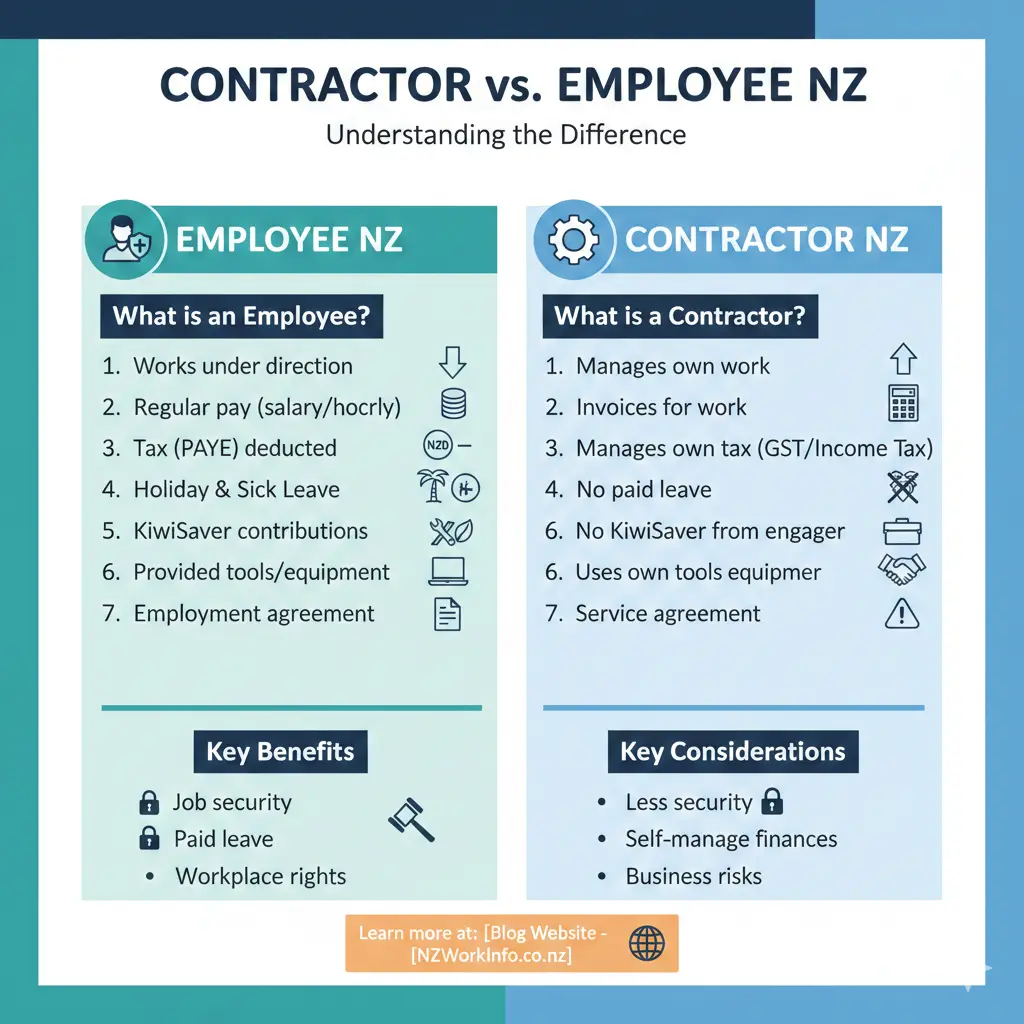
What is an Employee in New Zealand?
An employee works under your direction in exchange for wages or salary, integrated into your business with ongoing obligations. They're covered by the Employment Relations Act 2000 and Holidays Act 2003, entitling them to minimum rights like the 2026 adult minimum wage of $23.50 per hour (rising from previous years), paid annual leave (at least four weeks), sick leave (10 days after six months), and KiwiSaver contributions.
Key Employee Entitlements and Obligations
- Written Employment Agreement: Mandatory under law, detailing job description, hours, pay, leave, termination, and dispute processes.
- PAYE and Deductions: Employers withhold income tax via PAYE, plus KiwiSaver (minimum 3% employer contribution if opted in), student loan repayments, and ACC earners' levy.
- Health and Safety: Covered by the Health and Safety at Work Act 2015; employers manage risks and provide training.
- Termination Protections: Can't dismiss without cause or process; notice periods apply, plus redundancy pay if applicable.
For example, a full-time barista at your Auckland café would clock set shifts, use your equipment, wear your uniform, and attend team meetings—clear employee markers. You'd handle all their tax and leave, deducting from their fortnightly pay slip.
What is a Contractor in New Zealand?
A contractor operates as their own business, providing services via a 'contract for services' rather than an employment agreement. They control how, when, and where they work, invoice for fees, and manage their own taxes, ACC, and insurance. No minimum wage, leave, or job security—purely commercial under contract law.
Key Contractor Characteristics
- Invoicing and Payments: They quote a fee, invoice you (often GST-inclusive if registered), and you pay without deductions. They handle IRD filings, including provisional tax.
- Independence: Use their own tools, subcontract work, bear financial risk (e.g., cost overruns), and aren't integrated into your team.
- ACC and Insurance: Pay their own ACC levies as self-employed; often carry public liability insurance.
- No Employment Rights: No holiday pay, sick leave, or personal grievances; disputes go to civil courts.
Picture a Wellington graphic designer you hire for a one-off branding project: they work from home, use their Adobe suite, deliver by deadline, and invoice $5,000 plus GST. No supervision, no payroll—just a clean contractor gig.
Contractor vs Employee NZ: Key Differences at a Glance
The core distinctions boil down to control, integration, payment, and rights. Use this table for a quick comparison based on Employment New Zealand guidelines:
| Aspect | Employee | Contractor |
|---|---|---|
| Agreement | Employment agreement (mandatory) | Contract for services |
| Control | Employer directs how, when, where | Full independence |
| Payment | Wages/salary via PAYE | Invoiced fees, no deductions |
| Leave/Holidays | Paid annual/sick leave | None |
| Tools/Equipment | Provided by employer | Own tools |
| Tax/ACC | Employer deducts | Self-managed |
| Financial Risk | None | Bears losses, insurance |
How to Determine Contractor vs Employee Status: The Legal Tests
New Zealand courts use a 'real nature of the relationship' approach, applying four key tests. No single factor decides—it's the overall picture. Note: A 2026 Employment Relations Amendment Bill proposes a new 'gateway test' where meeting all four criteria deems someone a contractor, but it's not law yet.
The Four Tests Explained
- Intention Test: What did both parties intend? Check agreements and conduct.
- Control vs Independence Test: Employees follow instructions; contractors decide methods and schedule.
- Integration Test: Employees are core/ongoing; contractors do discrete tasks.
- Fundamental vs Peripheral Test: Is their role essential and continuous (employee) or one-off (contractor)?
Example: A software developer fixing bugs ongoing with your team login? Likely employee. One building a custom app then gone? Contractor.
Risks of Misclassification: What Happens if You Get it Wrong?
Calling an employee a 'contractor' to dodge obligations is risky. If challenged (e.g., via a personal grievance), the Employment Relations Authority reclassifies based on reality, not labels. Penalties include:
- Back pay for wages, holiday (8% of gross earnings), KiwiSaver.
- Sick leave, minimum wage shortfalls.
- Fines up to $10,000 per breach; business penalties higher.
- Reputational damage and IRD audits for tax errors.
Real Kiwi case: A delivery firm reclassified drivers as contractors, but courts ruled employee status due to control and uniforms—costing millions in backpay.
Practical Tips for Kiwi Businesses: Hiring Right
Get it right from day one to protect your business.
For Employers
- Draft clear agreements: Use Employment NZ templates for employees; independent contractor agreements for others.
- Assess using the four tests before hiring.
- Consult experts: IRD for tax (ird.govt.nz), Employment NZ for status (employment.govt.nz).
- Review annually, especially with gig workers.
For Workers
- Clarify status upfront; ask for written terms.
- If unsure, check Employment NZ's online tool.
- Contractors: Register for GST if over $60k, pay provisional tax quarterly.
Pro Tip: For short-term needs, true contractors save on overheads—no leave liabilities. For core roles, employees build loyalty.
Tax and Compliance Essentials: IRD and ACC
Employees: Deduct PAYE (rates up to 39% top bracket 2026), KiwiSaver, ACC (around 1.46% levy). Contractors: No deductions; if schedular income, you may withhold 10-20% tax. ACC treats contractors as self-employed— they cover cover themselves via Invoices or Experience Rating. Always verify GST status.
Disclaimer: This isn't financial advice. Consult a chartered accountant, lawyer, or IRD for your situation.
Next Steps: Protect Your Business and Workers
Review your current hires today: Use Employment NZ's employee or contractor checklist. Draft compliant agreements, factor costs into budgets (e.g., 20-30% extra for employee overheads), and stay updated via govt.nz sites. For personalised help, reach out to Employment NZ (0800 20 90 20), IRD, or a local advisor. Getting contractor vs employee NZ right ensures smooth operations, fair pay, and no nasty surprises.
Frequently Asked Questions
Sources & References
-
1
Differences Between a Contractor and Employee | LegalVision NZ — legalvision.co.nz
-
2
Employee or contractor? - Employment New Zealand — www.employment.govt.nz
-
3
What's the Difference Between Contractors and Employees? — Peninsula Group — peninsulagrouplimited.co.nz
-
4
Employees vs Contractors: A Small Business Owner's Guide — PaySauce — www.paysauce.com
- 5
-
6
Are we there yet? Much Ado About Employment Status in New Zealand — Wolters Kluwer — legalblogs.wolterskluwer.com
- 7
-
8
Contractors vs Employees: Why It Matters Now More Than Ever — Conduit Business Solutions — www.conduitbusinesssolutions.nz
-
9
Upcoming changes to Employment Relations Amendment Bill — DLA Piper — knowledge.dlapiper.com
Useful Tools
Related Articles

Industry Bodies and Professional Associations NZ
Whether you're launching a business, advancing your career, or navigating financial regulations, industry bodies and professional associations in New Zealand offer invaluable support. These organisati...

Emergency Benefit NZ: When You Have No Other Options
When you're struggling financially and don't qualify for other benefits, the Emergency Benefit might be your lifeline. It's a discretionary payment designed for Kiwis in genuine hardship who've exhaus...

Unpaid Internships NZ: Are They Legal?
Unpaid internships are a common pathway for students and graduates to gain work experience in New Zealand, but there's often confusion about whether they're actually legal. The short answer is: unpaid...

Estate Administration NZ: Managing Someone's Affairs After Death
Losing a loved one is one of life's toughest challenges, and stepping in to manage their estate can feel overwhelming. In New Zealand, estate administration—the process of handling someone's affairs a...