Gig Economy NZ: Your Rights as a Platform Worker

Whether you're dashing deliveries for Uber Eats, driving passengers with Zoomy, or offering handyman services on platforms like Airtasker, the gig economy NZ offers flexibility that suits many Kiwis'...
Sarah covers personal finance, tax, and KiwiSaver topics for Lifetimes NZ. She focuses on making money management straightforward and practical for everyday Kiwis.
Whether you're dashing deliveries for Uber Eats, driving passengers with Zoomy, or offering handyman services on platforms like Airtasker, the gig economy NZ offers flexibility that suits many Kiwis' lifestyles. But with great freedom comes uncertainty—especially when it comes to your rights as a platform worker. Recent employment law changes and tax rules mean it's more important than ever to know where you stand, so you can protect your income and wellbeing without nasty surprises from IRD or the Employment Relations Authority.
In this guide, we'll break down your key rights, from contractor status to tax obligations, with practical tips tailored for New Zealand's evolving landscape in 2026. Whether you're a full-time gig worker or topping up your KiwiSaver with side hustles, understanding these rules helps you work smarter.
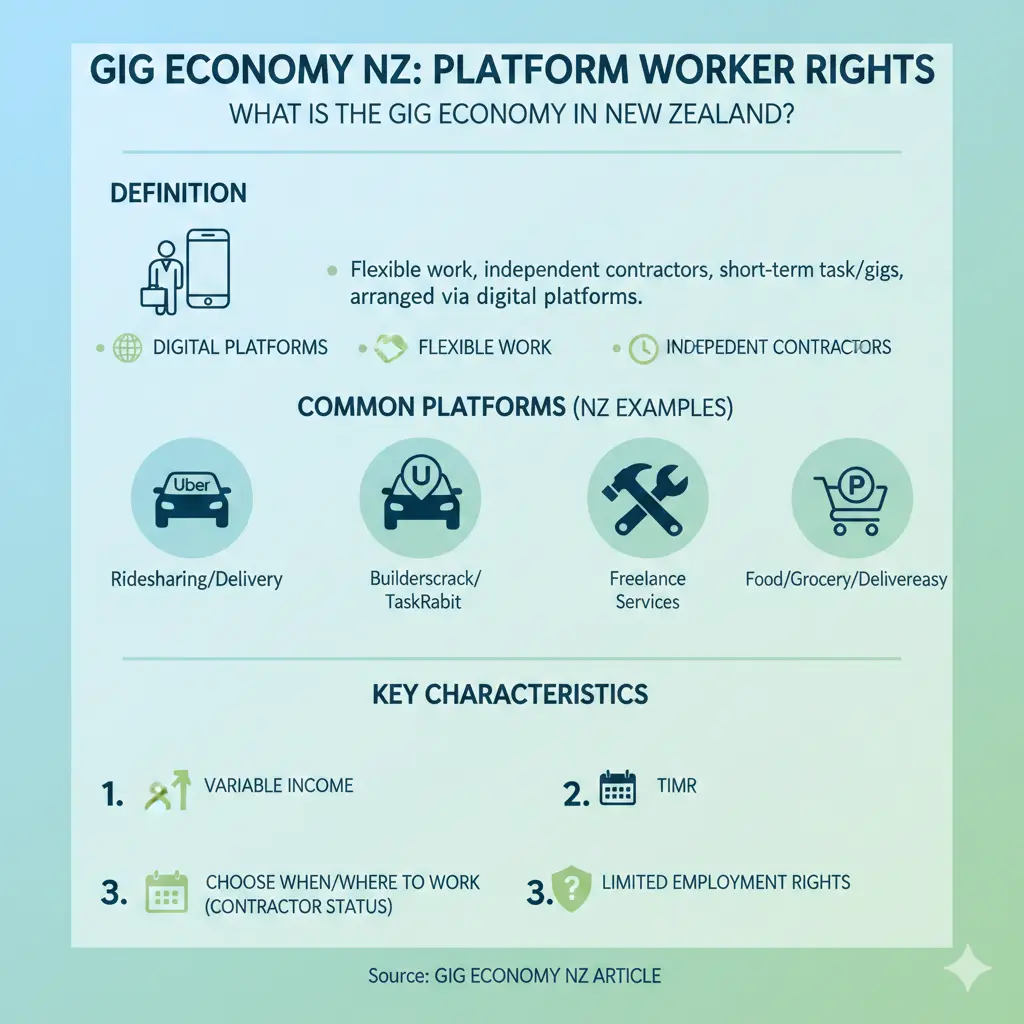
What is the Gig Economy in New Zealand?
The gig economy NZ thrives on digital platforms connecting workers with customers for short-term tasks. Think ride-sharing via Uber or Zoomy, food delivery through Uber Eats or DoorDash, freelance graphic design on Upwork, or even renting out your driveway on Parkopedia. These 'on-demand' jobs exploded post-COVID, with Stats NZ reporting over 100,000 Kiwis earning gig income in 2025 alone.
Platform workers operate in a unique space: you're not a traditional employee with set hours or a full-time contractor with a business setup. This flexibility lets you set your own schedule—perfect for students juggling StudyLink payments or parents balancing family—but it often leaves you without employee perks like paid leave or minimum wage guarantees.Gig economy NZ: your rights as a platform worker start with knowing if you're truly independent or if platforms owe you more protections.
Popular Gig Platforms in NZ
- Ride-sharing: Uber, Zoomy, Ola—earn $25–$40/hour peak times, but factor in vehicle costs.
- Delivery: Uber Eats, DoorDash, Menulog—flexible shifts, tips boost earnings to $20–$30/hour.
- Freelance: Airtasker, Freelancer NZ—tasks from gardening to IT, rates vary widely ($30–$100/hour).
- Sharing economy: Airbnb for spare rooms, CamperMate for van rentals.
These platforms handled billions in transactions last year, but workers bear risks like no sick pay or ACC coverage gaps if self-employed.
Are You an Employee or Contractor? The New Gateway Test
One of the biggest shifts for gig economy NZ: your rights as a platform worker came in 2025 with the Employment Relations Amendment Bill, introducing a 'gateway test' to clarify contractor vs employee status. Misclassification has long plagued platforms, leaving drivers in a "no-man’s land" without employee protections or true contractor freedoms.
Under the test, you're a **specified contractor** (not an employee) only if all four criteria are met:
- Written agreement: A clear contract stating you're an independent contractor.
- Non-exclusive work: Platforms can't stop you working for competitors—like driving for both Uber and Zoomy.
- Work flexibility: No fixed hours; you control when, how, and if you subcontract gigs.
- Right to decline: Rejecting jobs can't lead to termination.
Failing any criterion? You default to the old multi-factor test (control, integration, economic reality), potentially making you an employee entitled to minimum wage ($23.50/hour in 2026), holiday pay, and KiwiSaver contributions.
What This Means for Platform Workers
For Uber Eats couriers or Zoomy drivers, many arrangements fail the gateway—platforms often dictate zones, ratings, or deactivation for low performance. If reclassified, you could claim back pay via the Employment Relations Authority. Real-world tip: Review your platform agreement. Does it let you work rivals? Decline gigs freely? If not, document everything for potential disputes.
"This gateway aims to reduce disputes around such worker misclassification and provide for equitable protection for all Kiwi workers."
Businesses must adjust contracts by mid-2026, so platforms like DoorDash are updating terms—check your app notifications.
Your Employment Rights as a Platform Worker
Even as contractors, platform workers have baseline protections under NZ law. Here's what you need to know in 2026.
Health and Safety: ACC and Beyond
As a self-employed gig worker, you're eligible for ACC cover if registered as self-employed (via acc.co.nz). Delivery riders: declare your work to avoid gaps—ACC claims rose 25% for gig drivers in 2025. Platforms must ensure safe equipment (e.g., visible bike lights), but you're responsible for personal gear.
Dispute Resolution and Personal Grievances
New rules limit remedies if your misconduct contributed to dismissal-like deactivations. For high-earners ($180k+), no unjustified dismissal claims unless opted in. Mediation via MBIE is free first step; escalate to Employment Relations Authority if needed.
No 30-Day Rule Anymore
The 2025 Bill scrapped forced collective terms for new hires, giving platforms more flexibility—but it doesn't directly apply to contractors.
Actionable tip: Keep records of hours, earnings, and communications. Apps like Stride or Capturo track mileage for disputes or tax.
Tax Obligations for Gig Workers
IRD treats gig income as taxable from dollar one—no threshold. Platforms may report your earnings internationally via OECD rules, making compliance easier but evasion harder.
Key Tax Rules in 2026
- Income tax: Provisional tax if over $5,000/year; use IRD's gig economy calculator.
- GST: Register if turnover hits $60,000 (services $60k from April 2026). Platforms charge GST on fees.
- Deductions: Claim vehicle costs (72c/km 2026 rate), phone, uniforms. Keep receipts!
- KiwiSaver: Self-employed? Contribute voluntarily for employer match if eligible.
Fines for non-filing start at $500; use myIR portal for quarterly filings. Example: A full-time Uber driver earning $60k nets ~$45k after tax/deductions.
| Earning Level | Tax Rate (2026) | Approx Take-Home (after deductions) |
|---|---|---|
| $20k | 10.5%–17.5% | $17,500 |
| $60k | 17.5%–33% | $45,000 |
| $100k+ | 33%–39% | $65,000+ |
Disclaimer: Tax rules change; consult IRD or a tax advisor for personalised advice.
Practical Tips to Protect Your Rights
- Audit your status: Use MBIE's online tool to check employee vs contractor.
- Insurance: Get public liability ($10m cover recommended) and income protection—platforms don't provide it.
- Unions: Join NZCTU or platform-specific groups for advocacy.
- Multiple platforms: Diversify to meet gateway flexibility and boost earnings.
- Track everything: Use apps for logs; retain for 7 years per IRD.
Challenges Facing Gig Workers in NZ
Deactivation without notice, algorithm opacity, and peak-only pay plague the sector. Supreme Court Uber ruling clarified platforms as more than facilitators. Watch for 2026 minimum standards push, inspired by Aussie models.
Next Steps to Secure Your Gig Future
Start by reviewing your platform contracts against the gateway test today. Set up an IRD myIR account, track expenses diligently, and consider voluntary KiwiSaver for retirement security. Join gig worker forums on Facebook or Reddit's r/newzealand for peer tips. If unsure, contact MBIE's fair work line (0800 20 90 20) or a community law centre—free advice for Kiwis.
Knowledge is your best protection in the gig economy NZ. Stay informed, claim what's yours, and build a sustainable side hustle or career.
Always seek professional financial or legal advice tailored to your situation. This article uses 2026 rates; check official sources for updates.
Frequently Asked Questions
Sources & References
-
1
Major Shake-Up in NZ Employment Law — www.godfreyslaw.co.nz
-
2
Upcoming changes to Employment Relations Amendment Bill: Contractor or Employee? — knowledge.dlapiper.com
-
3
Digital platforms, gig and sharing economy - IRD Tax Policy — www.taxpolicy.ird.govt.nz
-
4
Setting a new standard: Uber Eats leads industry move — www.uber.com
-
5
New Zealand's 2025 regulatory year in review — themodernregulator.com
-
6
If this is employment law, the law needs to change — www.nzinitiative.org.nz
Related Articles

Industry Bodies and Professional Associations NZ
Whether you're launching a business, advancing your career, or navigating financial regulations, industry bodies and professional associations in New Zealand offer invaluable support. These organisati...

Emergency Benefit NZ: When You Have No Other Options
When you're struggling financially and don't qualify for other benefits, the Emergency Benefit might be your lifeline. It's a discretionary payment designed for Kiwis in genuine hardship who've exhaus...

Unpaid Internships NZ: Are They Legal?
Unpaid internships are a common pathway for students and graduates to gain work experience in New Zealand, but there's often confusion about whether they're actually legal. The short answer is: unpaid...

Estate Administration NZ: Managing Someone's Affairs After Death
Losing a loved one is one of life's toughest challenges, and stepping in to manage their estate can feel overwhelming. In New Zealand, estate administration—the process of handling someone's affairs a...