Final Pay NZ: What You Should Receive When Leaving

Leaving a job in New Zealand? Your final pay isn't just your last wages—it's a package that includes everything you've earned, from unused holidays to public holiday entitlements. Knowing exactly what...
The Lifetimes NZ editorial team curates, fact-checks, and updates guides on personal finance, property, health, immigration, legal, business, and lifestyle topics relevant to Lifetimes NZ readers. Articles are produced with AI assistance and reviewed by the editorial team before publication.
Leaving a job in New Zealand? Your final pay isn't just your last wages—it's a package that includes everything you've earned, from unused holidays to public holiday entitlements. Knowing exactly what you're entitled to under the Holidays Act 2003 and Employment Relations Act 2000 ensures you walk away with every dollar owed, avoiding common pitfalls that leave Kiwis short-changed.
What Makes Up Your Final Pay in NZ?
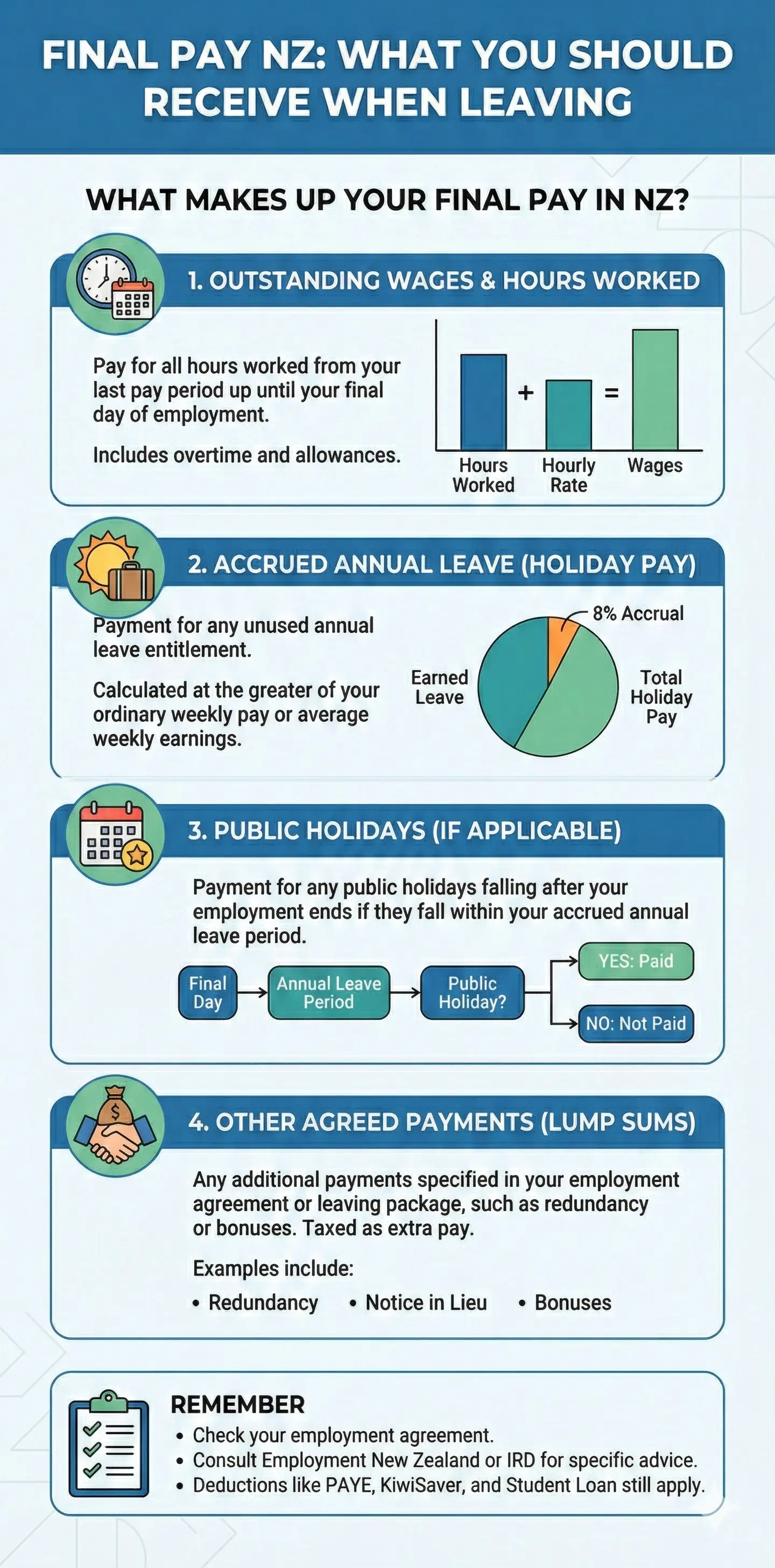
Your final pay must cover all work up to the end of your employment, plus entitlements like annual holidays and alternative holidays. Employers are legally required to pay this on or before the regular payday for your final pay period, even if it's after your last day. This includes:
- Wages for time worked since your last pay.
- Payment through your full notice period if you've given proper notice.
- Any public holidays falling during your notice period or extended annual leave, paid at your relevant daily rate.
- Remaining annual holidays, calculated at the higher of your ordinary weekly pay or average weekly earnings.
- 8% of gross earnings since your last annual holidays anniversary (minus any holidays already paid).
- Alternative holidays owed, at relevant daily or average daily pay.
Gross earnings factor in all payments since you started, including bonuses or commissions in your final pay. For example, if you've been on ACC leave, your annual holidays are still paid based on the higher of average weekly earnings (past 52 weeks) or ordinary weekly pay—though long absences might complicate calculations.
How Notice Periods Affect Your Payout
Your notice period—agreed in your employment contract or set by law (e.g., 4 weeks for many roles)—extends what you're paid for. If you resign with proper notice, you're entitled to wages right through it. Public holidays during this time? You're paid if they'd normally be workdays.
Take Tara's case: She finishes mid-December but takes annual leave over Christmas. Her leave extends into January, capturing New Year's public holidays, so her final pay includes 5 days' annual leave plus 4 public holidays. Always check your employment agreement for notice details.
Annual Holidays: Don't Leave Them Behind
Under the Holidays Act, you're entitled to at least 4 weeks' paid annual holidays per year. On leaving, get paid for unused days at the end-of-employment rate: the higher of ordinary weekly pay or average weekly earnings. Plus, that 8% on gross earnings covers holidays earned but not taken.
If your hours vary, ordinary weekly pay uses a 4-week average before your end date. Variable pay? Average weekly earnings over 52 weeks smooths it out. Pro tip: Track your anniversary date—it's when your 4-week entitlement renews.
Deductions from Your Final Pay: What Gets Withheld?
Employers deduct standard amounts from your gross final pay, just like regular wages. Common ones include:
- Income tax via IRD—based on your total earnings and tax code.
- ACC levies for accident cover.
- KiwiSaver contributions—note the rate rises to 3.5% for both employee and employer from 1 April 2026.
- Student loan repayments if applicable via StudyLink.
- Child support or union fees.
- Board/lodging if provided.
From 2026, expect itemised payslips every pay period (including finals) under Holidays Act reforms, breaking down gross pay, deductions, and net—making disputes easier to spot. Review your payslip closely; errors in KiwiSaver or ACC can be reclaimed via IRD or ACC directly.
2026 Updates Impacting Final Pay
KiwiSaver changes hit in April 2026: default contributions jump to 3.5%, up from 3%, affecting deductions on your final pay if it falls after. Minimum wage rises to $23.95/hour (adult) and $19.16 (starting/training) from 1 April 2026, influencing calculations for low-wage roles.
High earners over $180,000 may lose unjustified dismissal claims from early 2026, but final pay rules remain unchanged—focus here is entitlements, not disputes. No mandatory redundancy pay exists; it's negotiable per your contract.
Real-Life Examples: Final Pay Breakdowns
Let's apply this to Kiwi scenarios.
Example 1: Ted's Quick Exit
Ted works until 12 May, paid to 12 April. His final pay includes:
- Pay from 13 April to 12 May.
- 3 weeks' annual holidays at higher of ordinary/average weekly pay.
- 2 alternative holidays at daily pay.
- 8% gross earnings (April-May, including above).
Example 2: Jason's October Finish
Jason ends 16 October, paid to 6 October. Entitled to 4 weeks annual holidays (anniversary 25 June) and 3 alternative holidays. Final pay:
- 8 days' wages (7-16 October).
- 4 weeks' annual holidays.
- 3 alternative holidays.
- Extra for Labour Day (24 October) during extended leave.
- 8% since 25 June.
These show how extensions for holidays/public days boost payouts. Use Employment NZ's holiday calculator for your numbers.
Steps to Ensure You Get Your Full Final Pay
- Review your employment agreement: Confirm notice, holidays, and extras like bonuses.
- Track entitlements: Log annual leave taken, alternative holidays, and pay slips.
- Give proper notice: In writing, to secure full pay through it.
- Request an itemised payslip: Mandatory from 2026, but ask now.
- Calculate yourself: Use average weekly earnings: total gross over 52 weeks ÷ 52.
- Dispute if short: Contact Employment NZ mediation first, free and fast.
If on ACC or parental leave, entitlements carry over—don't forfeit them. For WINZ benefits post-job, final pay doesn't affect most, but declare it.
"The final pay must be paid on or before the pay day of the final pay period."
Common Mistakes Kiwis Make with Final Pay
- Forgetting to include alternative holidays or public holiday extensions.
- Miscalculating 8% holidays on gross (not just wages).
- Overlooking KiwiSaver hikes in 2026 deductions.
- Not negotiating redundancy if offered—it's not automatic.
- Ignoring variable pay averages, leading to underpayment.
Avoid these by double-checking with a payroll expert or free tools on employment.govt.nz.
FAQ: Final Pay Questions Kiwis Ask Most
What if my employer delays final pay?
They must pay by the next regular payday. Late? Claim interest via Employment Relations Authority.
Am I entitled to redundancy pay?
No legal right, but negotiate if in your contract or collective agreement.
How does ACC leave affect my holidays?
Paid at higher of ordinary/average weekly pay; long absences use 4-week average (could be zero if over 4 weeks).
Does sick leave pay out on leaving?
No, unused sick leave doesn't pay out—save it for future jobs.
What about bonuses or commissions?
Included in gross for 8% holidays if earned before end date.
High earner over $180k—any final pay changes in 2026?
Entitlements same, but limited grievance rights for dismissal.
Next Steps: Secure Your Final Pay Today
Grab your last payslips, note your holidays anniversary, and run the numbers using Employment NZ tools. If anything's off, email your employer with specifics—most fix errors quickly. For complex cases, chat to a community law centre or Employment NZ advocate. Remember, this isn't personalised advice—consult a financial advisor or lawyer for your situation, especially with 2026 changes looming.
Empowered with this knowledge, you'll leave no dollar behind.
Related Articles

Industry Bodies and Professional Associations NZ
Whether you're launching a business, advancing your career, or navigating financial regulations, industry bodies and professional associations in New Zealand offer invaluable support. These organisati...

Emergency Benefit NZ: When You Have No Other Options
When you're struggling financially and don't qualify for other benefits, the Emergency Benefit might be your lifeline. It's a discretionary payment designed for Kiwis in genuine hardship who've exhaus...

Unpaid Internships NZ: Are They Legal?
Unpaid internships are a common pathway for students and graduates to gain work experience in New Zealand, but there's often confusion about whether they're actually legal. The short answer is: unpaid...

Estate Administration NZ: Managing Someone's Affairs After Death
Losing a loved one is one of life's toughest challenges, and stepping in to manage their estate can feel overwhelming. In New Zealand, estate administration—the process of handling someone's affairs a...